

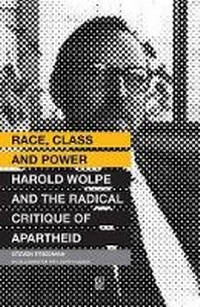
Race, Class and Power
Harold Wolpe and the Radical Critique of Apartheid
Will be published approx. on 13. October 2014
Book
Paperback/Softback
376 pages
978-1-86914-286-5 (ISBN)
Description
Over four decades ago, radical scholars began to suggest a new way of looking at South African society, one that blamed the economic power of those who owned property for the racial bondage of the black majority. Their work, and the debates it triggered, are mostly forgotten: but they and their critics have much to say that sheds lights on today's South African realities.
Harold Wolpe was arguably the most influential theorist of this generation. His writing played a major role in a revolution in thought and his celebrated escape from prison in the 1960s made him a symbol of alternative action.
Race, Class and Powerclearly and insightfully examines Wolpe's work in the political, intellectual and social contexts in which it was developed and to which it gave form. Drawing on interviews with those he worked with, disagreed with and inspired, the book also maps his influence on ideas and the culture that emerged in anti-apartheid circles in the 1970s. Wolpe's writing is a prism through which South African society can be viewed; this book is an intellectual biography both of Wolpe and of South Africa's left.
Race, Class and Power also assesses and engages with the ongoing impact of Wolpe's ideas into the post-apartheid present. Moreover, it suggests how Wolpe's work can move us towards a way of thinking about and acting upon South Africa's realities differently.
Harold Wolpe was arguably the most influential theorist of this generation. His writing played a major role in a revolution in thought and his celebrated escape from prison in the 1960s made him a symbol of alternative action.
Race, Class and Powerclearly and insightfully examines Wolpe's work in the political, intellectual and social contexts in which it was developed and to which it gave form. Drawing on interviews with those he worked with, disagreed with and inspired, the book also maps his influence on ideas and the culture that emerged in anti-apartheid circles in the 1970s. Wolpe's writing is a prism through which South African society can be viewed; this book is an intellectual biography both of Wolpe and of South Africa's left.
Race, Class and Power also assesses and engages with the ongoing impact of Wolpe's ideas into the post-apartheid present. Moreover, it suggests how Wolpe's work can move us towards a way of thinking about and acting upon South Africa's realities differently.
More details
Language
English
Place of publication
Scottsville, Kwazulu-Natal
South Africa
Target group
Professional and scholarly
Dimensions
Height: 220 mm
Width: 150 mm
Thickness: 20 mm
Weight
523 gr
ISBN-13
978-1-86914-286-5 (9781869142865)
Copyright in bibliographic data and cover images is held by Nielsen Book Services Limited or by the publishers or by their respective licensors: all rights reserved.
Schweitzer Classification
Person
Steven Friedman is an academic, newspaper columnist, widely quoted public intellectual, activist, former trade unionist and journalist. He directs the Centre for the Study of Democracy at both Rhodes University and the University of Johannesburg, South Africa. His book Building Tomorrow Today: African Workers in Trade Unions 1970 - 1984 has been described as a classic South African text.