

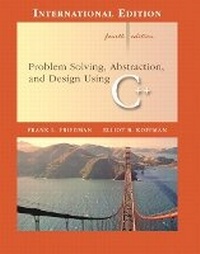
Problem Solving, Abstraction, and Design using C++
International Edition
4th Edition
Published on 20. November 2003
Book
Paperback/Softback
856 pages
978-0-321-24803-9 (ISBN)
Description
Problem Solving, Abstraction, and Design Using C++ presents and then reinforces the basic principles of software engineering and object-oriented programming while introducing the C++ programming language. The hallmarks of this book are the focus on problem solving and program design.
This book carefully presents object-oriented programming by balancing it with procedural programming so the reader does not overlook the fundamentals of algorithm organization and design.
This book carefully presents object-oriented programming by balancing it with procedural programming so the reader does not overlook the fundamentals of algorithm organization and design.
More details
Edition
4th edition
Language
English
Place of publication
United States
Publishing group
Pearson Education (US)
Target group
Professional and scholarly
Dimensions
Height: 232 mm
Width: 186 mm
Thickness: 30 mm
Weight
1254 gr
ISBN-13
978-0-321-24803-9 (9780321248039)
Copyright in bibliographic data and cover images is held by Nielsen Book Services Limited or by the publishers or by their respective licensors: all rights reserved.
Schweitzer Classification
Other editions
New editions
Frank L. Friedman | Elliot B. Koffman
Problem Solving, Abstraction & Design Using C++
International Edition
Book
10/2006
5th Edition
Pearson
€65.60
Article exhausted; check for reprint
Previous edition
Frank L. Friedman | Elliot B. Koffman
Problem Solving, Abstraction, & Design Using C++
Visual C++ Edition
Book
07/2001
3rd Edition
Pearson
€77.98
Article exhausted; check for reprint
Content
1. Introduction to Computers, Problem Solving, and Programming.
2. Overview of C++.
3. Top-Down Design with Functions and Classes.
4. Selection Structures: if and switch Statements.
5. Repetition and Loop Statements.
6. Modular programming.
7. Simple Data Types.
8 . Streams and Files.
9. Data Structures: Array and Structs.
10. User-Defined Classes.
11. Modeling Data with Arrays, Structs, and Classes.
12. Recursion.
13. Pointers and Dynamic Data Structures.
2. Overview of C++.
3. Top-Down Design with Functions and Classes.
4. Selection Structures: if and switch Statements.
5. Repetition and Loop Statements.
6. Modular programming.
7. Simple Data Types.
8 . Streams and Files.
9. Data Structures: Array and Structs.
10. User-Defined Classes.
11. Modeling Data with Arrays, Structs, and Classes.
12. Recursion.
13. Pointers and Dynamic Data Structures.