

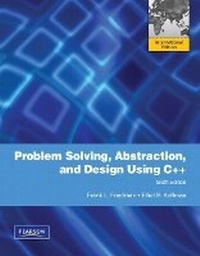
Problem Solving, Abstraction, and Design using C++
International Edition
6th Edition
Published on 29. April 2010
Book
Paperback/Softback
912 pages
978-0-13-706781-7 (ISBN)
Description
Problem Solving, Abstraction, and Design Using C++ presents and reinforces basic principles of software engineering design and object-oriented programming concepts while introducing the C++ programming language. The hallmark feature of this book is the Software Development Method that is introduced in the first chapter and carried throughout in the case studies presented.
More details
Edition
6th edition
Language
English
Place of publication
United States
Publishing group
Pearson Education (US)
Target group
College/higher education
Illustrations
Illustrations
Dimensions
Height: 232 mm
Width: 184 mm
Thickness: 33 mm
Weight
1360 gr
ISBN-13
978-0-13-706781-7 (9780137067817)
Copyright in bibliographic data and cover images is held by Nielsen Book Services Limited or by the publishers or by their respective licensors: all rights reserved.
Schweitzer Classification
Other editions
Previous edition
Frank L. Friedman | Elliot B. Koffman
Problem Solving, Abstraction & Design Using C++
International Edition
Book
10/2006
5th Edition
Pearson
€65.60
Article exhausted; check for reprint
Persons
Elliot Koffman is a professor of computer and information science at Temple University. He is one of the country's foremost CS educators, a former chairman of the ACM Task Force for introductory programming methods courses, and the co-author of Problem Solving, Abstraction, and Design, Problem Solving and Program Design in C, (both with Pearson) Objects, Abstraction, Data Structures and Design Using C++, and Objects, Abstraction, Data Structures and Design Using Java Version 5.0 (both with John Wiley & Sons).
Dr. Frank L. Friedman is Professor and Chairman of Computer and Information Science at Temple University. He received M.S. degrees from Johns Hopkins University and Purdue University and his Ph.D. in Computer Science from Purdue University. Dr. Friedman is the co-author of Problem Solving, Abstraction, and Design Using C++ and other textbooks on programming in Fortran and Basic. His current research and instructional interests are in software engineering, specifically object-oriented paradigms for software design.
Dr. Frank L. Friedman is Professor and Chairman of Computer and Information Science at Temple University. He received M.S. degrees from Johns Hopkins University and Purdue University and his Ph.D. in Computer Science from Purdue University. Dr. Friedman is the co-author of Problem Solving, Abstraction, and Design Using C++ and other textbooks on programming in Fortran and Basic. His current research and instructional interests are in software engineering, specifically object-oriented paradigms for software design.
Content
Brief Contents
chapter 0: Computer Science as a Career Path 1
chapter 1: Introduction to Computers, Problem Solving, and Programming 15
chapter 2: Overview of C++ 53
chapter 3: Top-Down Design with Functions and Classes 117
chapter 4: Selection Structures: if and switch Statements 197
chapter 5: Repetition and Loop Statements 259
chapter 6: Modular Programming 333
chapter 7: Simple Data Types 387
chapter 8: Streams and Files 443
chapter 9: Data Structures:Arrays and Structs 487
chapter 10: User-Defined Classes 565
chapter 11: Data Abstraction and Object-Oriented Design 627
chapter 12: Recursion 691
chapter 13: Pointers and Dynamic Data Structures 729
chapter 14: Multiprocessing Using Processes and Threads 795
Index 851
The following are available online:
Appendix A ASCII Character Set
Appendix B Reserved Words and Special Characters
Appendix C Selected C++ Library Facilities
Appendix D Operators
Appendix E A Brief Introduction to Inheritance and Polymorphism
Answers to Odd-Numbered Questions
chapter 0: Computer Science as a Career Path 1
chapter 1: Introduction to Computers, Problem Solving, and Programming 15
chapter 2: Overview of C++ 53
chapter 3: Top-Down Design with Functions and Classes 117
chapter 4: Selection Structures: if and switch Statements 197
chapter 5: Repetition and Loop Statements 259
chapter 6: Modular Programming 333
chapter 7: Simple Data Types 387
chapter 8: Streams and Files 443
chapter 9: Data Structures:Arrays and Structs 487
chapter 10: User-Defined Classes 565
chapter 11: Data Abstraction and Object-Oriented Design 627
chapter 12: Recursion 691
chapter 13: Pointers and Dynamic Data Structures 729
chapter 14: Multiprocessing Using Processes and Threads 795
Index 851
The following are available online:
Appendix A ASCII Character Set
Appendix B Reserved Words and Special Characters
Appendix C Selected C++ Library Facilities
Appendix D Operators
Appendix E A Brief Introduction to Inheritance and Polymorphism
Answers to Odd-Numbered Questions