

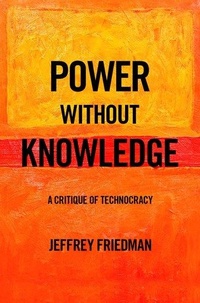
Power without Knowledge
A Critique of Technocracy
Published on 20. February 2020
Book
Hardback
408 pages
978-0-19-087717-0 (ISBN)
Description
Technocrats claim to know how to solve the social and economic problems of complex modern societies. But as Jeffrey Friedman argues in Power without Knowledge, there is a fundamental flaw with technocracy: it requires an ability to predict how the people whom technocrats attempt to control will act in response to technocratic policies. However, the mass public's ideas-the ideas that drive their actions-are far too varied and diverse to be reliably predicted.
But that is not the only problem. Friedman reminds us that a large part of contemporary mass politics, even populist mass politics, is essentially technocratic too. Members of the general public often assume that they are competent to decide which policies or politicians will be able to solve social and economic problems. Yet these ordinary "citizen-technocrats" typically regard the solutions to social problems as self-evident, such that politics becomes a matter of vetting public officials for their good intentions and strong wills, not technocratic expertise.
Finally, Friedman argues that technocratic experts themselves drastically oversimplify technocratic realities. Economists, for example, theorize that people respond rationally to the incentives they face. This theory is simplistic, but it gives the appearance of being able to predict people's behavior in response to technocratic policy initiatives. If stripped of such gross oversimplications, though, technocrats themselves would be forced to admit that a rational technocracy is nothing more than an impossible dream.
Ranging widely over the philosophy of social science, rational choice theory, and empirical political science, Power without Knowledge is a pathbreaking work that upends traditional assumptions about technocracy and politics, forcing us to rethink our assumptions about the legitimacy of modern governance.
But that is not the only problem. Friedman reminds us that a large part of contemporary mass politics, even populist mass politics, is essentially technocratic too. Members of the general public often assume that they are competent to decide which policies or politicians will be able to solve social and economic problems. Yet these ordinary "citizen-technocrats" typically regard the solutions to social problems as self-evident, such that politics becomes a matter of vetting public officials for their good intentions and strong wills, not technocratic expertise.
Finally, Friedman argues that technocratic experts themselves drastically oversimplify technocratic realities. Economists, for example, theorize that people respond rationally to the incentives they face. This theory is simplistic, but it gives the appearance of being able to predict people's behavior in response to technocratic policy initiatives. If stripped of such gross oversimplications, though, technocrats themselves would be forced to admit that a rational technocracy is nothing more than an impossible dream.
Ranging widely over the philosophy of social science, rational choice theory, and empirical political science, Power without Knowledge is a pathbreaking work that upends traditional assumptions about technocracy and politics, forcing us to rethink our assumptions about the legitimacy of modern governance.
Reviews / Votes
Recommended. * D. Bantz, University of Alaska, CHOICE * an intellectual and scholarly tour de force: impressively wide-ranging, refreshingly iconoclastic, and consistently interesting. * Eric MacGilvray, Ohio State University * Power without Knowledge gives us a provocative and moving evocation of how those ideals undercut technocracy from within. Friedman does not reject the technocratic dedication to the relief of human suffering. But he shows that we should not assume that those who suffer are so homogeneous that they must succumb to positivist methods of behavioral prediction. * Paul Gunn, University of London, The Review of Politics * This is just the book for social scientists still in thrall to the capacity of technocratic elites to bring the utopian ideas of political philosophers to the people by virtue of their instrumental skills. Friedman's critique will remove the scales from your eyes. The improvement of society may be possible but it will never emerge from the cost-benefit analyses of what he calls the Epistocrats. Densely and convincingly argued, lucidly written, Power without Knowledge is perhaps the most convincing case yet against the worship of classical economics in political life. * James C. Scott, Sterling Professor of Political Science and Anthropology, Yale University * Combining political philosophy, empirical studies of public opinion, and psychology, Jeffrey Friedman provides a brilliant and multi-faceted analysis of political epistemology. The question of how people judge the efficacy of alternative policies raises crucial questions for democracy, and by building on the century-old debates between Walter Lippmann and John Dewey, Friedman takes us deep into current predicaments of governance. * Robert Jervis, Adlai E. Stevenson Professor of International Politics, Columbia University, and author of How Statesmen Think * A creative effort to fuse political philosophy, epistemology, and cognitive science and rescue us from our current political predicament: closed-minded partisans locked in tight alliances with over-confident likeminded experts. This book is loaded with profoundly important arguments that I have never seen brought together so skillfully. * Philip E. Tetlock, Annenberg University Professor, University of Pennsylvania; author of Expert Political Judgment * Today, many embrace their own 'alternative facts,' but Jeffrey Friedman contends that we still all too often believe our preferred experts can guide human behavior to good results-when we should doubt that any know how to do so. The bold alternative he raises is to seek to provide people with the resources needed to make their own choices. While so many today claim to champion 'the people,' Friedman seeks instead to help people champion themselves. * Rogers M. Smith, Christopher H. Browne Distinguished Professor of Political Science, University of Pennsylvania * Friedman offers a powerful critique of technocratic politics. He marvelously pricks the hubris of social scientists with their naive epistemologies and their claims to predictive powers. And he provides an invigorating call for greater freedom and experimentation with a basis in universal welfare. * Mark Bevir, University of California, Berkeley * In this deeply learned, passionately argued book, Jeffrey Friedman offers a trenchant critique of technocracy that indicts both the epistocratic 'rule of experts' and the opinion-based policy produced by democratic collectives. Rejecting the idea that either experts or ordinary citizens are capable of attaining the knowledge necessary to solve the social problems of modernity, he urges that the choice of individual exit is epistemically superior to voice and offers 'exitocracy' as a radical alternative to existing forms of government. His bold, carefully reasoned argument challenges social theorists to rethink our most cherished assumptions about the potential of public policy to foster ameliorative change. * Josiah Ober, Stanford University *More details
Language
English
Place of publication
New York
United States
Target group
Professional and scholarly
Product notice
sewn/stitched
Cloth over boards
Dimensions
Height: 239 mm
Width: 158 mm
Thickness: 39 mm
Weight
680 gr
ISBN-13
978-0-19-087717-0 (9780190877170)
Copyright in bibliographic data and cover images is held by Nielsen Book Services Limited or by the publishers or by their respective licensors: all rights reserved.
Schweitzer Classification
Other editions
Additional editions
E-Book
12/2019
OUP eBook
€24.49
Available for download
E-Book
12/2019
OUP eBook
€24.49
Available for download
Person
Jeffrey Friedman, a Visiting Scholar in the Charles and Louise Travers Department of Political Science, University of California, Berkeley, is the editor of Critical Review: A Journal of Politics and Society, the editor of The Rational Choice Controversy: Economic Models of Politics Reconsidered (Yale University Press), and coauthor of Engineering the Perfect Storm: The Financial Crisis and the Failure of Regulation. He has taught political and social theory at Barnard College, Columbia University, Dartmouth College, Harvard University, and Yale University.
Content
Acknowledgments
Preface
Introduction: Technocracy and Political Epistemology
-The Absence of an Argument for Technocratic Knowledge
-Technocracy and Distributive Justice
-Technocratic Regulation and the Limits of State Autonomy
-The Technocratic Value Consensus
-The Politics of Negative Utilitarianism
-Citizens as Technocrats
-Distortions Caused by the Standard Definition of Technocracy
-The Public-Choice Alternative
-Democratic Technocracy and Nationalism
-Outline of the Book
Part I. Belief, Interpretation, and Unpredictability
Chapter 1: Technocratic Naivete
-Naive Realism and the Fact of Technocratic Disagreement
-Four Types of Technocratic Knowledge and the Possibility of Unintended Consequences
-Naive Realism as a Methodological Problem
-A Criterion of Technocratic Legitimacy and the Theodicy of Technocracy
Chapter 2: Lippmann and Dewey: The Unjoined Debate
-Lippmann and Progressive Epistemology
-Lippmann's Political Epistemology
-Dewey's Defense of Democratic Technocracy
-The Fundamental Dilemma of Democratic Technocracy
-Dewey's Evolving Defenses of Policy Science
Chapter 3: Technocracy and Interpretation
-Dewey's Evolutionary Epistemology
-Heterogeneous Beliefs and Environmental Unpredictability
-Epistemological Individualism
-Intellectual History and the Practical Problems of Technocracy
-Homogenizing Factors
Part II. Toward an Empirical Epistemology of Technocracy
Chapter 4: The Pathological Pressure to Predict
-Economics and the Assumption of Effective Omniscience
-Economics as a Policy Science
-The Taming of Ignorance by Behavioral Economics
-Econometrics and the Confrontation with Heterogeneity
-Non-Technocratic Social Scientists Who Think Like Technocrats
Chapter 5: Epistocracy and the Spiral of Conviction
-The Spiral of Conviction
-The Spiral of Conviction among Experts
-The Financial Crisis in Retrospect: The Economist as Ideologue
Chapter 6: Public Ignorance and Democratic Technocracy
-Public Ignorance as an A-Fortiori Argument for Epistocracy
-The Unfulfilled Promise of Heuristics Research
-Public Ignorance: Radical, Not Rational
-A Bias for Technocratic Action
-Simple Heuristics for a Complex World
-Systemic Pressures in a Democratic Technocracy
Part III. Exitocracy
Chapter 7: Capitalism, Socialism, and Technocracy
-A Revised Standard of Technocratic Legitimacy
-Exit and Voice
-The Public-Private Asymmetry in Voice
-Some Epistemic Limits of Exit
-An Exitocratic Difference Principle
-No Exit Redux: Epistemic and Cultural Critiques
-Exit and Human Happiness
Afterword
Technocracy and the Left
References
Preface
Introduction: Technocracy and Political Epistemology
-The Absence of an Argument for Technocratic Knowledge
-Technocracy and Distributive Justice
-Technocratic Regulation and the Limits of State Autonomy
-The Technocratic Value Consensus
-The Politics of Negative Utilitarianism
-Citizens as Technocrats
-Distortions Caused by the Standard Definition of Technocracy
-The Public-Choice Alternative
-Democratic Technocracy and Nationalism
-Outline of the Book
Part I. Belief, Interpretation, and Unpredictability
Chapter 1: Technocratic Naivete
-Naive Realism and the Fact of Technocratic Disagreement
-Four Types of Technocratic Knowledge and the Possibility of Unintended Consequences
-Naive Realism as a Methodological Problem
-A Criterion of Technocratic Legitimacy and the Theodicy of Technocracy
Chapter 2: Lippmann and Dewey: The Unjoined Debate
-Lippmann and Progressive Epistemology
-Lippmann's Political Epistemology
-Dewey's Defense of Democratic Technocracy
-The Fundamental Dilemma of Democratic Technocracy
-Dewey's Evolving Defenses of Policy Science
Chapter 3: Technocracy and Interpretation
-Dewey's Evolutionary Epistemology
-Heterogeneous Beliefs and Environmental Unpredictability
-Epistemological Individualism
-Intellectual History and the Practical Problems of Technocracy
-Homogenizing Factors
Part II. Toward an Empirical Epistemology of Technocracy
Chapter 4: The Pathological Pressure to Predict
-Economics and the Assumption of Effective Omniscience
-Economics as a Policy Science
-The Taming of Ignorance by Behavioral Economics
-Econometrics and the Confrontation with Heterogeneity
-Non-Technocratic Social Scientists Who Think Like Technocrats
Chapter 5: Epistocracy and the Spiral of Conviction
-The Spiral of Conviction
-The Spiral of Conviction among Experts
-The Financial Crisis in Retrospect: The Economist as Ideologue
Chapter 6: Public Ignorance and Democratic Technocracy
-Public Ignorance as an A-Fortiori Argument for Epistocracy
-The Unfulfilled Promise of Heuristics Research
-Public Ignorance: Radical, Not Rational
-A Bias for Technocratic Action
-Simple Heuristics for a Complex World
-Systemic Pressures in a Democratic Technocracy
Part III. Exitocracy
Chapter 7: Capitalism, Socialism, and Technocracy
-A Revised Standard of Technocratic Legitimacy
-Exit and Voice
-The Public-Private Asymmetry in Voice
-Some Epistemic Limits of Exit
-An Exitocratic Difference Principle
-No Exit Redux: Epistemic and Cultural Critiques
-Exit and Human Happiness
Afterword
Technocracy and the Left
References