

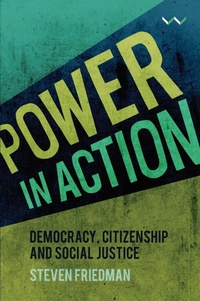
Power in Action
Democracy, Citizenship and Social Justice
Published on 1. December 2018
Book
Paperback/Softback
300 pages
978-1-77614-302-3 (ISBN)
Description
Argues that South Africans, like everyone else, need democracy for a more equal society
What are democracies meant to do? And how does one know when one is a democratic state? These incisive questions and more by leading political scientist, Steven Friedman, underlie this robust enquiry into what democracy means for South Africa post 1994. Democracy is often viewed through a lens reflecting Western understanding. New democracies are compared to idealized notions by which the system is said to operate in the global North. The democracies of Western Europe and North America are understood to be the finished product and all others are assessed by how far they have progressed towards approximating this model.
Power in Action persuasively argues against this stereotype. Friedman asserts that democracies can only work when every adult has an equal say in the public decisions that affect them.Democracy is achieved not by adopting idealized models derived from other societies-rather, it is the product of collective action by citizens who claim the right to be heard not only through public protest action, but also through the conscious exercise of influence on public and private power holders.
Viewing democracy in this way challenges us to develop a deeper understanding of democracy's challenges and in so doing to ensure that more citizens can claim a say over more decisions in society.
What are democracies meant to do? And how does one know when one is a democratic state? These incisive questions and more by leading political scientist, Steven Friedman, underlie this robust enquiry into what democracy means for South Africa post 1994. Democracy is often viewed through a lens reflecting Western understanding. New democracies are compared to idealized notions by which the system is said to operate in the global North. The democracies of Western Europe and North America are understood to be the finished product and all others are assessed by how far they have progressed towards approximating this model.
Power in Action persuasively argues against this stereotype. Friedman asserts that democracies can only work when every adult has an equal say in the public decisions that affect them.Democracy is achieved not by adopting idealized models derived from other societies-rather, it is the product of collective action by citizens who claim the right to be heard not only through public protest action, but also through the conscious exercise of influence on public and private power holders.
Viewing democracy in this way challenges us to develop a deeper understanding of democracy's challenges and in so doing to ensure that more citizens can claim a say over more decisions in society.
Reviews / Votes
"Intellectually superb. Friedman exposes the ideological zealotry of mainstream democratic transition theorists, exposing both their philosophical weaknesses and political hypocrisy. In the process he returns democratic Studies to what should be its core purpose: citizen participation and collective action. This magnificent book also provides a better framework to understand the democratic struggles underway in Africa and South Africa. An essential read for all those interested in the future of democracy in Africa and the rest of our politically polarized world." - Adam Habib, Vice-Chancellor and Principal of the University of the Witwatersrand "This is Steven Friedman at his best, combining an implicit passion for democratic change with considered analysis and judgement. By democratic change Friedman means going beyond electoral choice. He means that those who are poor must be able to shape and construct their own lives, structures of living and life choices. This is hardly simple and Friedman argues it is a long project in the making but that it needs to be made. His argument forms an intellectually considered backdrop to unrest in todays South Africa. It is a quarter century since majority rule elections were meant to transform South Africa yet everywhere there is poverty, and there are the preludes to a great clash between elite views of what democracy entails, and what the economically disenfranchised will demand. Friedmans book makes a critical and timely contribution to an urgent debate timely because there may not be much time left." - Stephan Chan,Professor of World Politics, School of Oriental & African Studies, University of LondonMore details
Language
English
Place of publication
Johannesburg
South Africa
Target group
Professional and scholarly
Product notice
Paperback (trade)
Dimensions
Height: 235 mm
Width: 154 mm
Thickness: 22 mm
Weight
446 gr
ISBN-13
978-1-77614-302-3 (9781776143023)
Copyright in bibliographic data and cover images is held by Nielsen Book Services Limited or by the publishers or by their respective licensors: all rights reserved.
Schweitzer Classification
Other editions
Additional editions
E-Book
12/2018
Abingdon Press
€29.49
Available for download
Person
Steven Friedman is Research Professor associated with the Department of Politics in the Humanities Faculty, University of Johannesburg. He is a political scientist who specialises in the study of democracy; a public commentator; newspaper columnist and a former trade unionist.
Content
Introduction
Chapter 1 The Journey Lasts Forever: Beyond 'Democratic Consolidation'
Chapter 2 Deeper and Broader: What Makes Democracies More or Less Democratic?
Chapter 3 Democracy in Deed: The Centrality of Collective Action
Chapter 4 Colonisation of a Sympathetic Type? The Culture of Democracy
Chapter 5 Another Lens: Collective Action and Democracy in Africa
Chapter 6 Every Day is a Special Day: Collective Action as Democratic Routine
Chapter 7 Power is Theirs? Why Collective Action Is Usually the Preserve of the Few
Chapter 8 Collective Action as Democratic Citizenship: The Treatment Action Campaign
Chapter 9 Towards Popular Sovereignty: Building a Deeper and Stronger Democracy
Notes
References
Index
Chapter 1 The Journey Lasts Forever: Beyond 'Democratic Consolidation'
Chapter 2 Deeper and Broader: What Makes Democracies More or Less Democratic?
Chapter 3 Democracy in Deed: The Centrality of Collective Action
Chapter 4 Colonisation of a Sympathetic Type? The Culture of Democracy
Chapter 5 Another Lens: Collective Action and Democracy in Africa
Chapter 6 Every Day is a Special Day: Collective Action as Democratic Routine
Chapter 7 Power is Theirs? Why Collective Action Is Usually the Preserve of the Few
Chapter 8 Collective Action as Democratic Citizenship: The Treatment Action Campaign
Chapter 9 Towards Popular Sovereignty: Building a Deeper and Stronger Democracy
Notes
References
Index