

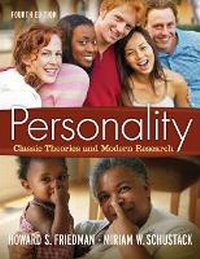
Personality
Classic Theories and Modern Research: United States Edition
4th Edition
Published on 30. October 2008
Book
Paperback/Softback
592 pages
978-0-205-57968-6 (ISBN)
Description
This successful text puts "personality" back into the personality course, integrating the classic insights of the personality theorists with modern research in a manner that will fascinate and encourage deeper thought.
This text explores classic theory from a perspective that encourages critical thinking and fosters intellectual insight with respect to human nature. For example, it shows the relevance of classic theory to topics of personality and culture, evolution, ego, gender, and person-situation interactionism.
Employing the highest scientific standards, Personality also uses a wide range of unique and provocative pedagogical devices that have been shown to motivate students. Hailed as the best-written, most relevant personality textbook on the market, Friedman and Schustack's fourth edition brings the field of personality to today's diverse student body.
This text explores classic theory from a perspective that encourages critical thinking and fosters intellectual insight with respect to human nature. For example, it shows the relevance of classic theory to topics of personality and culture, evolution, ego, gender, and person-situation interactionism.
Employing the highest scientific standards, Personality also uses a wide range of unique and provocative pedagogical devices that have been shown to motivate students. Hailed as the best-written, most relevant personality textbook on the market, Friedman and Schustack's fourth edition brings the field of personality to today's diverse student body.
More details
Edition
4th edition
Language
English
Place of publication
United States
Publishing group
Pearson Education (US)
Target group
Professional and scholarly
Dimensions
Height: 254 mm
Width: 203 mm
Weight
1250 gr
ISBN-13
978-0-205-57968-6 (9780205579686)
Copyright in bibliographic data and cover images is held by Nielsen Book Services Limited or by the publishers or by their respective licensors: all rights reserved.
Schweitzer Classification
Other editions
New editions
Book
01/2011
5th Edition
Pearson
€184.20
Article exhausted; check for reprint
Previous edition
Book
07/2005
3rd Edition
Pearson
€91.79
Article exhausted; check for reprint
Persons
Howard S. Friedman is Distinguished Professor of Psychology at the University of California, Riverside, where he studies personality and health. Dr. Friedman was awarded UCR's Distinguished Teaching Award, and in 2000 he was named Outstanding Teacher by the Western Psychological Association (WPA). He is an elected Fellow of the Division of Personality and Social Psychology and the Division of Health Psychology of the American Psychological Association. He received the 2007-2008 James McKeen Cattell Fellow Award from the Association for Psychological Science (APS), which recognizes a lifetime of outstanding contributions to the area of applied psychological research. An honors graduate of Yale University, Friedman received his Ph.D. from Harvard University.
Miriam W. Schustack is Professor of Psychology at the California State University in San Marcos (near San Diego), where she currently specializes in individual differences and the use of computers in learning. She previously taught at Harvard University. An honors graduate of Princeton University, Schustack received her master's from Yale and her Ph.D. from Carnegie-Mellon University.
Miriam W. Schustack is Professor of Psychology at the California State University in San Marcos (near San Diego), where she currently specializes in individual differences and the use of computers in learning. She previously taught at Harvard University. An honors graduate of Princeton University, Schustack received her master's from Yale and her Ph.D. from Carnegie-Mellon University.
Content
I. INTRODUCTION.
1. What Is Personality?
2. How Is Personality Studied and Assessed?
II. EIGHT BASIC ASPECTS OF PERSONALITY.
3. Psychoanalytic Aspects of Personality.
4. Neo-Analytic and Ego Aspects of Personality: Identity.
5. Biological Aspects of Personality.
6. Behaviorist and Learning Aspects of Personality.
7. Cognitive and Social-Cognitive Aspects of Personality.
8. Trait and Skill Aspects of Personality.
9. Humanistic and Existential Aspects of Personality.
10. Person-Situation Interactionist Aspects of Personality.
III. APPLICATIONS TO INDIVIDUAL DIFFERENCES.
11. Male-Female Differences.
12. Stress, Adjustment, and Health Differences.
13. Culture and Ethnicity: Processes and Differences.
14. Love and Hate.
IV. CONCLUSION AND OUTLOOK FOR THE FUTURE.
15. Where Will We Find Personality?
1. What Is Personality?
2. How Is Personality Studied and Assessed?
II. EIGHT BASIC ASPECTS OF PERSONALITY.
3. Psychoanalytic Aspects of Personality.
4. Neo-Analytic and Ego Aspects of Personality: Identity.
5. Biological Aspects of Personality.
6. Behaviorist and Learning Aspects of Personality.
7. Cognitive and Social-Cognitive Aspects of Personality.
8. Trait and Skill Aspects of Personality.
9. Humanistic and Existential Aspects of Personality.
10. Person-Situation Interactionist Aspects of Personality.
III. APPLICATIONS TO INDIVIDUAL DIFFERENCES.
11. Male-Female Differences.
12. Stress, Adjustment, and Health Differences.
13. Culture and Ethnicity: Processes and Differences.
14. Love and Hate.
IV. CONCLUSION AND OUTLOOK FOR THE FUTURE.
15. Where Will We Find Personality?