

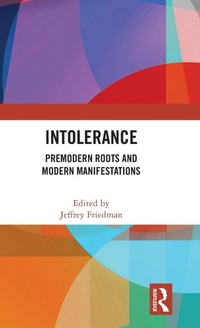
Intolerance
Premodern Roots and Modern Manifestations
1st Edition
Published on 12. December 2022
Book
Hardback
164 pages
978-1-032-37885-5 (ISBN)
Description
Intolerance of ideas different from one's own seems to be a common attitude among human beings and, at the same time, something that seems to be more pronounced in recent years. In this volume, political theorists and philosophers consider some of the historical preconditions of modern intolerance and debate the sources of its recent manifestations.
From theories of religious intolerance during the Reformation to the contemporary suppression of religious symbols; from homophobia to attempts to ban it; from populism on the right to "cancel culture" on the left-this book covers a variety of forms of intolerance, analysing not only its consequences but its causes and implications. Some of the chapters suggest means by which democracies may, through popular and judicial measures, defend themselves against intolerance, while others probe the philosophical grounding of intolerance in epistemological and metaphysical doctrines such as self-evident truth, divine revelation, inner illumination, naive realism, and the moral relativism attributed to analytic philosophy and postmodernism.
The chapters in this book were originally published as a special issue of Critical Review.
From theories of religious intolerance during the Reformation to the contemporary suppression of religious symbols; from homophobia to attempts to ban it; from populism on the right to "cancel culture" on the left-this book covers a variety of forms of intolerance, analysing not only its consequences but its causes and implications. Some of the chapters suggest means by which democracies may, through popular and judicial measures, defend themselves against intolerance, while others probe the philosophical grounding of intolerance in epistemological and metaphysical doctrines such as self-evident truth, divine revelation, inner illumination, naive realism, and the moral relativism attributed to analytic philosophy and postmodernism.
The chapters in this book were originally published as a special issue of Critical Review.
More details
Language
English
Place of publication
London
United Kingdom
Publishing group
Taylor & Francis Ltd
Target group
College/higher education
Professional and scholarly
Academic, Postgraduate, and Undergraduate
Dimensions
Height: 222 mm
Width: 145 mm
Thickness: 13 mm
Weight
360 gr
ISBN-13
978-1-032-37885-5 (9781032378855)
Copyright in bibliographic data and cover images is held by Nielsen Book Services Limited or by the publishers or by their respective licensors: all rights reserved.
Schweitzer Classification
Other editions
Additional editions
Book
08/2024
1st Edition
Routledge
€61.50
Shipment within 10-20 days
E-Book
12/2022
1st Edition
Routledge
€53.99
Available for download
E-Book
12/2022
1st Edition
Routledge
€53.99
Available for download
Person
Jeffrey Friedman, the editor of Critical Review, is a visiting scholar in the Social Studies program at Harvard University, USA. He has taught political theory at Barnard College, Columbia University, Dartmouth College, Harvard University, and Yale University, and is the author of Power Without Knowledge: A Critique of Technocracy (2019).
Content
Introduction: Intolerance, Power, and Epistemology 1. Consequences, Conscience, and Fallibility: Early Modern Roots of Toleration 2. Marx and Romanticism 3. Early Modern Epistemologies and Religious Intolerance 4. Citizens as Militant Democrats, Or: Just How Intolerant Should the People Be? 5. Philosophical Foundations of Contemporary Intolerance: Why We No Longer Take Martin Luther King, Jr. Seriously 6. Who Is Intolerant? The Clash Between LGBTQ+ Rights and Religious Free Exercise