

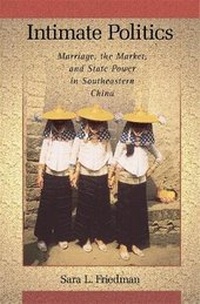
Intimate Politics
Marriage, the Market, and State Power in Southeastern China
Published on 1. June 2006
Book
Hardback
344 pages
978-0-674-02128-0 (ISBN)
Description
On a visit to eastern Hui'an in 1994, Sara Friedman was surprised to see a married woman reluctant to visit her conjugal home. The author would soon learn that this practice was typical of the area, along with distinctive female dress styles, gender divisions of labor, and powerful same-sex networks. These customs, she would learn, have long distinguished villages in this coastal region of southeastern China from other rural Han communities.
Intimate Politics explores these practices that have constituted eastern Hui'an residents, women in particular, as an anomaly among rural Han. This book asks what such practices have come to mean in a post-1949 socialist order that has incorporated forms of marriage, labor, and dress into a developmental scale extending from the primitive to the civilized. Government reform campaigns were part of a wholesale effort to remake Chinese society by replacing its "feudal" elements with liberated socialist ideals and practices. As state actors became involved in the intimate aspects of Huidong women's lives, their official models of progress were challenged by the diversity of local practices and commitment of local residents. These politicized entanglements have generated what the author calls "intimate politics," a form of embodied struggle in which socialist civilizing agendas-from the state-sponsored reforms of the Maoist decades to the market-based "reform and opening" of the post-Mao era-have been formulated, contested, and, in some cases, transformed through the bodies and practices of local women.
Intimate Politics explores these practices that have constituted eastern Hui'an residents, women in particular, as an anomaly among rural Han. This book asks what such practices have come to mean in a post-1949 socialist order that has incorporated forms of marriage, labor, and dress into a developmental scale extending from the primitive to the civilized. Government reform campaigns were part of a wholesale effort to remake Chinese society by replacing its "feudal" elements with liberated socialist ideals and practices. As state actors became involved in the intimate aspects of Huidong women's lives, their official models of progress were challenged by the diversity of local practices and commitment of local residents. These politicized entanglements have generated what the author calls "intimate politics," a form of embodied struggle in which socialist civilizing agendas-from the state-sponsored reforms of the Maoist decades to the market-based "reform and opening" of the post-Mao era-have been formulated, contested, and, in some cases, transformed through the bodies and practices of local women.
Reviews / Votes
In her ethnographic study of rural coastal women in Fujian province, anthropologist Friedman documents in excellent detail the diverse impacts of the modernizing Chinese state on women who are symbolically represented in wider Chinese society as 'the Hui'an woman.' -- E. P. Lozada * Choice *More details
Series
Language
English
Place of publication
Cambridge, Mass
United States
Target group
Professional and scholarly
Illustrations
21 black and white photographs, 1 table, 3 maps
Dimensions
Height: 235 mm
Width: 156 mm
ISBN-13
978-0-674-02128-0 (9780674021280)
Copyright in bibliographic data and cover images is held by Nielsen Book Services Limited or by the publishers or by their respective licensors: all rights reserved.
Schweitzer Classification
Person
Sara L. Friedman is an Assistant Professor of Anthropology and Gender Studies at Indiana University in Bloomington.