

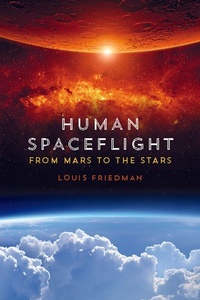
Human Spaceflight
From Mars to the Stars
2nd Edition
Published on 5. November 2015
Book
Paperback/Softback
176 pages
978-0-8165-3146-2 (ISBN)
Description
Mars, the red planet named for the god of war, a mysterious dust-ridden place, is most like Earth in its climate and seasons. Of all the possible destinations in space to travel, Mars is the most likely for humans to reach. According to esteemed scientist Louis Friedman, it may be the only destination outside the moon to ever see human footprints.
Far from diminishing our future in space, Human Spaceflight lays out a provocative future for human space travel. The noted aerospace engineer and scientist says that human space exploration will continue well into the future, but space travel by humans will stop at Mars. Instead, nanotechnology, space sails, robotics, biomolecular engineering, and artificial intelligence will provide the vehicles of the future for an exciting evolution not just of space travel but of humankind.
Friedman has worked with agencies around the globe on space exploration projects to extend human presence beyond Mars and beyond the solar system. He writes that once we accept Mars as the only viable destination for humans, our space program on planet Earth can become more exciting and more relevant. Mars, he writes, will take hundreds, even thousands, of years to settle. During that time, humans and all our supporting technologies will evolve, allowing our minds to be present throughout the universe while our bodies stay home on Earth and Mars.
Far from diminishing our future in space, Human Spaceflight lays out a provocative future for human space travel. The noted aerospace engineer and scientist says that human space exploration will continue well into the future, but space travel by humans will stop at Mars. Instead, nanotechnology, space sails, robotics, biomolecular engineering, and artificial intelligence will provide the vehicles of the future for an exciting evolution not just of space travel but of humankind.
Friedman has worked with agencies around the globe on space exploration projects to extend human presence beyond Mars and beyond the solar system. He writes that once we accept Mars as the only viable destination for humans, our space program on planet Earth can become more exciting and more relevant. Mars, he writes, will take hundreds, even thousands, of years to settle. During that time, humans and all our supporting technologies will evolve, allowing our minds to be present throughout the universe while our bodies stay home on Earth and Mars.
More details
Edition
2nd edition
Language
English
Place of publication
Tucson
United States
Product notice
Paperback (trade)
Unsewn / adhesive bound
Illustrations
17 halftones, 12 line drawings, 11 colour plates
Dimensions
Height: 228 mm
Width: 151 mm
Thickness: 15 mm
Weight
243 gr
ISBN-13
978-0-8165-3146-2 (9780816531462)
Copyright in bibliographic data and cover images is held by Nielsen Book Services Limited or by the publishers or by their respective licensors: all rights reserved.
Schweitzer Classification
Person
Louis Friedman holds a PhD in aeronautics and astronautics from MIT. He has worked on deep-space missions at the Jet Propulsion Laboratory (JPL) in Pasadena, California, and he co-founded The Planetary Society with Carl Sagan and Bruce Murray, serving as the organization's executive director for thirty years. He was co-leader of the Keck Institute for Space Studies (KISS) Asteroid Retrieval Mission and Interstellar Medium Exploration Studies at Caltech.