

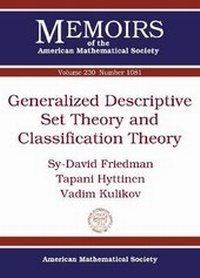
Generalized Descriptive Set Theory and Classification Theory
Will be published approx. on 30. June 2014
Book
Paperback/Softback
80 pages
978-0-8218-9475-0 (ISBN)
Description
Descriptive set theory is mainly concerned with studying subsets of the space of all countable binary sequences. In this paper the authors study the generalization where countable is replaced by uncountable. They explore properties of generalized Baire and Cantor spaces, equivalence relations and their Borel reducibility. The study shows that the descriptive set theory looks very different in this generalized setting compared to the classical, countable case. They also draw the connection between the stability theoretic complexity of first-order theories and the descriptive set theoretic complexity of their isomorphism relations. The authors' results suggest that Borel reducibility on uncountable structures is a model theoretically natural way to compare the complexity of isomorphism relations.
More details
Series
Language
English
Place of publication
Providence
United States
Target group
Professional and scholarly
Dimensions
Height: 254 mm
Width: 178 mm
Weight
200 gr
ISBN-13
978-0-8218-9475-0 (9780821894750)
Copyright in bibliographic data and cover images is held by Nielsen Book Services Limited or by the publishers or by their respective licensors: all rights reserved.
Schweitzer Classification
Persons
Sy-David Friedman, Kurt Godel Research Center, Vienna, Austria.
Tapani Hyttinen, University of Helsinki, Finland.
Vadim Kulikov, Kurt Godel Research Center, Vienna, Austria.
Tapani Hyttinen, University of Helsinki, Finland.
Vadim Kulikov, Kurt Godel Research Center, Vienna, Austria.
Content
History and motivation
Introduction
Borel sets, D11 sets and infinitary logic
Generalizations from classical descriptive set theory
Complexity of isomorphism relations
Reductions
Open questions
Bibliography
Introduction
Borel sets, D11 sets and infinitary logic
Generalizations from classical descriptive set theory
Complexity of isomorphism relations
Reductions
Open questions
Bibliography