

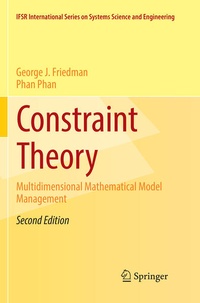
Constraint Theory
Multidimensional Mathematical Model Management
2nd Edition
Published on 3. August 2018
Book
Paperback/Softback
XXIV, 220 pages
978-3-319-85483-0 (ISBN)
Description
This text analyses the defectiveness of large mathematical models of physical systems. It demonstrates how to use the bipartite graph of the defective model to pinpoint and overcome that inconsistency. Enriched "with formal proofs interspersed among the illuminating hypothetical dialog sequences between manager and analyst, this work is an essential tool in achieving quality control in developing and applying large models." - John Warfield. It is an indispensable reference for mathematician, engineer and manager alike.
Reviews / Votes
"The book contains many open problems and suggestions for further research. . The book is very useful for researchers in discrete mathematics and combinatorics, applied statisticians, coding theorists and signal processors, but also for graduate students interested in these fields of mathematics." (Dean Crnkovic, zbMATH 1400.05002, 2019)More details
Product info
Previously published in hardcover
Series
Edition
Softcover reprint of the original 2nd ed. 2017
Language
English
Place of publication
Cham
Switzerland
Publishing group
Springer International Publishing
Target group
Professional and scholarly
Edition type
Revised edition
Illustrations
117 s/w Abbildungen, 9 farbige Abbildungen
XXIV, 220 p. 126 illus., 9 illus. in color.
Dimensions
Height: 235 mm
Width: 155 mm
Thickness: 14 mm
Weight
376 gr
ISBN-13
978-3-319-85483-0 (9783319854830)
DOI
10.1007/978-3-319-54792-3
Schweitzer Classification
Other editions
Additional editions

Book
08/2017
2nd Edition
Springer
€82.38
Shipment within 10-15 days
Persons
George Friedman
is a Professor of Practice in the Astronautical Engineering Department of the Viterbi School of Engineering of the University of Southern California. He has developed and taught graduate courses in systems engineering with emphasis on the management of complexity and decision science. This book is the product of one of these courses. He has had over 45 years of experience in industry, retiring from the Northrop Corporation as their Corporate Vice President of Engineering and Technology. He worked on a wide variety of aerospace programs and served as a consultant to all branches of the Department of Defense, NASA, the National Science Foundation, and Department of Energy as well as to the NATO industrial advisory group. He was a founder of the International Council on Systems Engineering (INCOSE), served as its third president, was elected a fellow and is on the editorial board of INCOSE's journal, Systems Engineering. He has also been a member of the Institute of Electrical and Electronic Engineers (IEEE) since its formation from the IRE and AIEE, was elected a fellow and was the vice president for publications of the IEEE Transactions on Aerospace and Electronics Systems. He received the Baker Prize for the best paper published by all societies of the IEEE in 1970 -- the subject of the paper was Constraint Theory.
Phan Phan is a Lecturer in the Astronautical Engineering Department of the Viterbi School of Engineering of the University of Southern California (USC). He has assisted and taught graduate courses in systems engineering, systems management, lean operations and economic analysis. He has had over 36 years of technical and managerial experience in government, military and various industries, including oil & gas exploration, commercial and military aircraft, unmanned sensors, and major weapon systems. His industry assignments included Mobil Research & Development, General Dynamics, Lockheed Aeronautical Systems, McDonnell Douglas and Boeing Integrated Defense Systems. As a registered Professional Engineer in California, he currently works as a reliability analyst with the Naval Surface Warfare Center -- Corona Division. He has also served in the U.S. Navy Reserve as an Engineering Duty Officer, attaining the rank of Captain, and currently assigned to Naval Sea Systems Command. His previous Navy assignments included Office of Naval Research/Naval Research Laboratory, Program Executive Office Integrated Warfare Systems, Naval Space & Warfare Systems Command, Mobile Mine Assembly Group, Naval Weapons Station Seal Beach and Naval Shipyard Long Beach. He received his B.S. in Engineering from the University of Alabama in Huntsville, Master of Engineering from the University of Texas at Arlington, MBA from California State University - Fullerton, M.S. in Systems Architecture & Engineering from USC, Master of Engineering Acoustics fromthe Naval Postgraduate School, and Ph.D. in Industrial & Systems Engineering from USC. The topic of his doctoral dissertation was "Expanding Constraint Theory to Determine Well-Posedness of Large Mathematical Models," the main contribution to the second edition of this book.
Phan Phan is a Lecturer in the Astronautical Engineering Department of the Viterbi School of Engineering of the University of Southern California (USC). He has assisted and taught graduate courses in systems engineering, systems management, lean operations and economic analysis. He has had over 36 years of technical and managerial experience in government, military and various industries, including oil & gas exploration, commercial and military aircraft, unmanned sensors, and major weapon systems. His industry assignments included Mobil Research & Development, General Dynamics, Lockheed Aeronautical Systems, McDonnell Douglas and Boeing Integrated Defense Systems. As a registered Professional Engineer in California, he currently works as a reliability analyst with the Naval Surface Warfare Center -- Corona Division. He has also served in the U.S. Navy Reserve as an Engineering Duty Officer, attaining the rank of Captain, and currently assigned to Naval Sea Systems Command. His previous Navy assignments included Office of Naval Research/Naval Research Laboratory, Program Executive Office Integrated Warfare Systems, Naval Space & Warfare Systems Command, Mobile Mine Assembly Group, Naval Weapons Station Seal Beach and Naval Shipyard Long Beach. He received his B.S. in Engineering from the University of Alabama in Huntsville, Master of Engineering from the University of Texas at Arlington, MBA from California State University - Fullerton, M.S. in Systems Architecture & Engineering from USC, Master of Engineering Acoustics fromthe Naval Postgraduate School, and Ph.D. in Industrial & Systems Engineering from USC. The topic of his doctoral dissertation was "Expanding Constraint Theory to Determine Well-Posedness of Large Mathematical Models," the main contribution to the second edition of this book.
Content
Chapter 1, Motivations: What is Constraint Theory and why is it important?.- Chapter 2, The Four-Fold Way: How to Perceive Complex Mathematical Models and Well-Posed Problems.- Chapter 3, General Results: From Protomath to Math to Metamath.- Chapter 4, Regular Relations: Searching for the Kernels of Constraint.- Chapter 5, Model Consistency and Computational Allowability.- Chapter 6, Discrete and Interval Relations: The Diminished Utility of Metamodels.- Chapter 7, The Logical Structure of Constraint Theory: A Compact Summary.- Chapter 8, Examples of Constraint Theory Applied to Real-World Problems.- Chapter 9, Manager and Analyst Meet Again: Gists and Schizophrenia.- Appendices.