

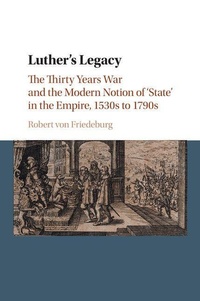
Luther's Legacy
The Thirty Years War and the Modern Notion of 'State' in the Empire, 1530s to 1790s
Published on 31. August 2017
Book
Paperback/Softback
448 pages
978-1-107-53067-6 (ISBN)
Description
In this new account of the emergence of a distinctive territorial state in early modern Germany, Robert von Friedeburg examines how the modern notion of state does not rest on the experience of a bureaucratic state-apparatus. It emerged to stabilize monarchy from dynastic insecurity and constrain it to protect the rule of law, subjects, and their lives and property. Against this background, Lutheran and neo-Aristotelian notions on the spiritual and material welfare of subjects dominating German debate interacted with Western European arguments against 'despotism' to protect the lives and property of subjects. The combined result of this interaction under the impact of the Thirty Years War was Seckendorff's Der Deutsche Fuerstenstaat (1656), constraining the evil machinations of princes and organizing the detailed administration of life in the tradition of German Policey, and which founded a specifically German notion of the modern state as comprehensive provision of services to its subjects.
Reviews / Votes
'This book offers an original and striking argument about the emergence of the German concept of the State from conflict and dialogue among princes and their subjects amidst the catastrophic circumstances of the Thirty Years War and its immediate aftermath. Friedeburg breaks new ground by shifting the discussion away from the unsteady development of German liberalism and the supposed uncritical and even enthusiastic embrace of monarchism, which allegedly pushed Germany along a deviant 'special path' away from western democracy and towards Nazism.' Peter H. Wilson, University of Hull 'This work is a tour de force on the development of the modern state in Germany, and a gift for all who are fascinated by the way ideas and passions can transform an empire. It is also a reminder of how voices from the past, and Luther's in particular, continue to speak to critical issues of injustice today.' Brenden Bott, Renaissance and Reformation 'This original interpretation makes the book a major intervention and provides a new way of thinking about the emergence of the state in the German lands.' Martin Christ, European History QuarterlyMore details
Language
English
Place of publication
Cambridge
United Kingdom
Target group
College/higher education
Professional and scholarly
Product notice
Paperback (trade)
Dimensions
Height: 229 mm
Width: 152 mm
Thickness: 25 mm
Weight
644 gr
ISBN-13
978-1-107-53067-6 (9781107530676)
Copyright in bibliographic data and cover images is held by Nielsen Book Services Limited or by the publishers or by their respective licensors: all rights reserved.
Schweitzer Classification
Other editions
Additional editions
Robert von Friedeburg
Luther's Legacy
The Thirty Years War and the Modern Notion of 'State' in the Empire, 1530s to 1790s
Book
02/2016
Cambridge University Press
€143.80
Shipment within 15-20 days
Person
Robert von Friedeburg has been a Visiting Fellow at Harvard University, Massachusetts (1987-88), a Heisenberg Research Fellow (1996-2000), a Member of the Institute for Advanced Study, Princeton (2002), and holder of the Chaire Dupron (Sorbonne, Paris, 2009). He received the Bennigsen Foerder Prize in 1992 and has been a member of the Academia Europaea since 2012. He is the author of seven monographs and the editor of ten volumes, including Self-Defence and Religious Strife in Early Modern Europe: England and Germany, 1530-1680 (2002), Murder and Monarchy: Regicide in European History, 1300-1800 (2004) and Perspectives on an Interdisciplinary Subject: Politics, Law, Society, History and Religion in the Politica, 1590s-1650s (2013).
Content
Introduction: Luther's legacy and the 'German' notion of state; 1. Meinecke's riddle: reason of state and Reformation prudence; 2. Royal rights and princely dynasties in late medieval and early modern Germany, fourteenth to early seventeenth centuries; 3. Civil order and princely rights, 1450s to 1580s: the making of the elements; 4. The transformation of ideas on order and the rise of the 'fatherland', 1580s to 1630s: the re-ordering of the elements; 5. The challenge of 'reason of state', 1600s to 1650s; 6. The catastrophe of war and the collapse of relations between princes and vassals; 7. The re-establishing of compromise and the new use of the elements: Seckendorff, Pufendorf and the dissemination of the new concept of 'state'; 8. Readings of despotism: the attack on 'war-despotism' between Bodin and Montesquieu; Conclusion: Luther's legacy: the 'Germaness' of the modern notion of 'state'; Bibliography; Index.