

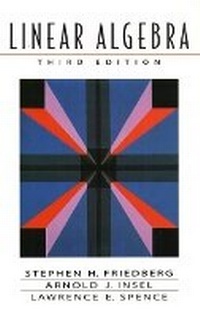
Linear Algebra
International Edition
4th Edition
Published on 14. August 2003
Book
Paperback/Softback
601 pages
978-0-13-120266-5 (ISBN)
Description
For courses in Advanced Linear Algebra.
This top-selling, theorem-proof text presents a careful treatment of the principal topics of linear algebra, and illustrates the power of the subject through a variety of applications. It emphasizes the symbiotic relationship between linear transformations and matrices, but states theorems in the more general infinite-dimensional case where appropriate.
This top-selling, theorem-proof text presents a careful treatment of the principal topics of linear algebra, and illustrates the power of the subject through a variety of applications. It emphasizes the symbiotic relationship between linear transformations and matrices, but states theorems in the more general infinite-dimensional case where appropriate.
More details
Edition
4th edition
Language
English
Place of publication
United States
Publishing group
Pearson Education (US)
Target group
Professional and scholarly
Dimensions
Height: 229 mm
Width: 151 mm
Thickness: 28 mm
Weight
700 gr
ISBN-13
978-0-13-120266-5 (9780131202665)
Copyright in bibliographic data and cover images is held by Nielsen Book Services Limited or by the publishers or by their respective licensors: all rights reserved.
Schweitzer Classification
Other editions
New editions
Stephen Friedberg | Stephen H. Friedberg | Arnold J. Insel
Linear Algebra
Pearson New International Edition
Book
07/2013
4th Edition
Pearson Education Limited
€97.99
Shipment within 10-20 days
Previous edition
Insel Friedberg
Linear Algebra
Book
11/1996
3rd Edition
Pearson Education (US)
€58.17
Article exhausted; check different version
Content
1. Vector Spaces.
Introduction. Vector Spaces. Subspaces. Linear Combinations and Systems of Linear Equations. Linear Dependence and Linear Independence. Bases and Dimension. Maximal Linearly Independent Subsets.
2. Linear Transformations and Matrices.
Linear Transformations, Null Spaces, and Ranges. The Matrix Representation of a Linear Transformation. Composition of Linear Transformations and Matrix Multiplication. Invertibility and Isomorphisms. The Change of Coordinate Matrix. Dual Spaces. Homogeneous Linear Differential Equations with Constant Coefficients.
3. Elementary Matrix Operations and Systems of Linear Equations.
Elementary Matrix Operations and Elementary Matrices. The Rank of a Matrix and Matrix Inverses. Systems of Linear Equations-Theoretical Aspects. Systems of Linear Equations-Computational Aspects.
4. Determinants.
Determinants of Order 2. Determinants of Order n. Properties of Determinants. Summary-Important Facts about Determinants. A Characterization of the Determinant.
5. Diagonalization.
Eigenvalues and Eigenvectors. Diagonalizability. Matrix Limits and Markov Chains. Invariant Subspaces and the Cayley-Hamilton Theorem.
6. Inner Product Spaces.
Inner Products and Norms. The Gram-Schmidt Orthogonalization Process and Orthogonal Complements. The Adjoint of a Linear Operator. Normal and Self-Adjoint Operators. Unitary and Orthogonal Operators and Their Matrices. Orthogonal Projections and the Spectral Theorem. The Singular Value Decomposition and the Pseudoinverse. Bilinear and Quadratic Forms. Einstein's Special Theory of Relativity. Conditioning and the Rayleigh Quotient. The Geometry of Orthogonal Operators.
7. Canonical Forms.
The Jordan Canonical Form I. The Jordan Canonical Form II. The Minimal Polynomial. Rational Canonical Form.
Appendices.
Sets. Functions. Fields. Complex Numbers. Polynomials.
Answers to Selected Exercises.
Index.
Introduction. Vector Spaces. Subspaces. Linear Combinations and Systems of Linear Equations. Linear Dependence and Linear Independence. Bases and Dimension. Maximal Linearly Independent Subsets.
2. Linear Transformations and Matrices.
Linear Transformations, Null Spaces, and Ranges. The Matrix Representation of a Linear Transformation. Composition of Linear Transformations and Matrix Multiplication. Invertibility and Isomorphisms. The Change of Coordinate Matrix. Dual Spaces. Homogeneous Linear Differential Equations with Constant Coefficients.
3. Elementary Matrix Operations and Systems of Linear Equations.
Elementary Matrix Operations and Elementary Matrices. The Rank of a Matrix and Matrix Inverses. Systems of Linear Equations-Theoretical Aspects. Systems of Linear Equations-Computational Aspects.
4. Determinants.
Determinants of Order 2. Determinants of Order n. Properties of Determinants. Summary-Important Facts about Determinants. A Characterization of the Determinant.
5. Diagonalization.
Eigenvalues and Eigenvectors. Diagonalizability. Matrix Limits and Markov Chains. Invariant Subspaces and the Cayley-Hamilton Theorem.
6. Inner Product Spaces.
Inner Products and Norms. The Gram-Schmidt Orthogonalization Process and Orthogonal Complements. The Adjoint of a Linear Operator. Normal and Self-Adjoint Operators. Unitary and Orthogonal Operators and Their Matrices. Orthogonal Projections and the Spectral Theorem. The Singular Value Decomposition and the Pseudoinverse. Bilinear and Quadratic Forms. Einstein's Special Theory of Relativity. Conditioning and the Rayleigh Quotient. The Geometry of Orthogonal Operators.
7. Canonical Forms.
The Jordan Canonical Form I. The Jordan Canonical Form II. The Minimal Polynomial. Rational Canonical Form.
Appendices.
Sets. Functions. Fields. Complex Numbers. Polynomials.
Answers to Selected Exercises.
Index.