

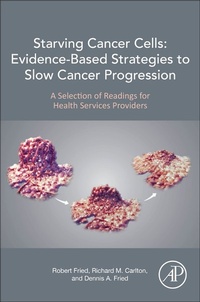
Starving Cancer Cells: Evidence-Based Strategies to Slow Cancer Progression
A Selection of Readings for Health Services Providers
Published on 5. March 2021
Book
Paperback/Softback
246 pages
978-0-12-824013-7 (ISBN)
Description
Starving Cancer Cells: Evidence-Based Strategies to Slow Cancer Progression - A Selection of Readings for Health Services Providers presents an edited and annotated collection of recent medical journal publications and abstracts illustrating new approaches to treatment derived from the metabolic theory of cancer. It intends to shed an early light on a relatively new approach to our understanding of the cancer cell idiosyncratic metabolic dysfunction, and on evidence-based new treatment strategies derived from that understanding.
The book discusses topics such as tumor starvation by L-arginine deprivation; L-canavanine depriving tumors of L-arginine in pancreatic, multiple myeloma and breast cancer; glucose deprivation and intermittent fasting; glutamine uptake in cancer; the relation of oxygen-starved cancer cells with aspartate; and reducing tolerance of tumor cells to nutrition starvation. The content is presented in a contextualized and practical way in order to facilitate the transition from bench to bedside.
This is a valuable resource for practitioners, oncologists and other members of healthcare chain who are interested in learning more about the most recent tumor cell starvation strategies and how they can improve overall treatment outcome.
The book discusses topics such as tumor starvation by L-arginine deprivation; L-canavanine depriving tumors of L-arginine in pancreatic, multiple myeloma and breast cancer; glucose deprivation and intermittent fasting; glutamine uptake in cancer; the relation of oxygen-starved cancer cells with aspartate; and reducing tolerance of tumor cells to nutrition starvation. The content is presented in a contextualized and practical way in order to facilitate the transition from bench to bedside.
This is a valuable resource for practitioners, oncologists and other members of healthcare chain who are interested in learning more about the most recent tumor cell starvation strategies and how they can improve overall treatment outcome.
Reviews / Votes
"Starving Cancer Cells: Evidence-Based Strategies to Slow Cancer Progression - A Selection of Readings for Health Services Providers presents an edited and annotated collection of recent medical journal publications and abstracts illustrating new approaches to treatment derived from the metabolic theory of cancer. It intends to shed an early light on a relatively new approach to our understanding of the cancer cell idiosyncratic metabolic dysfunction, and on evidence-based new treatment strategies derived from that understanding. The book discusses topics such as tumor starvation by L-arginine deprivation; L-canavanine depriving tumors of L-arginine in pancreatic, multiple myeloma and breast cancer; glucose deprivation and intermittent fasting; glutamine uptake in cancer; the relation of oxygen-starved cancer cells with aspartate; and reducing tolerance of tumor cells to nutrition starvation." --Anticancer ResearchMore details
Language
English
Place of publication
San Diego
United States
Publishing group
Elsevier Science Publishing Co Inc
Target group
Professional and scholarly
Clinicians, medical doctors, oncologists, cancer researchers, nutritional oncologists, healthcare providers
Dimensions
Height: 229 mm
Width: 152 mm
Weight
500 gr
ISBN-13
978-0-12-824013-7 (9780128240137)
Copyright in bibliographic data and cover images is held by Nielsen Book Services Limited or by the publishers or by their respective licensors: all rights reserved.
Schweitzer Classification
Other editions
Additional editions
Robert Fried | Richard M. Carlton | Dennis A. Fried
Starving Cancer Cells: Evidence-Based Strategies to Slow Cancer Progression
A Selection of Readings for Health Services Providers
E-Book
03/2021
Academic Press
€131.00
Available for download
Persons
Dr. Robert Fried is Emeritus Professor, Doctoral Faculty, Behavioral Neuroscience, City University of New York (CUNY), New York, NY. Member American Physiology Society (APS) (Cardiovascular and Respiration division). Formerly, Director of the Rehabilitation Research Institute (RRI), International Center for the Disabled (ICD), New York, NY. Diplomate in Behavioral Medicine, International Academy of Behavioral Medicine, Counseling and Psychotherapy (IABMCP). Fellow, New York Academy of Sciences (NYAS). 1953 - 1956, US Army Signal Corps. Korean Military Advisory Group (KMAG), Seoul, Korea. Hon. Discharge, 1956. Richard M. Carlton, MD is an integrative physician who includes complementary and alternative approaches in the treatment of numerous medical problems, including migraines, inflammatory bowel disease, and diabetes. He had been Principal Staff Physician, Rehabilitation Research Institute (RRI), ICD-International Center for the Disabled, New York, NY. Dennis A. Fried, PHD, MPH, MBA is Assistant Professor, Department of Epidemiology, Rutgers School of Public Health, Newark, NJ; Health Science Specialist, U.S. Department of Veterans Affairs, War-Related Illness & Injury Study Center, East Orange, NJ.
Author
Emeritus professor, Doctoral Faculty, Behavioral Neuroscience, City University of New York (CUNY), New York, NY, USA
Integrative physician who includes complementary and alternative approaches in the treatment of numerous medical problems, including migraines, inflammatory bowel disease, and diabetes
Assistant Professor, Department of Epidemiology, Rutgers School of Public Health, Newark, NJ; Health Science Specialist, U.S. Department of Veterans Affairs, War-Related Illness and Injury Study Center, East Orange, NJ, USA
Content
1. Introduction2. The Metabolic Theory of Cancer and its Clinical Implications3. Tumor Starvation by L-Arginine Deprivation 4. L-Canavanine Deprives Tumors of L-Arginine 5. Glucose Deprivation and Fasting Strategies6. Tumor Starvation by Deprivation of Glutamine and Aspartate