

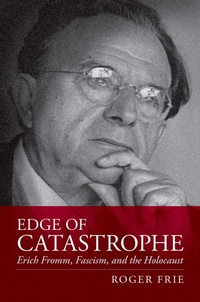
Edge of Catastrophe
Erich Fromm, Fascism, and the Holocaust
Published on 12. November 2024
Book
Hardback
214 pages
978-0-19-774877-0 (ISBN)
Description
Erich Fromm, the prominent twentieth-century public intellectual and psychoanalyst, was recognized for his courageous stand against fascism, racism, and human destructiveness. Until now, however, little has been known about the extent to which Fromm's personal experience of Nazi Germany and the Holocaust shaped his outlook and work.
In Edge of Catastrophe, Roger Frie introduces for the first time the unpublished Holocaust correspondence in Fromm's family. The letters provide insight into Fromm's life as a German-Jewish refugee and help us to understand the effect of Nazi Germany's racial terror on Fromm and his German-Jewish family. In the aftermath of the genocide, Fromm returned again and again to the themes of responsibility, social justice, and human solidarity, yet without revealing his own experience. As this book powerfully shows, Fromm's social, political, and psychological writings take on new meaning in light of the traumas and tragedies that he and his family experienced.
The image of Fromm that emerges from this book enriches our understanding of what it means to be both a social critic and practicing psychologist. In light of the racial hatred and antisemitism we see today, Frie demonstrates that a politics of engagement and a psychology of well-being go hand in hand. Frie suggests that there is much to be learned from the urgency in Fromm's writings as we seek to respond to the social crises and the renewed threat of fascism in our present age.
In Edge of Catastrophe, Roger Frie introduces for the first time the unpublished Holocaust correspondence in Fromm's family. The letters provide insight into Fromm's life as a German-Jewish refugee and help us to understand the effect of Nazi Germany's racial terror on Fromm and his German-Jewish family. In the aftermath of the genocide, Fromm returned again and again to the themes of responsibility, social justice, and human solidarity, yet without revealing his own experience. As this book powerfully shows, Fromm's social, political, and psychological writings take on new meaning in light of the traumas and tragedies that he and his family experienced.
The image of Fromm that emerges from this book enriches our understanding of what it means to be both a social critic and practicing psychologist. In light of the racial hatred and antisemitism we see today, Frie demonstrates that a politics of engagement and a psychology of well-being go hand in hand. Frie suggests that there is much to be learned from the urgency in Fromm's writings as we seek to respond to the social crises and the renewed threat of fascism in our present age.
Reviews / Votes
Frie's fascinating and evocative portrayal of Erich Fromm weaves together the plight of a man tortured by the peril his relatives faced in Nazi Germany with that of a scholar analyzing the grip that fascism had on its supporters. Crucially, Fromm's social psychoanalytic approach examines not only people's feelings, but the social contexts that shaped them. Fromm's analysis of authoritarianism explains the allure of Hitler and racial narcissism more generally-- then and now. Frie offers us a brilliant thinker, German and Holocaust history, and a warning for today. * Marion Kaplan, Professor Emerita of Modern Jewish History, New York University, and author of Between Dignity and Despair: Jewish Life in Nazi Germany (Oxford) and Hitler's Jewish Refugees: Hope and Anxiety in Portugal * No contemporary writer comes close to the sophistication of Erich Fromm's social psychology. His insights into people's desire for control and power over their lives no matter what the cost could not be more urgently relevant to this historical moment. Frie masterfully shows how athe personal is political' goes beyond a slogan to illuminate trauma, both personal and cultural. * Gail A. Hornstein, Professor Emerita of Psychology, Mount Holyoke College, and author of To Redeem One Person Is to Redeem the World: The Life of Frieda Fromm-Reichmann * Scholarly, humane, and eminently readable, Roger Frie's Edge of Catastrophe is a masterful tracing of Erich Fromm's theory, life, and times. Interweaving psychoanalysis, history, and social critique, this book explains the dangers of fascism, and issues an urgent call for these times. * Sue Grand, PhD, author of The Reproduction of Evil: A Clinical and Cultural Perspective * Highly recommended. * Choice * Roger Frie's biographical account of Fromm's personal encounter with Nazism is a beautifully written historical contribution to our understanding of Fromm's ideas that will find new readers for his work as well as change our understanding of both the person and the intellectual legacy... Heartbreakingly personal and tragic, Fromm's letters with his relatives, particularly an aunt and a second cousin both on his mother's side who were murdered by the Nazis, changes our view of the intellectual history of Fromm's contribution to social science, psychoanalysis and politics and raises several provocative questions for thoughtful observers of contemporary politics. * Neil McLaughlin, Journal of the History of the Behavioral Sciences *More details
Language
English
Place of publication
New York
United States
Target group
Professional and scholarly
Product notice
sewn/stitched
Cloth over boards
Illustrations
11 b/w illustrations
Dimensions
Height: 239 mm
Width: 160 mm
Thickness: 18 mm
Weight
454 gr
ISBN-13
978-0-19-774877-0 (9780197748770)
Copyright in bibliographic data and cover images is held by Nielsen Book Services Limited or by the publishers or by their respective licensors: all rights reserved.
Schweitzer Classification
Other editions
Additional editions
E-Book
07/2024
OUP eBook
€24.99
Available for download
E-Book
07/2024
OUP eBook
€24.99
Available for download
Person
Roger Frieis Professor of Education at Simon Fraser University and Affiliate Professor of Psychiatry at the University of British Columbia in Vancouver, and Psychoanalytic Faculty and Supervisor at the William Alanson White Institute of Psychiatry, Psychoanalysis, and Psychology in New York. He is a clinical psychologist and psychoanalyst, as well as historian and social philosopher. Frie is the author and editor of many works including the award-winning bookNot in My Family: German Memory and Responsibility After the Holocaust(Oxford) andHistory Flows Through Us: Germany, the Holocaust and the Importance of Empathy.
Content
Acknowledgements
Introduction
Chapter 1: The Holocaust Correspondence
Chapter 2: How Is This Possible?
Chapter 3: Yearning to Submit
Chapter 4: Confronting Genocide
Chapter 5: Cultivating Love and Hope
References
Endnotes
Introduction
Chapter 1: The Holocaust Correspondence
Chapter 2: How Is This Possible?
Chapter 3: Yearning to Submit
Chapter 4: Confronting Genocide
Chapter 5: Cultivating Love and Hope
References
Endnotes