

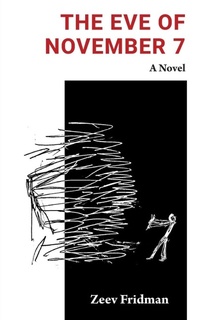
The Eve of November 7
A Novel
Published on 14. May 2026
Book
Paperback/Softback
320 pages
979-8-88719-872-9 (ISBN)
Description
The Eve of November 7 is an incisive, semi-fantastic journey into the latter years of the repressive Soviet era, seen through the eyes, imagination and experiences of a young adult addressing issues of conflicting realities in his life. In the Soviet Union, November 7th was established as a public holiday celebrating the Bolshevik Revolution. Author Zeev Fridman's autobiographical novel reflects his lived experience of growing up in the totalitarian Soviet communist era and its effect on the ultimate generation of young adults who grew up in the former USSR, with its obsessive, targeted repression of Jewish life, institutionalized and inculcated antisemitism.
Reviews / Votes
"The reader who hastily leafs through the novel The Eve of November 7 will remain totally perplexed.... What is going on here? A well-crafted, leisurely narrative in the spirit of the last century? Mysticism, intertwined with reality? A thriller about KGB intrigues? A Jewish family chronicle? Only by reading it seriously will one see clearly that Zeev Fridman's novel vividly and comprehensively contains all these elements. These layers complement each other, interlace and permeate one other, thus creating symphonic prose. The novel is autobiographical: its plot is based on the author's personal experiences and impressions and on the reversals of his difficult fate and on descriptions of characters who were Zeev Fridman's contemporaries. At the same time, many readers will see themselves in the hero; their own milieu in his colleagues; their ancestors in his relatives; their friends in his friends, and enemies in his enemies.- Aleksandr Razgon, editor of the Russian edition
"The Eve of November 7 leaves the reader with a smidgen of indelible flavor, and that is indeed the difference between a good novel and a casual book.
Fridman emerges as an artist of Magical Realism, the same enchanting genre that characterized the work of Gabriel Garcia Marquez, Mikhail Bulgakov, Jorge Amado, and Jorge Luis Borges.
His oeuvre is comparable to a mesmerizing fireworks show: he seems to create and erase worlds with a stroke of a pen, in two or three single lines of magical text. His writing style is captivating and full of sparks, and the topics that he chose to touch on are fascinating and thought-provoking."
- Ariel Bulshtein, Advocate, Journalist
"From its initial pages, Zeev Friedman's captivating novel, The Night of November 7, gently introduces us to the world of a young Jewish man suffering from the breakup of the relationship with his beloved. The reader, engrossed by this romantic narrative, will relax as the protagonist bares his soul-and will be taken by unawares by the KGB's sudden intrusion into his personal space. The thickening plot develops against the backdrop of the central character's vulnerable soul, at the peak of his personal crisis and seeming defenselessness. Then, unexpectedly, his link with his ancestral heritage provides him a pillar of support, while his confrontation with the KGB, at both the material and spiritual level, transforms us into witnesses to a series of surrealistic events, with our hero acting as the defendant of both his future and his past. The novel offers a cryptic, multi-layered plot, with the characters of all participants revealing their true nature as its phases unfold-all subtly woven into the author's ironic view of reality, intertwined with seemingly tragic moments and interspersed with other interludes that will bring a smile and, sometimes, an occasional laugh to the reader. This compelling narrative, with its wealth of detail and perspectives, will probably have readers repeatedly returning to pages you have already read! Even the most demanding scrutiny will not unveil exactly when or where the author-playing with his readers-actually makes them an accomplice to these events."
- Rivka Rubin, Member, Israeli Writers' Union
I would like to direct the reader's attention to several impressive facets of Zeev Fridman's novel, The Eve of November 7. The author's greatest achievement is his integration of this multi-layered, multifaceted novel, with all its events, into the temporal space of a single night! Another skillful feature of his prose is that it does not hark of Galut-although all the action occurs in the Galut. It is neither the prose of Sholom Aleichem, nor that of Galut writers in the nineteenth and the early twentieth centuries. It stands head and shoulders above any Galut prose, and the author displays his successful mastery of this endeavor. The novel's plot is tightly coiled, intricately spun and exquisitely produced. To my mind, the most important, highly significant and striking aspect of this work-one that has resonated with me more deeply at each reading-is that this is new prose, a work where the author is living in two worlds, and he has succeeded in rendering this duality. Yet all of this takes place so naturally: it is all fluently described; and this is where I envy the author, because I have myself attempted to create similar prose-lines that would flow so effortlessly and be so readable. To me, as a writer, this came as the greatest shock of all."
- Eli Luxemburg, writer
"You can meet someone every day at orchestra rehearsals for years, become family friends, enjoy long, captivating conversations- and only laterfind out that this extraordinary musician is also a mind-blowingly talented writer! You read his novel in one go, until 5 am, from beginning to end. In fact, I was also its first reader-because the novel was actually a closely guarded secret from anyone else: it was only discovered by his mother after Zeev departed our sinful Earth... I doubt whether there has ever been a similar precedent in all of history. The virtuosity and ease of Zeev's writing contrast with the novel's murky reality, creating a sense of the author's spiritual victory, with its obvious surrealism proving the most adequate reflection of this reality. The main theme is Jewish, welcoming and heart-warming. There are no borders between past and present, between the world of souls and the world of the living; light is not dominated by darkness. This novel is just begging to be brought to the big screen; the screenplay is already ready and waiting."
- Anna Gitterman, Member of the Beersheva Sinfonietta Orchestra
"Zeev Fridman's novel, The Eve of November 7, stands out among his writing and undoubtedly represents the pinnacle of the author's work. Even the title-which grapples with the eternal Jewish theme, that is, the fate of so-called Diaspora Jews at the crossroads of history-is significant, in that it reflects not only the core issues under consideration, but equally, the author's demanding yet restrained optimism. I dare to assert that Zeev Fridman's utterance is destined for longevity because that which is articulated in original, hard-won, truthful words can and should outlive those who articulated them, the person from whose lips they flew to find refuge on the blank page."
- Grigory Kanovich, writer
"'Everything's an illusion, you are under surveillance.' The Eve of November 7 is an autobiographical novel by the late Zeev Fridman, expertly translated from Russian into beautiful English with explanatory notes, rendering it accessible to a global audience. The first-person narrative reveals Misha, a conflicted young Russian Jew, entrapped physically and mentally in his humdrum existence, in the Soviet Union of the 1980s, where dark forces prevail, intent on preventing free speech, with the power of summary arrest. Misha's agonies of love, identity, and conscience are woven into a surrealistic fantasy with complex overlays and subtext, lending the novel a Kafkaesque flavour. Eventually, the protagonist reveals his inner truth and finds a path to redemption. This novel is a valuable contribution to both Russian and Jewish literature as well as a harbinger of things to come. We can never be complacent."
- Irene Lancaster, PhD
"Welcome to the surrealistic world of Soviet Jewish life under Brezhnev [1964-1982] as seen through the vivid imagination of author Zeev Fridman's hero, Misha. He captures the intimate world of being a Soviet Jew; that sense of marginality and lurking anti-Semitism and the impossibility of being a true part of Soviet society while preserving a positive Jewish identity. His sole sanctuaries are the warm and loving life of his Jewish family, his visits to the local synagogue, and his hope of immigrating to Israel, which he finally realizes. He reminds us that maintaining one's moral compass is ultimately in our hands, and not in the hands of our adversaries, an especially fitting message for today's complex world. His imagery and graphic use of language are powerful. The flowing translation from the Russian is especially elegant and very accessible. A uniquely compelling tale."
- Rabbi Jonathan Porath, Senior Staff AJJDC Russian Department [ret.];and author of Here We Are All Jews-175 Russian-Jewish Journeys*
More details
Language
English
Place of publication
United States
Publishing group
Academic Studies Press
Product notice
Paperback (trade)
Illustrations
Illustrations
Dimensions
Height: 147 mm
Width: 203 mm
Thickness: 18 mm
Weight
332 gr
ISBN-13
979-8-88719-872-9 (9798887198729)
Copyright in bibliographic data and cover images is held by Nielsen Book Services Limited or by the publishers or by their respective licensors: all rights reserved.
Schweitzer Classification
Persons
A talented musician, Fridman grew up in the USSR and struggled with its prevailing antisemitic atmosphere, initially being denied entry into the All-Union competition of Musicians in Moscow as a clarinetist. He went on to emigrate to Israel where he continued his musical career in the Beersheva Sinfonietta Orchestra as well as becoming a successful music teacher. Sadly, Fridman passed away prematurely in 2009 at the age of forty-nine. Drawn from his writings which were published posthumously in Russian, The Eve of November 7 illustrates the superficial, rigid, monotony of grim urban reality that served as the backdrop against his emerging desire for freedom of conscience and inspiration, his moral quest, and his attempts to reconnect with his Jewish past and fulfill personal aspirations.
Content
Note to the English Edition
Stefani Hoffman-Translator
Gillian (Gila) Ansell Brauner-English Editor
About Zeev Fridman
Rita Fridman
Preface to the Russian Edition
Aleksandr Razgon
Destined for a Long Life . . .
Grigory Kanovich
Chapter 1: News
Chapter 2: The Apartment
Chapter 3: New Friends
Chapter 4: A Wholesome Cafeteria
Chapter 5: The Party Obkom
Chapter 6: Yosif
Chapter 7: The Party Obkom (continued)
Chapter 8: "The Siren"
Chapter 9: The Synagogue
Chapter 10: The Parade
Epilogue: Excerpts from the Author's Notebooks
Russian and Hebrew Editions
Stefani Hoffman-Translator
Gillian (Gila) Ansell Brauner-English Editor
About Zeev Fridman
Rita Fridman
Preface to the Russian Edition
Aleksandr Razgon
Destined for a Long Life . . .
Grigory Kanovich
Chapter 1: News
Chapter 2: The Apartment
Chapter 3: New Friends
Chapter 4: A Wholesome Cafeteria
Chapter 5: The Party Obkom
Chapter 6: Yosif
Chapter 7: The Party Obkom (continued)
Chapter 8: "The Siren"
Chapter 9: The Synagogue
Chapter 10: The Parade
Epilogue: Excerpts from the Author's Notebooks
Russian and Hebrew Editions