

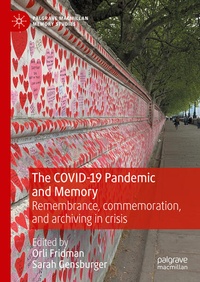
The COVID-19 Pandemic and Memory
Remembrance, commemoration, and archiving in crisis
Published on 15. December 2023
Book
Hardback
XX, 332 pages
978-3-031-34596-8 (ISBN)
Description
This book offers a platform for the analysis of commemorative and archiving practices as they were shaped, expanded, and developed during the Covid-19 lockdown periods in 2020 and the years that followed. By offering an extensive global view of these changes as well as of the continuities that went with them, the book enters a dialogue with what has emerged as an initial response to the pandemic and the ways in which it has affected memory and commemoration.
The book aims to critically and empirically engage with this abundance of memory to understand both memorialization of the pandemic and commemoration during the pandemic : what happened then to commemorative practices and rituals around the world? How has the Covid-19 pandemic been archived and remembered? What will remembering it actually entail, and what will it mean in the future? Where did the Covid memory boom come from? Who was behind it, how did it emerge, and in what socialconfigurations did it evolve?
The book aims to critically and empirically engage with this abundance of memory to understand both memorialization of the pandemic and commemoration during the pandemic : what happened then to commemorative practices and rituals around the world? How has the Covid-19 pandemic been archived and remembered? What will remembering it actually entail, and what will it mean in the future? Where did the Covid memory boom come from? Who was behind it, how did it emerge, and in what socialconfigurations did it evolve?
Reviews / Votes
This jewel of a book sets a new persuasive agenda for memory studies by an international group of scholars. Exploring individual and collective mnemonic practices that took place during Covid-19 and of Covid-19, this book offers indispensable contributions to timely questions: Has the pandemic transformed mnemonic practices? Will Covid-19 become part of collective memory?"- Vered Vinitzky-Seroussi , The Hebrew University of Jerusalem"How the Covid-19 pandemic unlocked memory. A truly international cast of authors throw light on archiving, mobilization, and the digitalization of memory - from Athens to Brazil, from Nigeria to Hong Kong. Essential reading for everyone interested in Corona and collective memory."- Astrid Erll , Goethe University Frankfurt
"This innovative volume documents a profound transformation in digital memory practices triggered by the covid-19 pandemic. Empirically rich contributions interrogate mnemonic activism as a response to trauma, a form of protest and an homage to legacies of violence. It is an essential reference for the study of memory."- Denisa Kostovicova , London School of Economics and Political Science
More details
Series
Edition
2024 ed.
Language
English
Place of publication
Cham
Switzerland
Publishing group
Springer International Publishing
Target group
Professional and scholarly
Illustrations
32 s/w Abbildungen
XX, 332 p. 32 illus.
Dimensions
Height: 216 mm
Width: 153 mm
Thickness: 24 mm
Weight
573 gr
ISBN-13
978-3-031-34596-8 (9783031345968)
DOI
10.1007/978-3-031-34597-5
Schweitzer Classification
Other editions
Additional editions
Orli Fridman | Sarah Gensburger
The COVID-19 Pandemic and Memory
Remembrance, commemoration, and archiving in crisis
Book
03/2025
Palgrave Macmillan
€149.79
Shipment within 15-20 days
Orli Fridman | Sarah Gensburger
The COVID-19 Pandemic and Memory
Remembrance, commemoration, and archiving in crisis
E-Book
12/2023
1st Edition
Palgrave Macmillan
€139.09
Available for download
Persons
Orli Fridman is an associate professor at the Belgrade Faculty of Media and Communications (FMK) and the academic director of the SIT learning center in Serbia. She is the author of
Memory Activism and Digital Practices after Conflict: Unwanted Memories
(2022).
Sarah Gensburger is a professor at CNRS-Sciences Po Paris. Her most recent books are Beyond Memory. Can we really learn from the past? (Palgrave, 2020, with S. Lefranc) and Memory on my doorstep. Chronicles of the Bataclan Neighborhood (2019).
Sarah Gensburger is a professor at CNRS-Sciences Po Paris. Her most recent books are Beyond Memory. Can we really learn from the past? (Palgrave, 2020, with S. Lefranc) and Memory on my doorstep. Chronicles of the Bataclan Neighborhood (2019).
Content
Chapter 1. Introduction: Unlocking Memory Studies: Understanding Collective Remembrance During and of Covid-19.- Part I Can We Speak of a Covid Memory Boom?.- Chapter 2. "It seemed right to keep some sort of history": Performances of Digital Memory Work by Young Women in London During Covid-19.- Chapter 3. Picturing Lockdown in the UK: Memorializing anOngoing Crisis.- Chapter 4. #Mémoriascovid19: Reimagining and Narrating Trauma in the Core of the Covid-19 Pandemic in Brazil.- Chapter 5. The Danger of a Single Story: Epic-Pandemic Narratologies and Memorials of COVID-19 in Nigeria.- Chapter 6. Pandemic from the Margins: How United-States-Based College Students Think the Pandemic Should Be Remembered.- Part II Commemorative Events Between Memory Politics and Protests: What Has Changed During the Lockdowns?.- Chapter 7. "No quarantine to workers' rights": Recontextualizing Labour Day Commemoration in the Semiotic Landscape of a Pandemic Demonstration.- Chapter 8. TheStruggle to Remember Tiananmen Under COVID-19 and the National Security Law in Hong Kong.- Chapter 9. "Memory Does Not Quarantine": COVID-19, Remembering the Coup, and the Struggle for Democracy in Bolsonaro's Brazil.- Chapter 10. Human Rights Day: Grassroots Commemoration of the 60th Anniversary of the Sharpeville Massacre Amidst the COVID-19 Pandemic Restrictions in South Africa.- Part III Memorial Museums and National Days: Did DigitalPractices Transform Commemoration in Times of the Pandemic?.- Chapter 11. "Le goût d'un jour de fête"? Commemorating the End of the Second World War on Twitter During the Lockdown: A Comparison Between France and Italy.- Chapter 12. #Hashtag Commemoration: A Comparison of Public Engagement with Commemoration Events for Neuengamme, Srebrenica, and Beau Bassin During Covid-19 Lockdowns.- Chapter 13. #DigitalMemorial(s): How COVID-19 Reinforced Holocaust Memorials and Museums' Shift Toward Social Media Memory.- Chapter 14. Holocaust Remembrance on Facebook During the Lockdown: A Turning Point or a Token Gesture?.- Chapter 15. Epilogue: Did the Pandemic Change the Future of Memory?./