

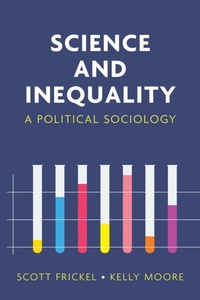
Science and Inequality
A Political Sociology
1st Edition
Published on 27. June 2025
Book
Hardback
184 pages
978-1-5095-1479-3 (ISBN)
Description
Science and technology produce a wide range of benefits in society but they also create harm, both of which are unequally distributed across social groups and geographic regions. This incisive book provides a set of analytical tools to understand how inequality relating to science and technology is produced, and how the field can be reorganized to make good on its promise to improve life for all.
Using a range of evidence and examples, Frickel and Moore show that science and technology are closely bound up with social inequalities, including linked problems of poor health, environmental degradation, racism, and sexism. They use the frame of "scientific inequality formations" to investigate the technoscientific sources of unequal power relations in society, examining issues such as the underdevelopment of non-profitable technologies, how laws and markets direct scientific advances, and the exclusion of certain social groups from the creation of knowledge and solutions relevant to their lives. This timely book illuminates interventions that redirect science and technology toward more equitable ends with the potential to be more widely distributed, charting a path to a more just future.
Using a range of evidence and examples, Frickel and Moore show that science and technology are closely bound up with social inequalities, including linked problems of poor health, environmental degradation, racism, and sexism. They use the frame of "scientific inequality formations" to investigate the technoscientific sources of unequal power relations in society, examining issues such as the underdevelopment of non-profitable technologies, how laws and markets direct scientific advances, and the exclusion of certain social groups from the creation of knowledge and solutions relevant to their lives. This timely book illuminates interventions that redirect science and technology toward more equitable ends with the potential to be more widely distributed, charting a path to a more just future.
Reviews / Votes
"This fantastic book demonstrates how inequality is built into modern science, and why we need to take power and social structure seriously to fully understand and address it. It is essential reading for anyone who mistakenly believes that science is neutral."Shobita Parthasarathy, University of Michigan
"Accessible to students but also valuable for seasoned researchers, this landmark book provides a systematic, sociological lens for understanding how science and societal inequality shape what we know and do not know. But it is not just diagnosis: the book also offers hopeful recipes for change."
David J. Hess, Vanderbilt University
More details
Language
English
Place of publication
Oxford
United Kingdom
Publishing group
John Wiley and Sons Ltd
Target group
Professional and scholarly
Product notice
sewn/stitched
Cloth over boards
Dimensions
Height: 218 mm
Width: 142 mm
Thickness: 18 mm
Weight
340 gr
ISBN-13
978-1-5095-1479-3 (9781509514793)
Copyright in bibliographic data and cover images is held by Nielsen Book Services Limited or by the publishers or by their respective licensors: all rights reserved.
Schweitzer Classification
Other editions
Additional editions
E-Book
08/2025
1st Edition
Jossey-Bass
€16.99
Available for download
Book
06/2025
1st Edition
Polity Press
€20.00
Shipment within 15-20 days
Persons
Scott Frickel is Professor of Sociology and Environment & Society at Brown University.
Kelly Moore is Associate Professor of Sociology at Loyola University Chicago.
Kelly Moore is Associate Professor of Sociology at Loyola University Chicago.
Content
1. Science, Society, and the Paradox of Inequality
2. Profitable Knowledge
3. Absent-Minded Science
4. Challenging Scientific Inequality Formation
Provocation: Toward a Deeply Adapted Science
2. Profitable Knowledge
3. Absent-Minded Science
4. Challenging Scientific Inequality Formation
Provocation: Toward a Deeply Adapted Science