

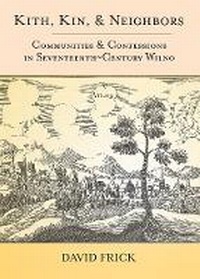
Kith, Kin, and Neighbors
Communities and Confessions in Seventeenth-Century Wilno
Published on 15. June 2013
Book
Hardback
560 pages
978-0-8014-5128-7 (ISBN)
Description
In the mid-seventeenth century, Wilno (Vilnius), the second capital of the Polish-Lithuanian Commonwealth, was home to Poles, Lithuanians, Germans, Ruthenians, Jews, and Tatars, who worshiped in Catholic, Uniate, Orthodox, Calvinist, and Lutheran churches, one synagogue, and one mosque. Visitors regularly commented on the relatively peaceful coexistence of this bewildering array of peoples, languages, and faiths. In Kith, Kin, and Neighbors, David Frick shows how Wilno's inhabitants navigated and negotiated these differences in their public and private lives.
This remarkable book opens with a walk through the streets of Wilno, offering a look over the royal quartermaster's shoulder as he made his survey of the city's intramural houses in preparation for King Wladyslaw IV's visit in 1636. These surveys (Lustrations) provide concise descriptions of each house within the city walls that, in concert with court and church records, enable Frick to accurately discern Wilno's neighborhoods and human networks, ascertain the extent to which such networks were bounded confessionally and culturally, determine when citizens crossed these boundaries, and conclude which kinds of cross-confessional constellations were more likely than others. These maps provide the backdrops against which the dramas of Wilno lives played out: birth, baptism, education, marriage, separation or divorce, guild membership, poor relief, and death and funeral practices. Perhaps the most complete reconstruction ever written of life in an early modern European city, Kith, Kin, and Neighbors sets a new standard for urban history and for work on the religious and communal life of Eastern Europe.
This remarkable book opens with a walk through the streets of Wilno, offering a look over the royal quartermaster's shoulder as he made his survey of the city's intramural houses in preparation for King Wladyslaw IV's visit in 1636. These surveys (Lustrations) provide concise descriptions of each house within the city walls that, in concert with court and church records, enable Frick to accurately discern Wilno's neighborhoods and human networks, ascertain the extent to which such networks were bounded confessionally and culturally, determine when citizens crossed these boundaries, and conclude which kinds of cross-confessional constellations were more likely than others. These maps provide the backdrops against which the dramas of Wilno lives played out: birth, baptism, education, marriage, separation or divorce, guild membership, poor relief, and death and funeral practices. Perhaps the most complete reconstruction ever written of life in an early modern European city, Kith, Kin, and Neighbors sets a new standard for urban history and for work on the religious and communal life of Eastern Europe.
Reviews / Votes
Frick's work is an inspiration and a treasury of information to any scholar dealing with almost any aspect of early-modern European history. It is exuberant in detail, yet not overburdened; such a book could have been written very differently. Frick leads the reader by the hand through the streets of a city throbbing with life, echoing to the sounds of bells from different churches and an almost Pentecostal variety of Vilnian voices. The book is an exciting time-travel guide besides its scholarly excellence.- Maria Takala-Roszczenko (The Catholic Historical Review) "The book is studded with amusing anecdotes and memorable passages... This is a multilayered 'thick description' of innumerable archival documents, not an attempt to make sweeping generalizations or provide an overview of religious history is the Grand Duchy of Lithuania. Cornell University Press also deserves praise for producing this long, complex, and fascinating book on a topic that would probably not appear to be at the height of present scholarly fashions. For anyone interested in Slavic linguistics, Polish-Lithuanian history in the modern period, or urban history in east central Europe, Kith, Kin, and Neighbors is a must-read, while the rich material and lively writing will captivate historians, linguists, and Slavists of any period." -Theodore R. Weeks, Southern Illinois University, Carbondale, Slavic Review
This remarkable volume spreads before the reader one of the most detailed pictures of social, cultural, and religious life in an early modern European town that I have ever seen. Since the town in question is Wilno (called Vilnius by Lithuanians and Vilna by Russians and Jews), capital of the Grand Duchy of Lithuania, which was one of the constituent parts of the Polish-Lithuanian Commonwealth, the picture is a complex one. It combines in a fascinating blend much that is familiar from other parts of Europe with the features specific to Eastern Europe....The book's great success is in capturing the immediacy of Wilno's multiconfessionality through the intensive use of personal stories. The reader can thus get to know at least some of seventeenth-century Wilno's population by name, to recognize the prominent families, and often to see the same people in action in a range of different settings. The author's close attention to the source material also permits him to examine the full range of social structures and relations that made up early modern urban life without ignoring the frictions and tensions they inevitably caused. This is social history at its best[.].
- Adam Teller, (The Journal of Modern History)
More details
Language
English
Place of publication
Ithaca
United States
Target group
College/higher education
Product notice
Paper over boards
Illustrations
7 halftones, 1 table, 13 maps, 4 line drawings - 7 Halftones, black and white - 4 Tables, unspecified - 3 Charts
Dimensions
Height: 238 mm
Width: 168 mm
Thickness: 37 mm
Weight
1361 gr
ISBN-13
978-0-8014-5128-7 (9780801451287)
Copyright in bibliographic data and cover images is held by Nielsen Book Services Limited or by the publishers or by their respective licensors: all rights reserved.
Schweitzer Classification
Other editions
Additional editions
E-Book
06/2013
Cornell University Press
€64.99
Available for download
Person
David Frick is Professor of Slavic Languages and Literatures at the University of California, Berkeley. He is the author of Polish Sacred Philology in the Reformation and the Counter-Reformation: Chapters in the History of the Controversies (1551-1632) and Meletij Smotryc'kyj.
Content
Introduction1. Over the Quartermaster's Shoulder2. The Neighbors3. One Roof, Four Walls4. The Bells of Wilno5. Stereotyping, Writing, Speaking6. Birth, Baptism, Godparenting7. Education and Apprenticeship8. Courtship and Marriage9. Marital Discontents10. Guild House, Workshop, Brotherhood Altar11. Going to Law: The Language of Litigation12. War, Occupation, Exile, Liberation (1655-1661)13. Old Age and Poor Relief14. Death in WilnoEpilogue: Conflict and CoexistenceAppendix A: Selected Streets and Areas Treated in the TextAppendix B: Genealogical TablesAbbreviations
Notes
Works Cited
Index
Notes
Works Cited
Index