

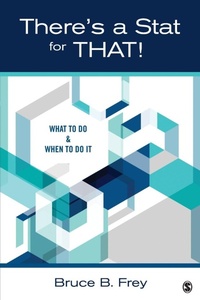
There's a Stat for That!
What to Do & When to Do it
1st Edition
Published on 4. June 2015
Book
Paperback/Softback
120 pages
978-1-4833-1875-2 (ISBN)
Description
Bruce Frey's There's a Stat for That! is a brief, straightforward, and to-the-point guide to deciding which statistical analysis to use and when to use it. Designed for consultants, researchers, students, and those who already have the resources to tell them how to perform the analyses, this text explains why a particular statistical approach is the right one to use. The book affirms that regardless of the group design, once the variables are chosen and the measurement strategy is worked out, one can rest assured that there is a stat for that!
Reviews / Votes
[...T]his is a book that students will keep for their entire career. It will be handy year after year as they are designing and conducting research. It will help them to design studies that answer their exact research hypothesis, rather than designing studies around the techniques they know how to use. -- Joe Benz, University of Neraska Kearney Clear writing style, nice tables and charts, and good references to journal articles for each statistic make this valuable for reviewing statistics and for helping decide which statistic to use in a research situation. -- Dr. T. John Alexander, Texas Wesleyan University The consistency of the visual presentation of the topics is very clear and helpful. Things to consider is more simple and easy to understand and use than any other supplemental books I have used. -- Yeonsoo Kim, University of Nevada, Las Vegas Short, concise treatment of topics is a notable strength of this book. Each test is boiled down to its basics, giving a precise and 'in the nutshell' reference that students are likely to find straightforward and helpful. -- Nicole McDonald, Cornerstone UniversityMore details
Language
English
Place of publication
Thousand Oaks
United States
Target group
College/higher education
Dimensions
Height: 229 mm
Width: 152 mm
Thickness: 7 mm
Weight
187 gr
ISBN-13
978-1-4833-1875-2 (9781483318752)
Copyright in bibliographic data and cover images is held by Nielsen Book Services Limited or by the publishers or by their respective licensors: all rights reserved.
Schweitzer Classification
Person
Bruce B. Frey, PhD, is an award-winning researcher, author, teacher, and professor of educational psychology at the University of Kansas. He is the editor of The SAGE Encyclopedia of Educational Research, Measurement and Evaluation and the SAGE Encyclopedia of Educational Design. In addition to being the lead author for The Statistics for People Who (Think They) Hate Statistics series, his books for Sage include There's a Stat for That!, and 100 Questions (and Answers) About Tests and Measurement. He also wrote Statistics Hacks for O'Reilly Media. In his spare time, Bruce leads a secret life as Professor Bubblegum, host of a YouTube channel and Echo Valley, a podcast that celebrates bubblegum pop music of the late 1960s. The show is wildly popular with the young people.
Content
There's a Stat for That!
Preface
Acknowledgments
About the Author
The Basics
PART 1. FREQUENCY ANALYSIS
Module 1. Binomial Test
Module 2. Chi-Squared
Module 3. Kolmogorov-Smirnov Test
Module 4. Single-Sample t Test
Module 5. Fisher Exact Test
Module 6. Two-Way Chi-Squared
PART 2. GROUP COMPARISONS
Module 7. Mann-Whitney Test
Module 8. Independent t Test
Module 9. Median Test
Module 10. Kruskal-Wallis Test
Module 11. Analysis of Variance
Module 12. Two-Way Analysis of Variance
Module 13. aAalysis of Covariance
Module 14. Multivariate Analysis of Variance
PART 3. REPEATED MEASURES OF ANALYSES
Module 15. McNemar Change Test
Module 16. Wilcoxon Signed Ranks Test
Module 17. Paired-Samples t Test
Module 18. Cochran Q Test
Module 19. Friedman Test
Module 20. Repeated Measures Analysis of Variance
Module 21. Two-Way Repeated Measures
Module 22. Mixed Analysis of Variance
Module 23. Time Series Analysis
PART 4. CORRELATIONAL ANALYSES
Module 24. Kappa Coefficient of Agreement
Module 25. Spearman Correlation Coefficient
Module 26. Phi Correlation Coefficient
Module 27. Cramer's V Coefficient
Module 28. Simple Logistic Regression
Module 29. Multiple Logistic Regression
Module 30. Discriminant Analysis
Module 31. Pearson Correlation Coefficient
Module 32. Simple Linear Regression
Module 33. Multiple Linear Regression
Module 34. Canonical Correlation
Module 35. Exploratory Factor Analysis
Module 36. Confirmatory Factor Analysis
Module 37. Cluster Analysis
Module 38. Path Analysis
Module 39. Structural Equation Modeling
Module 40. Hierarchical Linear Modeling
Index
Preface
Acknowledgments
About the Author
The Basics
PART 1. FREQUENCY ANALYSIS
Module 1. Binomial Test
Module 2. Chi-Squared
Module 3. Kolmogorov-Smirnov Test
Module 4. Single-Sample t Test
Module 5. Fisher Exact Test
Module 6. Two-Way Chi-Squared
PART 2. GROUP COMPARISONS
Module 7. Mann-Whitney Test
Module 8. Independent t Test
Module 9. Median Test
Module 10. Kruskal-Wallis Test
Module 11. Analysis of Variance
Module 12. Two-Way Analysis of Variance
Module 13. aAalysis of Covariance
Module 14. Multivariate Analysis of Variance
PART 3. REPEATED MEASURES OF ANALYSES
Module 15. McNemar Change Test
Module 16. Wilcoxon Signed Ranks Test
Module 17. Paired-Samples t Test
Module 18. Cochran Q Test
Module 19. Friedman Test
Module 20. Repeated Measures Analysis of Variance
Module 21. Two-Way Repeated Measures
Module 22. Mixed Analysis of Variance
Module 23. Time Series Analysis
PART 4. CORRELATIONAL ANALYSES
Module 24. Kappa Coefficient of Agreement
Module 25. Spearman Correlation Coefficient
Module 26. Phi Correlation Coefficient
Module 27. Cramer's V Coefficient
Module 28. Simple Logistic Regression
Module 29. Multiple Logistic Regression
Module 30. Discriminant Analysis
Module 31. Pearson Correlation Coefficient
Module 32. Simple Linear Regression
Module 33. Multiple Linear Regression
Module 34. Canonical Correlation
Module 35. Exploratory Factor Analysis
Module 36. Confirmatory Factor Analysis
Module 37. Cluster Analysis
Module 38. Path Analysis
Module 39. Structural Equation Modeling
Module 40. Hierarchical Linear Modeling
Index