

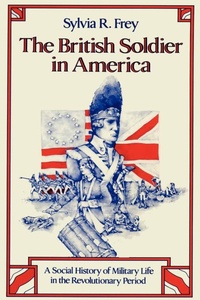
The British Soldier in America
A Social History of Military Life in the Revolutionary Period
Published on 1. June 1981
Book
Paperback/Softback
224 pages
978-0-292-74092-1 (ISBN)
Description
In her investigation of the social history of the common British soldier in the era of the American Revolution, Sylvia Frey has extensively surveyed recruiting records, contemporary training manuals, statutes, and memoirs in an attempt to provide insight into the soldier's "life and mind." In the process she has discovered more about the common soldier than anyone thought possible: his social origins and occupational background, his size, age, and general physical condition, his personal economics and daily existence. Her findings dispel the traditional assumption that the army was made up largely of criminals and social misfits.
Special attention is given to soldiering as an occupation. Focusing on two of the major campaigns of the war-the Northern Campaign which culminated at Saratoga and the Southern Campaign which ended at Yorktown-Frey describes the human face of war, with particular emphasis on the physical and psychic strains of campaigning in the eighteenth century.
Perhaps the most important part of the work is the analysis of the moral and material factors which induced men to accept the high risks of soldiering. Frey rejects the traditional assumption that soldiers were motivated to fight exclusively by fear and force and argues instead that the primary motivation to battle was generated by regimental esprit, which in the eighteenth century substituted for patriotism. After analyzing the sources of esprit, she concludes that it was the sustaining force for morale in a long and discouraging war.
This book is a contribution to our understanding of the eighteenth century and should appeal not only to military historians but also to social and economic historians and to those interested in the history of medicine.
Special attention is given to soldiering as an occupation. Focusing on two of the major campaigns of the war-the Northern Campaign which culminated at Saratoga and the Southern Campaign which ended at Yorktown-Frey describes the human face of war, with particular emphasis on the physical and psychic strains of campaigning in the eighteenth century.
Perhaps the most important part of the work is the analysis of the moral and material factors which induced men to accept the high risks of soldiering. Frey rejects the traditional assumption that soldiers were motivated to fight exclusively by fear and force and argues instead that the primary motivation to battle was generated by regimental esprit, which in the eighteenth century substituted for patriotism. After analyzing the sources of esprit, she concludes that it was the sustaining force for morale in a long and discouraging war.
This book is a contribution to our understanding of the eighteenth century and should appeal not only to military historians but also to social and economic historians and to those interested in the history of medicine.
More details
Language
English
Place of publication
Austin, TX
United States
Dimensions
Height: 229 mm
Width: 152 mm
Thickness: 13 mm
Weight
371 gr
ISBN-13
978-0-292-74092-1 (9780292740921)
Copyright in bibliographic data and cover images is held by Nielsen Book Services Limited or by the publishers or by their respective licensors: all rights reserved.
Schweitzer Classification
Other editions
Additional editions
Sylvia R. Frey
The British Soldier in America
A Social History of Military Life in the Revolutionary Period
E-Book
11/2012
1st Edition
University of Texas Press
from
€32.99
Available for download
Person
Sylvia Frey is Professor Emerita of History at Tulane University.
Content
Acknowledgments
Introduction
1. Volunteers and Conscripts
2. Diseases and Doctors
3. Rewards and Recreation
4. Crimes and Courts
5. Training and Campaigning
6. Bonds and Banners
Conclusion
Appendix. Parliamentary Debate on Responsibility for the British Loss in America
Notes
Abbreviations Used in Notes
Bibliography
Index
Introduction
1. Volunteers and Conscripts
2. Diseases and Doctors
3. Rewards and Recreation
4. Crimes and Courts
5. Training and Campaigning
6. Bonds and Banners
Conclusion
Appendix. Parliamentary Debate on Responsibility for the British Loss in America
Notes
Abbreviations Used in Notes
Bibliography
Index