

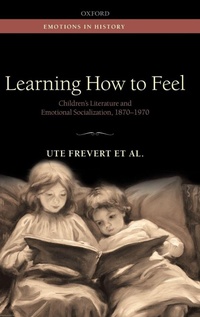
Learning How to Feel
Children's Literature and Emotional Socialization, 1870-1970
Published on 24. July 2014
Book
Hardback
322 pages
978-0-19-968499-1 (ISBN)
Description
Learning How to Feel explores the ways in which children and adolescents learn not just how to express emotions that are thought to be pre-existing, but actually how to feel. The volume assumes that the embryonic ability to feel unfolds through a complex dialogue with the social and cultural environment and specifically through reading material. The fundamental formation takes place in childhood and youth. A multi-authored historical monograph, Learning How to Feel uses children's literature and advice manuals to access the training practices and learning processes for a wide range of emotions in the modern age, circa 1870-1970. The study takes an international approach, covering a broad array of social, cultural, and political milieus in Britain, Germany, India, Russia, France, Canada, and the United States.
Learning How to Feel places multidirectional learning processes at the centre of the discussion, through the concept of practical knowledge. The book innovatively draws a framework for broad historical change during the course of the period. Emotional interaction between adult and child gave way to a focus on emotional interactions among children, while gender categories became less distinct. Children were increasingly taught to take responsibility for their own emotional development, to find 'authenticity' for themselves. In the context of changing social, political, cultural, and gender agendas, the building of nations, subjects and citizens, and the forging of moral and religious values, Learning How to Feel demonstrates how children were provided with emotional learning tools through their reading matter to navigate their emotional lives.
Learning How to Feel places multidirectional learning processes at the centre of the discussion, through the concept of practical knowledge. The book innovatively draws a framework for broad historical change during the course of the period. Emotional interaction between adult and child gave way to a focus on emotional interactions among children, while gender categories became less distinct. Children were increasingly taught to take responsibility for their own emotional development, to find 'authenticity' for themselves. In the context of changing social, political, cultural, and gender agendas, the building of nations, subjects and citizens, and the forging of moral and religious values, Learning How to Feel demonstrates how children were provided with emotional learning tools through their reading matter to navigate their emotional lives.
Reviews / Votes
this [is] an example of rigorous collaborative work ... It is impossible, in the limited space of this review, to do justice to each article individually ... [this book] sets an enticing research agenda for the burgeoning subfield of the history of emotions. * Thomas Dodman, Journal of Social History * an admirable approach to writing histories collaboratively, resulting in an unusually tightly focused set of sociological questions and six shared conclusions ... The book thus suggests important questions for future research into the roles of authors, publishers and readers in effecting not just emotional change, but also generationally specific social and political transformations, through the emotional experience of childhood. * Sian Pooley, English Historical Review *More details
Series
Language
English
Place of publication
Oxford
United Kingdom
Target group
College/higher education
Professional and scholarly
Illustrations
20 black and white images
Dimensions
Height: 240 mm
Width: 161 mm
Thickness: 22 mm
Weight
649 gr
ISBN-13
978-0-19-968499-1 (9780199684991)
Copyright in bibliographic data and cover images is held by Nielsen Book Services Limited or by the publishers or by their respective licensors: all rights reserved.
Schweitzer Classification
Other editions
Additional editions
Ute Frevert | Bettina Hitzer | Jan Plamper
Learning How to Feel
Children's Literature and Emotional Socialization, 1870-1970
E-Book
07/2014
1st Edition
OUP eBook
€70.99
Available for download
Persons
Ute Frevert is Director at the Max Planck Institute for Human Development and a Scientific Member of the Max Planck Society. From 2003 to 2007 she was professor of German history at Yale University and previously taught History at the Universities of Konstanz, Bielefeld and the Free University in Berlin. Her research interests include the social and cultural history of the modern period, the history of emotions, gender history and political history. Some of her best known work has examined the history of women and gender relations in modern Germany, social and medical politics in the nineteenth century, and the impact of military conscription from 1814 to the present day. Ute Frevert is an honorary professor at the Free University in Berlin and member of several scientific advisory boards. In 1998 she was awarded the prestigious Leibniz Prize.
Author
DirectorDirector, Max Planck Institute for Human Development
ResearcherResearcher, Max Planck Institute for Human Development
Postdoctoral FellowPostdoctoral Fellow, Max Planck Institute for Human Development
ResearcherResearcher, Max Planck Institute for Human Development
Senior ResearcherSenior Researcher, Max Planck Institute for Human Development
Assistant Professor of HistoryAssistant Professor of History, Beloit College
Postdoctoral FellowPostdoctoral Fellow, Max Planck Institute for Human Development
ResearcherResearcher, Max Planck Institute for Human Development
ResearcherResearcher, Max Planck Institute for Human Development
ResearcherResearcher, Max Planck Institute for Human Development
Content
Introduction ; 1. Mrs Gaskell's Anxiety ; 2. Dickon's Trust ; 3. Ashgari's Piety ; 4. Ralph's Compassion ; 5. Doctor Dolittle's Empathy ; 6. Wendy's Love ; 7. Piggy's Shame ; 8. Lebrac's Pain ; 9. Jim Button's Fear ; 10. Ivan's Bravery ; 11. Heidi's Homesickness ; 12. Ingrid's Boredom ; Epilogue: Translating Books, Translating Emotions