

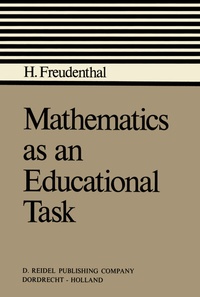
Mathematics as an Educational Task
Published on 31. December 1972
Book
Paperback/Softback
XII, 680 pages
978-90-277-0322-4 (ISBN)
Description
Like preludes, prefaces are usually composed last. Putting them in the front of the book is a feeble reflection of what, in the style of mathe matics treatises and textbooks, I usually call thf didactical inversion: to be fit to print, the way to the result should be the inverse of the order in which it was found; in particular the key definitions, which were the finishing touch to the structure, are put at the front. For many years I have contrasted the didactical inversion with the thought-experiment. It is true that you should not communicate your mathematics to other people in the way it occurred to you, but rather as it could have occurred to you if you had known then what you know now, and as it would occur to the student if his learning process is being guided. This in fact is the gist of the lesson Socrates taught Meno's slave. The thought-experi ment tries to find out how a student could re-invent what he is expected to learn. I said about the preface that it is a feeble reflection of the didactical inversion. Indeed, it is not a constituent part of the book. It can even be torn out. Yet it is useful. Firstly, to the reviewer who then need not read the whole work, and secondly to the author himself, who like the composer gets an opportunity to review the Leitmotivs of the book.
More details
Edition
1973
Language
English
Place of publication
Dordrecht
Netherlands
Publishing group
Springer
Target group
Professional and scholarly
Research
Illustrations
XII, 680 p.
Dimensions
Height: 235 mm
Width: 155 mm
Thickness: 38 mm
Weight
1036 gr
ISBN-13
978-90-277-0322-4 (9789027703224)
DOI
10.1007/978-94-010-2903-2
Schweitzer Classification
Other editions
Additional editions
Hans Freudenthal
Mathematics as an Educational Task
Book
12/1972
1st Edition
Kluwer Academic Publishers
€320.99
Shipment within 15-20 days
Content
I. The Mathematical Tradition.- II. Mathematics Today.- III. Tradition and Education.- IV. Use and Aim of Mathematics Instruction.- V. The Socratic Method.- VI. Re-invention.- VII. Organization of a Field by Mathematizing.- VIII. Mathematical Rigour.- IX. Instruction.- X. The Mathematics Teacher.- XI. The Number Concept - Objective Accesses.- XII. Developing the Number Concept from Intuitive Methods to Algorithmizing and Rationalizing.- XIII. Development of the Number Concept - The Algebraic Method.- XIV. Development of the Number Concept - From the Algebraic Principle to the Global Organization of Algebra.- XV. Sets and Functions.- XVI. The Case of Geometry.- XVII. Analysis.- XVIII. Probability and Statistics.- XIX. Logic.- Appendix I. Piaget and the Piaget School's Investigations on the Development of Mathematical Notions.- Appendix II. Papers of the Author on Mathematical Instruction.