

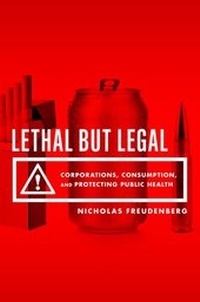
Lethal But Legal
Corporations, Consumption, and Protecting Public Health
Published on 7. April 2016
Book
Paperback/Softback
360 pages
978-0-19-049537-4 (ISBN)
Description
Decisions made by the food, tobacco, alcohol, pharmaceutical, gun, and automobile industries have a greater impact on today's health than the decisions of scientists and policymakers. As the collective influence of corporations has grown, governments around the world have stepped back from their responsibility to protect public health by privatizing key services, weakening regulations, and cutting funding for consumer and environmental protection. Today's corporations are increasingly free to make decisions that benefit their bottom line at the expense of public health.
Lethal but Legal examines how corporations have impacted -- and plagued -- public health over the last century, first in industrialized countries and now in developing regions. It is both a current history of corporations' antagonism towards health and an analysis of the emerging movements that are challenging these industries' dangerous practices. The reforms outlined here aim to strike a healthier balance between large companies' right to make a profit and governments' responsibility to protect their populations.
While other books have addressed parts of this story, Lethal but Legal is the first to connect the dots between unhealthy products, business-dominated politics, and the growing burdens of disease and health care costs. By identifying the common causes of all these problems, then situating them in the context of other health challenges that societies have overcome in the past, this book provides readers with the insights they need to take practical and effective action to restore consumers' right to health.
Lethal but Legal examines how corporations have impacted -- and plagued -- public health over the last century, first in industrialized countries and now in developing regions. It is both a current history of corporations' antagonism towards health and an analysis of the emerging movements that are challenging these industries' dangerous practices. The reforms outlined here aim to strike a healthier balance between large companies' right to make a profit and governments' responsibility to protect their populations.
While other books have addressed parts of this story, Lethal but Legal is the first to connect the dots between unhealthy products, business-dominated politics, and the growing burdens of disease and health care costs. By identifying the common causes of all these problems, then situating them in the context of other health challenges that societies have overcome in the past, this book provides readers with the insights they need to take practical and effective action to restore consumers' right to health.
Reviews / Votes
Lethal But Legal has scholarly merit and marshals compelling evidence to support its central thesis. * Bonnie Stabile, George Mason University; World Medical and Health Policy * Freudenberg details how six industries * food and beverage, tobacco, alcohol, firearms, pharmaceutical, and automotiveuse pretty much the same playbook to defend the sales of health-threatening products. This playbook, largely developed by the tobacco industry, disregards human health and poses greater threats to our existence than any communicable disease you can name.New York Times * A reservoir of constructive indignation that can arouse all Americans who adhere to basic human values. * Ralph Nader * Freudenberg lays out the labyrinth of connections between corporate misbehavior and the health of the world, then and gives a roadmap to fix it. I love this book. * Cheryl G. Healton, Director, NYU Global Institute of Public Health; former President and CEO, American Legacy Foundation * After documenting how multinational corporations manipulate us into hyperconsumption, this book goes on to identify the strategies we can, together, use to liberate ourselves. * Richard Wilkinson, Emeritus Professor of Social Epidemiology, University of Nottingham * Freudenberg brings clarity to our understanding of these fundamental determinants of population health in a way that no one else has. * Sandro Galea, Dean, Boston University School of Public Health * A richly detailed account of how corporate power has been used to corrupt health and well-being, along with excellent advice on what readers can do about it. * Kirkus * An exceptionally detailed and thought-provoking historical profile of how corporations have risen to power and maintained their influence in the shaping of our societies. * The Lancet * Provides an advocate's perspective on how industry shapes health, and in Freudenberg's words, 'This is something not only to think about, but to rant about.' * Health Affairs *More details
Language
English
Place of publication
New York
United States
Dimensions
Height: 234 mm
Width: 155 mm
Thickness: 25 mm
Weight
454 gr
ISBN-13
978-0-19-049537-4 (9780190495374)
Copyright in bibliographic data and cover images is held by Nielsen Book Services Limited or by the publishers or by their respective licensors: all rights reserved.
Schweitzer Classification
Other editions
Additional editions
Book
04/2014
Oxford University Press Inc
€39.50
Shipment within 15-20 days
E-Book
01/2014
1st Edition
OUP eBook
€18.49
Available for download
E-Book
01/2014
1st Edition
OUP eBook
€18.49
Available for download
Person
Nicholas Freudenberg, PhD, MPH, is Distinguished Professor of Public Health at the City University of New York School of Public Health at Hunter College and founder and director of Corporations and Health Watch (www.corporationsandhealth.org), an international network of activists and researchers that monitors the business practices of the alcohol, automobile, firearms, food and beverage, pharmaceutical, and tobacco industries.
Content
1. Manufacturing Disease: Unhealth Products Become Ubiquitous
2. The Public Health Evidence: How Corporate Practices Contribute to Global Epidemics of Chronic Disease and Injuries
3. Corporations Take Control: A New Political and Economic Order Emerges
4. The Corporate Consumption Complex
5. The Corporate Ideology of Consumption
6. The Health Impact of Corporate Managed Globalization
7. Optimism Past, Present, and Future: The Buiding Blocks for a Movement
8. Wanted: A Movement for a Healther, More Sustainable Future
Afterword
2. The Public Health Evidence: How Corporate Practices Contribute to Global Epidemics of Chronic Disease and Injuries
3. Corporations Take Control: A New Political and Economic Order Emerges
4. The Corporate Consumption Complex
5. The Corporate Ideology of Consumption
6. The Health Impact of Corporate Managed Globalization
7. Optimism Past, Present, and Future: The Buiding Blocks for a Movement
8. Wanted: A Movement for a Healther, More Sustainable Future
Afterword