

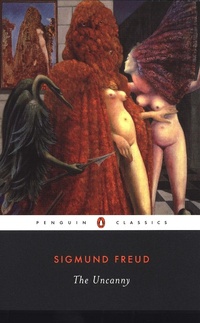
The Uncanny
Published on 30. September 2003
Book
Paperback/Softback
240 pages
978-0-14-243747-6 (ISBN)
Description
Freud was fascinated by the mysteries of creativity and the imagination. The groundbreaking works that comprise "The Uncanny" present some of his most influential explorations of the mind. In these pieces Freud investigates the vivid but seemingly trivial childhood memories that often "screen" deeply uncomfortable desires; the links between literature and daydreaming; and our intensely mixed feelings about things we experience as "uncanny." Also included is Freud's celebrated study of Leonardo Da Vinci-his first exercise in psychobiography.
More details
Language
English
Place of publication
United States
Publishing group
Penguin Putnam Inc
Product notice
Paperback (trade)
Dimensions
Height: 199 mm
Width: 131 mm
Thickness: 16 mm
Weight
195 gr
ISBN-13
978-0-14-243747-6 (9780142437476)
Copyright in bibliographic data and cover images is held by Nielsen Book Services Limited or by the publishers or by their respective licensors: all rights reserved.
Schweitzer Classification
Persons
Sigmund Freud (1856-1939) was born in Moravia and lived in Vienna between the ages of four and eighty-two. In 1938 Hitler's invasion of Austria forced him to seek asylum in London, where he died the following year. Freud's career began with several years of brilliant work on the anatomy and physiology of the nervous system. He was almost thirty when, after a period of study under Charcot in Paris, his interests first turned to psychology, and another ten years of clinical work in Vienna (at first in collaboration with Breuer, an older colleague) saw the birth of his creation: psychoanalysis. This began simply as a method of treating neurotic patients by investigating their minds, but it quickly grew into an accumulation of knowledge about the workings of the mind in general, whether sick or healthy. Freud was thus able to demonstrate the normal development of the sexual instinct in childhood and, largely on the basis of an examination of dreams, arrived at his fundamental discovery of the unconscious forces that influence our everyday thoughts and actions. Freud's life was uneventful, but his ideas have shaped not only many specialist disciplines, but the whole intellectual climate of the last half-century.