

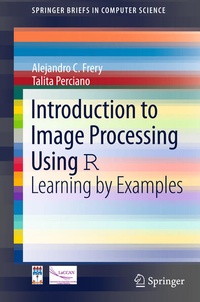
Introduction to Image Processing Using R
Learning by Examples
1st Edition
Published on 7. February 2013
Book
Paperback/Softback
XV, 87 pages
978-1-4471-4949-1 (ISBN)
Description
This book introduces the statistical software R to the image processing community in an intuitive and practical manner. R brings interesting statistical and graphical tools which are important and necessary for image processing techniques. Furthermore, it has been proved in the literature that R is among the most reliable, accurate and portable statistical software available. Both the theory and practice of R code concepts and techniques are presented and explained, and the reader is encouraged to try their own implementation to develop faster, optimized programs. Those who are new to the field of image processing and to R software will find this work a useful introduction. By reading the book alongside an active R session, the reader will experience an exciting journey of learning and programming.
Reviews / Votes
From the reviews:
"This book addresses the basic use of R for image processing . . The index is well designed and the presentation of the subject is adequate, given the short length of the chapters. Both professionals and students in image processing or statistical data analysis could use this book as a good guide to using R for image processing." (G. Albeanu, Computing Reviews, July, 2013)More details
Series
Language
English
Place of publication
London
United Kingdom
Target group
Professional and scholarly
Research
Illustrations
25 s/w Abbildungen, 17 farbige Abbildungen
XV, 87 p. 42 illus., 17 illus. in color.
Dimensions
Height: 235 mm
Width: 155 mm
Thickness: 7 mm
Weight
172 gr
ISBN-13
978-1-4471-4949-1 (9781447149491)
DOI
10.1007/978-1-4471-4950-7
Schweitzer Classification
Other editions
Additional editions
E-Book
02/2013
1st Edition
Springer
€58.84
Available for download
Persons
Content
Definitions and Notation.- Image Data Formats and Color Representation.- Reading and Writing Images with R: Generating High Quality Output.- Contrast Manipulation.- Filters in the Image Domain.- Contrast Enhancement and Dimensionality Reduction by Principal.