

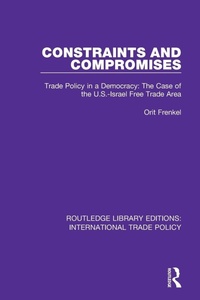
Constraints and Compromises
Trade Policy in a Democracy: The Case of the U.S.-Israel Free Trade Area
1st Edition
Published on 8. May 2019
Book
Paperback/Softback
234 pages
978-1-138-10681-9 (ISBN)
Description
The negotiation of the Free Trade Area between the US and Israel was, at the time, a remarkable political accomplishment, and is a useful case study because it includes all of the industrial and agricultural sectors, thus spanning the full spectrum of issues that would be dealt with in negotiations. In addition, it has the advantage of involving just two countries and lasting only fifteen months from start to finish, facilitating a comprehensive analysis. This book, first published in 1990, provides a valuable analysis of this vital case study of an FTA from commencement to completion.
More details
Series
Language
English
Place of publication
London
United Kingdom
Publishing group
Taylor & Francis Ltd
Target group
College/higher education
Dimensions
Height: 234 mm
Width: 156 mm
Thickness: 13 mm
Weight
365 gr
ISBN-13
978-1-138-10681-9 (9781138106819)
Copyright in bibliographic data and cover images is held by Nielsen Book Services Limited or by the publishers or by their respective licensors: all rights reserved.
Schweitzer Classification
Other editions
Additional editions
Orit Frenkel
Constraints and Compromises
Trade Policy in a Democracy: The Case of the U.S.-Israel Free Trade Area
Book
10/2017
1st Edition
Routledge
€119.03
Shipment within 10-20 days
Orit Frenkel
Constraints and Compromises
Trade Policy in a Democracy: The Case of the U.S.-Israel Free Trade Area
E-Book
10/2017
Routledge
€31.49
Available for download
Orit Frenkel
Constraints and Compromises
Trade Policy in a Democracy: The Case of the U.S.-Israel Free Trade Area
E-Book
10/2017
Routledge
€31.49
Available for download
Person
Orit Frenkel
Content
1. Introduction 2. Literature Review and Theoretical Framework 2.1. Economic Theory and the Determinants of Protection 2.2. Industry Differences in Obtaining Protection 2.3. Industry Differences in Trade Negotiations 2.4. The Role of Politics in Trade Policy Formation 2.5. Developing a Framework 3. Economic Framework of the FTA 3.1. Trade Overview 3.2. The Free Trade Area Agreement 3.3. Analysing the Effect of the US-Israel FTA 4. The Trade Policy Process 4.1. The Partnership Between Congress and the Executive Branch in the Trade Policy Process 4.2. The Decision to Negotiate a Free Trade Area 4.3. The Role of Congress in the US-Israel FTA 4.4. The ITC Report 4.5. The Role of Pressure Groups 5. The US-Israel Free Trade Area: The Negotiation Process 5.1. Initial Objectives and Opening Moves 5.2. The Negotiation Process and Subsequent Moves 6. Empirical Analysis 6.1. The Model and the Hypothesis 6.2. The Variables and their Expected Signs 6.3. Empirical Results 7. Summary and Conclusions