

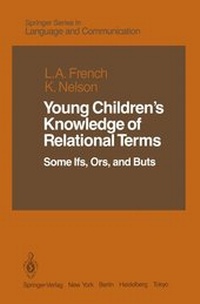
Young Children's Knowledge of Relational Terms
Some Ifs, Ors, and Buts
Published on 25. October 1985
Book
Hardback
130 pages
978-0-387-96164-4 (ISBN)
Description
An appreciation of temporal and logical relationships is one of the essential and defining features of human cognition. A central question in developmental psy chology, and in the philosophical speculations out of which psychology evolved, has been how children come to understand temporal and logical relationships. For many recent investigators, this question has been translated into empiri cal studies of children's acquisition of relational terms-words such as before, after, because, so, if, but, and or that permit the linguistic expression of logi cal relationships. In the mid 1970s, Katherine Nelson began to study young children's knowledge about routine activities in which they participated. The goal of this research was to understand how children represented their personal experiences and how these representations contributed to further cognitive development. A primary method used in the early phases of this research involved simply asking children to describe familiar events. They were asked, for example, "What happens when you have lunch at school?" or "What happens at a birthday party?" Hundreds of transcripts of children's responses to such questions were available when Lucia French became an NICHD Postdoctoral Fellow in Developmental Psychology at City University of New York in 1979.
More details
Other editions
Additional editions
Lucia A. French | Katherine Nelson
Young Children's Knowledge of Relational Terms
Some Ifs, Ors, and Buts
Book
11/2011
Springer
€53.49
Shipment within 7-9 days
Content
1 Introduction.- 2 The Temporal Structure of Event Descriptions.- 3 The Use of Temporal Terms.- 4 Using If, Because, and So to Indicate Causal Relationships.- 5 Some Ors and Buts.- 6 Conclusion.- References.- Appendices.- Author Index.