

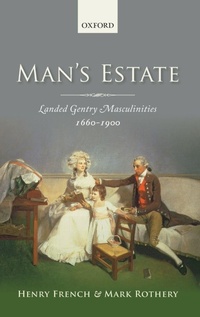
Man's Estate
Landed Gentry Masculinities, 1660-1900
Published on 23. February 2012
Book
Hardback
292 pages
978-0-19-957669-2 (ISBN)
Description
Masculinity is an expanding area of gender history. Man's Estate is the first book to focus on a particular social group, the English landed gentry, and to cover a time span of several hundred years. The authors move beyond the study of printed conduct literature, which dominated earlier accounts, by examining the values expressed in family correspondence in order to get closer to social practices. Letters between parents, children, siblings, and other relatives reveal the ways in which masculine norms were produced through everyday interactions and judgements, and help to reconstruct the subjective experiences of elite masculinity in this period. Man's Estate concentrates on four important periods in the life-course for the reproduction of these masculine values: schooling, university, foreign travel, and marriage and family life. These illustrate that there is only limited evidence of sharp-edged differences in values between generations in these families, and that these changes appear not to correspond to the deep 'hegemonic shifts' so often emphasized in existing accounts.
French and Rothery suggest that the fundamental distributions of power and authority within Gentry families remained fairly constant. Conventional ideas of male honour, virtue, reputation, and autonomy were remarkably tenacious, and the continued stress on family heritage, dynastic traditions, and the future security of the family patrimony acted as a brake on changes in the training of young English gentlemen.
The research is based on over 4,000 letters drawn from 19 landed families across England between c. 1680 and c. 1900, and is the result of a three-year research project funded by the Arts and Humanities Research Council.
French and Rothery suggest that the fundamental distributions of power and authority within Gentry families remained fairly constant. Conventional ideas of male honour, virtue, reputation, and autonomy were remarkably tenacious, and the continued stress on family heritage, dynastic traditions, and the future security of the family patrimony acted as a brake on changes in the training of young English gentlemen.
The research is based on over 4,000 letters drawn from 19 landed families across England between c. 1680 and c. 1900, and is the result of a three-year research project funded by the Arts and Humanities Research Council.
Reviews / Votes
this well-organised monograph will surely suggest promising topics for future research on northern gentry. * Northern History * raises important questions about how one thinks about periodization that will preoccupy historians of gender for some time to come. * Ben Griffin, English Historical Review * Harry French and Mark Rothery's book is a very welcome intervention in the rapidly advancing history of masculinity, providing a valuable empirical account of gentry masculine identity. * Continuity and Change * The authors have done students of gender and masculinity a great service in uncovering this material and presenting it, with care and sensitivity, for the first time. Such a thoroughgoing study of English landed gentlemen has not existed before. * Karen Harvey, H-Net * Henry French and Mark Rothery ambitiously undertake to bring clarity to what is a still rather muddled history of men and manhood. They succeed admirably. * James Rosenheim, American Historical Review *More details
Language
English
Place of publication
Oxford
United Kingdom
Target group
College/higher education
Illustrations
black and white images
Dimensions
Height: 240 mm
Width: 161 mm
Thickness: 20 mm
Weight
605 gr
ISBN-13
978-0-19-957669-2 (9780199576692)
Copyright in bibliographic data and cover images is held by Nielsen Book Services Limited or by the publishers or by their respective licensors: all rights reserved.
Schweitzer Classification
Persons
Henry French studied for his first degree and doctorate at the University of Cambridge. After temporary appointments at the Universities of Central Lancashire, Manchester, Essex, and East Anglia, he was appointed at Exeter in 2001. His first book focused on the definition and social identity of the 'middle sort of people' within rural society in the seventeenth century. Having worked on two research projects with Prof. Richard Hoyle at the University of Central Lancashire, he is co-author of a monograph study of land ownership in the Essex village of Earls Coln.
Mark Rothery studied for his MA and PhD degrees at the University of Exeter between 2000 and 2005. This was followed by a postdoctoral research fellowship (The Postan Fellowship) funded by the Economic History Society, based at the Cambridge Group for the Study of Population and Social Structure. In 2007, he was appointed Associate Research Fellow on a British Academy small grant project and a 3-year AHRC research project at University of Exeter, both of which were focused on the masculine identities of the landed gentry. He was appointed postdoctoral research assistant on the project 'Consumption and the country house' at University of Northampton with Professor Jon Stobart in April 2010.
Mark Rothery studied for his MA and PhD degrees at the University of Exeter between 2000 and 2005. This was followed by a postdoctoral research fellowship (The Postan Fellowship) funded by the Economic History Society, based at the Cambridge Group for the Study of Population and Social Structure. In 2007, he was appointed Associate Research Fellow on a British Academy small grant project and a 3-year AHRC research project at University of Exeter, both of which were focused on the masculine identities of the landed gentry. He was appointed postdoctoral research assistant on the project 'Consumption and the country house' at University of Northampton with Professor Jon Stobart in April 2010.
Content
Introduction: The Landed Elite and Male Gender Identities over the Longue Duree ; 1. The World of Learning: Schooling and Training Academies ; 2. Entering into the World: University and Apprenticeships ; 3. Seeing the World: The Grand Tour and Other Travels ; 4. Settled in the World: Marriage, Fatherhood, and the Reproduction of Male Identities ; Conclusion: Normative Reproduction and Change over Time ; Bibliography