

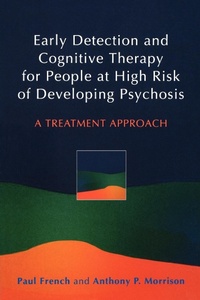
Early Detection and Cognitive Therapy for People at High Risk of Developing Psychosis
A Treatment Approach
1st Edition
Published on 10. February 2004
Book
Paperback/Softback
176 pages
978-0-470-86315-2 (ISBN)
Description
Written with clinicians in mind, this book demonstrates the use of Cognitive Behavior Therapy with individuals who are at risk of developing psychosis. Divided into three parts, the book opens with the background to the clinical trial including the rationale for the early intervention strategy, assessment strategies to identify "at risk" groups, and a review of prevention strategies. In Part II the focus is on the application of cognitive therapy for this group. Part III examines strategies for change, as well as specific issues including social isolation and relapse prevention.
Reviews / Votes
"...an easy to read guide..." (Behavioural & Cognitive Psychology, Vol. 33 2005) "...well researched, well written and easily understood...of interest to all who work with high-risk adolescents and young adults..." (Intl Jnl of Clinical Practice, June 2004)"...extremely interesting and highly readable..." (Mental Health Today, September 2004)
"Strong stuff...[the authors] offer some well-researched loyalty truths" (Daily Telegraph, 22nd November 2005)
"...an excellent introduction...illuminating but concise..." (BACP, December 2005)
More details
Language
English
Place of publication
New York
United States
Target group
Professional and scholarly
Product notice
Paperback (trade)
Unsewn / adhesive bound
Dimensions
Height: 229 mm
Width: 152 mm
Thickness: 9 mm
Weight
251 gr
ISBN-13
978-0-470-86315-2 (9780470863152)
Copyright in bibliographic data and cover images is held by Nielsen Book Services Limited or by the publishers or by their respective licensors: all rights reserved.
Schweitzer Classification
Other editions
Additional editions
Paul French | Anthony P. Morrison
Early Detection and Cognitive Therapy for People at High Risk of Developing Psychosis
A Treatment Approach
E-Book
03/2004
1st Edition
Wiley
€48.99
Available for download
Paul French | Anthony P. Morrison
Early Detection and Cognitive Therapy for People at High Risk of Developing Psychosis
A Treatment Approach
Book
02/2004
Wiley
€103.06
Article exhausted; check different version
Persons
Paul French is co-ordinator of a specialist clinical team based at Bolton, Salford & Trafford Mental Health Trust offering cognitive interventions for people who are considered at high risk of developing psychosis. He has worked in mental health since 1989 and has always been interested in the provision of services for people with psychosis having worked in a variety of inpatient and community settings. More recently, he has developed a research interest in working with people at high risk of developing psychosis.Hehas published a number of articles relating to early psychosis and particularly the provision of psychological interventions in early psychosis. Anthony P. Morrison is a reader in psychology at the University of Manchester and is also programme co-ordinator for a specialist programme of care for people with early psychosis in Bolton, Salford & Trafford Mental Health Trust. He has published a number of articles on cognitive therapy for psychosis and experimental studies of cognitive processes in psychosis. He has been involved in a number of treatment trials for cognitive therapy for psychosis and has a special interest in the cognitive theory of and therapy for hearing voices. More recently, he has developed a research interest in working with people at high risk of developing psychosis and the links between trauma and psychosis. He was awarded the May Davidson Award 2002 for his contributions to clinical psychology.
Content
List of Figures and Appendices vii
About the Authors ix
Foreword by Max Birchwood xi
Introduction xiii
Acknowledgements xvii
Part I: Background 1
1 The Importance of Early Recognition 3
2 How to Identify At-Risk Groups 9
3 Which Prevention Strategy to Adopt 23
Part II: Cognitive Therapy for Prevention of Psychosis 27
4 Why Cognitive Therapy? 29
5 Engagement 37
6 Theory, Assessment and Formulation 45
Part III: Change Strategies 55
7 Normalisation 57
8 Generating and Evaluating Alternative Explanations 65
9 Safety Behaviours 75
10 Metacognitive Beliefs 87
11 'I Am Different' and Other Core Beliefs 93
12 Social Isolation 101
13 Relapse Prevention 111
14 Conclusions 117
Appendices 121
References 135
Index 143
About the Authors ix
Foreword by Max Birchwood xi
Introduction xiii
Acknowledgements xvii
Part I: Background 1
1 The Importance of Early Recognition 3
2 How to Identify At-Risk Groups 9
3 Which Prevention Strategy to Adopt 23
Part II: Cognitive Therapy for Prevention of Psychosis 27
4 Why Cognitive Therapy? 29
5 Engagement 37
6 Theory, Assessment and Formulation 45
Part III: Change Strategies 55
7 Normalisation 57
8 Generating and Evaluating Alternative Explanations 65
9 Safety Behaviours 75
10 Metacognitive Beliefs 87
11 'I Am Different' and Other Core Beliefs 93
12 Social Isolation 101
13 Relapse Prevention 111
14 Conclusions 117
Appendices 121
References 135
Index 143