

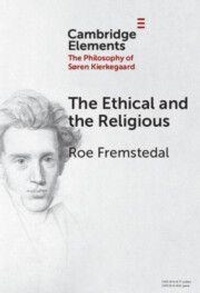
The Ethical and the Religious
Will be published approx. on 31. July 2026
Book
Hardback
75 pages
978-1-009-54758-1 (ISBN)
Description
This Element discusses the relation between the ethical and religious as key concepts in Kierkegaard's works. Instead of viewing the ethical and religious mainly as different stages on life's way, it identifies different connections between ethical and religious considerations, reasons, and values. By discussing Abraham's sacrifice of Isaac in Fear and Trembling, it argues that - despite appearances - religion does not undermine but rather supports moral constraints. However, Kierkegaard is clear that our moral requirements exceed our natural capabilities, something that makes divine assistance morally necessary. Thus, religious belief seems supported by moral reasons. Still, we often recognize moral truth without seeing the metaphysical and theological implications of morality. Therefore, moral agents need not be religious believers, although morality nevertheless has metaphysical and theological implications if Kierkegaard is correct. Specifically, Kierkegaard seems to combine realism regarding value with the view that some moral requirements are divinely commanded.
More details
Series
Language
English
Place of publication
Cambridge
United Kingdom
Target group
College/higher education
Illustrations
Worked examples or Exercises
ISBN-13
978-1-009-54758-1 (9781009547581)
Copyright in bibliographic data and cover images is held by Nielsen Book Services Limited or by the publishers or by their respective licensors: all rights reserved.
Schweitzer Classification
Person
Content
Introduction: traditional readings and contemporary debates; 1. Different stages on life's way; 2. Abraham's sacrifice of Isaac: A religious 'suspension of the ethical'?; 3. Moral demandingness and religious ethics; 4. Moral reasons for religious belief? The ethics of belief; 5. The good and the divine: metaethics, realism, and god's command; 6. Moral epistemology vs. metaphysical and theological implications; 7. Closing words; References.