

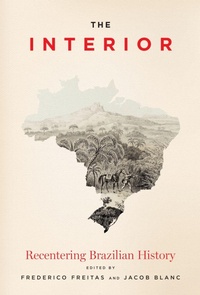
The Interior
Recentering Brazilian History
Published on 28. January 2025
Book
Hardback
328 pages
978-1-4773-3037-1 (ISBN)
Description
A new history of Brazil told through the lens of the often-overlooked interior regions.
In colonial Brazil, observers frequently complained that Portuguese settlers appeared content to remain "clinging to the coastline, like crabs." From their perspective, the vast Brazilian interior seemed like an untapped expanse waiting to be explored and colonized. This divide between a thriving coastal area and a less-developed hinterland has become deeply ingrained in the nation's collective imagination, perpetuating the notion of the interior as a homogeneous, stagnant periphery awaiting the dynamic influence of coastal Brazil.
The Interior challenges these narratives and reexamines the history of Brazil using an "interior history" perspective. This approach aims to reverse the conventional conceptual and geographical boundaries often employed to study Brazilian history, and, by extension, Latin America as a whole. Through the work of twelve leading scholars, the volume highlights how the people and spaces within the interior have played a pivotal role in shaping national identities, politics, the economy, and culture. The Interior goes beyond the traditional boundaries of borderland and frontier history, expands on the current wave of scholarship on regionalism in Brazil, and, by asking new questions about space and nation, provides a fresh perspective on Brazil's history.
In colonial Brazil, observers frequently complained that Portuguese settlers appeared content to remain "clinging to the coastline, like crabs." From their perspective, the vast Brazilian interior seemed like an untapped expanse waiting to be explored and colonized. This divide between a thriving coastal area and a less-developed hinterland has become deeply ingrained in the nation's collective imagination, perpetuating the notion of the interior as a homogeneous, stagnant periphery awaiting the dynamic influence of coastal Brazil.
The Interior challenges these narratives and reexamines the history of Brazil using an "interior history" perspective. This approach aims to reverse the conventional conceptual and geographical boundaries often employed to study Brazilian history, and, by extension, Latin America as a whole. Through the work of twelve leading scholars, the volume highlights how the people and spaces within the interior have played a pivotal role in shaping national identities, politics, the economy, and culture. The Interior goes beyond the traditional boundaries of borderland and frontier history, expands on the current wave of scholarship on regionalism in Brazil, and, by asking new questions about space and nation, provides a fresh perspective on Brazil's history.
Reviews / Votes
This volume exquisitely succeeds in presenting many fresh new lenses through which to see these concepts of the frontier in both micro and macro frames. I find this among the best volumes I've seen in some time, containing the most effective voices in Brazilian history today, both within Brazil and beyond. - Emily Wakild, Boise State University, author of Revolutionary Parks: Conservation, Social Justice, and Mexico's National Parks, 1910-1940 "Interior history" is a framework that emphasizes how noncoastal spaces have been critical to the development of Brazil in everything from politics to culture to economics. Coeditors Freitas and Blanc have cleverly positioned the volume as the opening salvo in a reexamination of national identities globally by centering the Brazilian interior and understanding its broader impact. The twelve chapters, written by a multinational group of authors, are short and well written. Together they focus on themes including real and imagined geographic scales, Indigenous worlds, human and nonhuman lives and actions, and natural and built environments. - Jeffrey Lesser, Emory University, author of Living and Dying in Sao Paulo: Immigrants, Health, and the Built Environment in BrazilMore details
Language
English
Place of publication
Austin, TX
United States
Target group
Professional and scholarly
College/higher education
Product notice
sewn/stitched
Cloth over boards
Illustrations
16 maps, 16 b&w photos
Dimensions
Height: 236 mm
Width: 163 mm
Thickness: 28 mm
Weight
598 gr
ISBN-13
978-1-4773-3037-1 (9781477330371)
Copyright in bibliographic data and cover images is held by Nielsen Book Services Limited or by the publishers or by their respective licensors: all rights reserved.
Schweitzer Classification
Persons
Frederico Freitas is an associate professor of Latin American and digital history at North Carolina State University. He is the author of Nationalizing Nature.
Jacob Blanc is an associate professor of history and international development studies at McGill University and the author of The Prestes Column: An Interior History of Brazil.
Jacob Blanc is an associate professor of history and international development studies at McGill University and the author of The Prestes Column: An Interior History of Brazil.
Content
Introduction (Frederico Freitas and Jacob Blanc)
Part I. The Knowledge Interior
Chapter 1. Indigenous Spies and Surveillance in Late Colonial Brazil (Heather F. Roller)
Chapter 2. Imagined SertOes: The Quest for Silver, Indigenous Conquest, and the Circulation of Knowledge in the Bahian Interior (Judy Bieber)
Chapter 3. The Interior as Borderlands: The Campanha at the Edge of Empire (FabrIcio Prado)
Chapter 4. SAo Paulo and Its Interior in the Eighteenth and Nineteenth Centuries (Carlos de Almeida Prado Bacellar)
Part II. The National Interior
Chapter 5. Moral Grounds: Plants and Plans for Imperial Brazil's Backlands (Seth Garfield)
Chapter 6. The Romantic SertOes (LUcia SA)
Chapter 7. Charting the Planalto Central: The Quest for a New Capital and the Opening of the Brazilian Interior in the 1890s (Frederico Freitas)
Part III. The Roving Interior
Chapter 8. The Wandering Bororo of Central Brazil in Photo Albums and the 1908 National Exhibition in Rio de Janeiro (Antonio Luigi Negro)
Chapter 9. A Cartographic Picaresque: The Prestes Column and the Symbolism of Brazil's Interior (Jacob Blanc)
Part IV. The Transformed Interior
Chapter 10. The March toward the Hinterland: The West as Geographic Fiction and the Conquering of Central Brazil (Sandro Dutra e Silva)
Chapter 11. From Boi Gordo to Biofuel: Western SAo Paulo and the Transformation of Rural Brazil (Thomas D. Rogers)
Epilogue. The Interior and the Scale of History (Susanna Hecht)
Acknowledgments
Contributors
Index
Part I. The Knowledge Interior
Chapter 1. Indigenous Spies and Surveillance in Late Colonial Brazil (Heather F. Roller)
Chapter 2. Imagined SertOes: The Quest for Silver, Indigenous Conquest, and the Circulation of Knowledge in the Bahian Interior (Judy Bieber)
Chapter 3. The Interior as Borderlands: The Campanha at the Edge of Empire (FabrIcio Prado)
Chapter 4. SAo Paulo and Its Interior in the Eighteenth and Nineteenth Centuries (Carlos de Almeida Prado Bacellar)
Part II. The National Interior
Chapter 5. Moral Grounds: Plants and Plans for Imperial Brazil's Backlands (Seth Garfield)
Chapter 6. The Romantic SertOes (LUcia SA)
Chapter 7. Charting the Planalto Central: The Quest for a New Capital and the Opening of the Brazilian Interior in the 1890s (Frederico Freitas)
Part III. The Roving Interior
Chapter 8. The Wandering Bororo of Central Brazil in Photo Albums and the 1908 National Exhibition in Rio de Janeiro (Antonio Luigi Negro)
Chapter 9. A Cartographic Picaresque: The Prestes Column and the Symbolism of Brazil's Interior (Jacob Blanc)
Part IV. The Transformed Interior
Chapter 10. The March toward the Hinterland: The West as Geographic Fiction and the Conquering of Central Brazil (Sandro Dutra e Silva)
Chapter 11. From Boi Gordo to Biofuel: Western SAo Paulo and the Transformation of Rural Brazil (Thomas D. Rogers)
Epilogue. The Interior and the Scale of History (Susanna Hecht)
Acknowledgments
Contributors
Index