

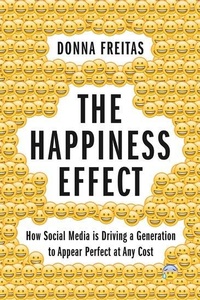
The Happiness Effect
How Social Media is Driving a Generation to Appear Perfect at Any Cost
Published on 30. March 2017
Book
Hardback
368 pages
978-0-19-023985-5 (ISBN)
Description
Sexting. Cyberbullying. Narcissism. People-and especially the media-are consumed by fears about the effect of social media on young people. We hear constantly about the dangers that lurk online, and about young people's seemingly pathological desire to share anything and everything about themselves with the entire world. Donna Freitas has traveled the country, talking to college students about what's really happening on social media. What she finds is that, while we focus on the problems that make headlines, we are ignoring the seemingly mundane, but much more widespread, problems that occur every day.
Young people, she shows, feel enormous pressure to look happy all the time-and not just basically content, but blissful, ecstatic, inspiring and successful in their personal, professional, and academic lives-regardless of how they actually feel. Of course, these young adults are not that happy, at least not all of the time, and the constant exposure to the seemingly perfect lives of other people on social media only makes them feel worse. What's more, far from wanting to share everything about themselves, they are terrified of sharing something that will come back to haunt them later in life. The rise of social media has brought about a dramatic cultural shift: the need to curate a perfect identity online that often has little to do with reality. The consequences, Freitas shows, can be very real.
Drawing on an online survey and in-person interviews with students from thirteen campuses around the U.S, Freitas offers a window into the social media generation and how they use Facebook, Snapchat, and Twitter, and other online platforms. She presents fascinating insights about how these people are consciously creating alternate identities for themselves, while also suffering from the belief that the other people they encounter online really are as perfect as their profiles appear. This is an eye-opening look at the real world of social media today.
Young people, she shows, feel enormous pressure to look happy all the time-and not just basically content, but blissful, ecstatic, inspiring and successful in their personal, professional, and academic lives-regardless of how they actually feel. Of course, these young adults are not that happy, at least not all of the time, and the constant exposure to the seemingly perfect lives of other people on social media only makes them feel worse. What's more, far from wanting to share everything about themselves, they are terrified of sharing something that will come back to haunt them later in life. The rise of social media has brought about a dramatic cultural shift: the need to curate a perfect identity online that often has little to do with reality. The consequences, Freitas shows, can be very real.
Drawing on an online survey and in-person interviews with students from thirteen campuses around the U.S, Freitas offers a window into the social media generation and how they use Facebook, Snapchat, and Twitter, and other online platforms. She presents fascinating insights about how these people are consciously creating alternate identities for themselves, while also suffering from the belief that the other people they encounter online really are as perfect as their profiles appear. This is an eye-opening look at the real world of social media today.
Reviews / Votes
She [Freitas] limits herself to a single topic -- the effect of social media on the lives of college students -- that turns out to have myriad dimensions, each of them explored in informative, artfully crafted chapters on selfies and self-image, sex and sexting, public and private identity, and more. * The Gospel Coalition * Ms. Freitas's detailed survey adds substance to her compelling thesis. Her interviews with 184 randomly selected, diverse students from 13 colleges - public and private, selective and less so - covered faith, parents, selfies, sexting and individual social-media histories... Some of her interviews contain real gems. One woman reported being so attached to her phone that, mugged for it on a bus, she pursued the muggers and to get it back gave them $150. * Laura Vanderkam, Wall Street Journal *More details
Language
English
Place of publication
New York
United States
Target group
College/higher education
Professional and scholarly
Product notice
sewn/stitched
Cloth over boards
Dimensions
Height: 244 mm
Width: 164 mm
Thickness: 35 mm
Weight
617 gr
ISBN-13
978-0-19-023985-5 (9780190239855)
Copyright in bibliographic data and cover images is held by Nielsen Book Services Limited or by the publishers or by their respective licensors: all rights reserved.
Schweitzer Classification
Other editions
Additional editions
Donna Freitas
The Happiness Effect
How Social Media is Driving a Generation to Appear Perfect at Any Cost
Book
10/2019
Oxford University Press Inc
€29.40
Available immediately
Donna Freitas
The Happiness Effect
How Social Media is Driving a Generation to Appear Perfect at Any Cost
E-Book
01/2017
1st Edition
OUP eBook
€8.49
Available for download
Donna Freitas
The Happiness Effect
How Social Media is Driving a Generation to Appear Perfect at Any Cost
E-Book
01/2017
1st Edition
OUP eBook
€8.49
Available for download
Persons
Donna Freitas is a Research Associate at the University of Notre Dame's Center for the Study of Religion and Society. A regular contributor to Publishers Weekly, she has also written for The Wall Street Journal, The New York Times, and Christianity Today.
Author
Research AssociateResearch Associate, Center for the Study of Religion and Society, University of Notre Dame
William R. Kenan, Jr. Professor of Sociology and DirectorWilliam R. Kenan, Jr. Professor of Sociology and Director, Center for the Study of Religion and Society, University of Notre Dame
Content
Introduction: Masters of Happiness1) The Importance of Being "Liked"2) The Professionalization of Facebook3) My Name is My Brand and My Brand is Happiness!4) The Selfie Generation5) Performing for God6) Virtual Playgrounds7) An Acceptable Level of Meanness8) So You Wanna Make that Facebook Official?9) The Ethics of Sexting10) My Smartphone and Me11) Taking a Timeout from the TimelineConclusion: The Problem with HappinessAppendix: MethodologyNotesBibliographyIndex