

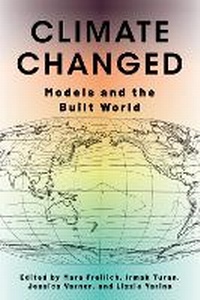
Climate Changed
Models and the Built World
Published on 26. August 2025
Book
Hardback
248 pages
978-0-231-21769-9 (ISBN)
Description
Models change our worlds. From global carbon flux models to regional coastal flood prediction maps, climate-related models influence how we know our environment, how we build our cities, and how we act on a climate-altered planet. Yet such models typically require specialized knowledge to navigate, and because the climate crisis is inherently multidimensional, technical expertise in isolation is not enough.
Climate Changed examines models and their imperfect yet central role in understanding the relationship between global climate dynamics and the human-built environment. It compares and synthesizes the methods and function of models in disciplines ranging from architecture and planning to climate science and natural hazards research. This book considers how disparate models are woven together to understand the climate crisis, underscoring the necessity of combining locally situated and transdisciplinary knowledge with climate science to navigate current and future cataclysmic changes. It highlights the challenges and consequences of disciplinary boundaries, siloed scientific knowledge, and uneven data and develops ways to overcome these limitations.
As the world faces the effects of climate change, climate scientists are debating the future of their field; architects, engineers, and planners are designing in the context of climate change; and society at large is grappling with how to take action. This book brings those communities together to chart a path forward.
Climate Changed examines models and their imperfect yet central role in understanding the relationship between global climate dynamics and the human-built environment. It compares and synthesizes the methods and function of models in disciplines ranging from architecture and planning to climate science and natural hazards research. This book considers how disparate models are woven together to understand the climate crisis, underscoring the necessity of combining locally situated and transdisciplinary knowledge with climate science to navigate current and future cataclysmic changes. It highlights the challenges and consequences of disciplinary boundaries, siloed scientific knowledge, and uneven data and develops ways to overcome these limitations.
As the world faces the effects of climate change, climate scientists are debating the future of their field; architects, engineers, and planners are designing in the context of climate change; and society at large is grappling with how to take action. This book brings those communities together to chart a path forward.
Reviews / Votes
In Climate Changed, a well-chosen, multidisciplinary set of authors looks at the climate problem through the lens of the various types of models we use to understand it, with a particular emphasis on risks and opportunities for the built environment. Through that lens, a kaleidoscopic view emerges of the whole chain connecting knowledge to action. It's an innovative, insightful, and thoughtfully edited volume that should be of interest to a very broad range of scholars and practitioners. -- Adam H. Sobel, author of <i>Storm Surge: Hurricane Sandy, Our Warming Planet, and the Extreme Weather of the Past and Future </i> Models reveal whether approximations of complexity are likely to fit in real life. The essays here consider climate models from different disciplinary perspectives, turning the Swiss cheese of our necessarily simplified climate models into an intriguing conversation about what we can see through the holes. -- Kristina Hill, University of California, Berkeley Through a vast range of disciplinary perspectives, this book captures the mosaic of interests, biases, limitations, and opportunities that arise in the attempt to model complex phenomena. From the science and art of atmospheres to the emerging world of uncertainty, Climate Changed goes beyond despair to get at the heart of our dilemma. -- John E. Fernandez, director, MIT Environmental Solutions InitiativeMore details
Language
English
Place of publication
New York
United States
Target group
Professional and scholarly
College/higher education
Product notice
Trade binding
Illustrations
39 b&w illustrations, 36 figures in color insert
Dimensions
Height: 235 mm
Width: 156 mm
ISBN-13
978-0-231-21769-9 (9780231217699)
Copyright in bibliographic data and cover images is held by Nielsen Book Services Limited or by the publishers or by their respective licensors: all rights reserved.
Schweitzer Classification
Other editions
Additional editions
E-Book
08/2025
1st Edition
Columbia University Press
€29.49
Available for download
Persons
Mara Freilich is an assistant professor in the Department of Earth, Environmental, and Planetary Sciences and Division of Applied Mathematics at Brown University.
Irmak Turan is a building technologist, researcher, and educator specializing in the design and analysis of sustainable and climate-responsive strategies for the built environment.
Jessica Varner is an assistant professor of history in the Department of Landscape Architecture and Regional Planning at the Weitzman School of the University of Pennsylvania.
Lizzie Yarina is an assistant professor of architecture and planning in the College of Arts, Media, and Design at Northeastern University.
Irmak Turan is a building technologist, researcher, and educator specializing in the design and analysis of sustainable and climate-responsive strategies for the built environment.
Jessica Varner is an assistant professor of history in the Department of Landscape Architecture and Regional Planning at the Weitzman School of the University of Pennsylvania.
Lizzie Yarina is an assistant professor of architecture and planning in the College of Arts, Media, and Design at Northeastern University.
Content
Introduction, by Mara Freilich, Irmak Turan, Jessica Varner, and Lizzie Yarina
Part I: Know
1. The Sahara on the March: The Limits of Nineteenth-Century Colonial Climatology, by Philipp Nicolas Lehmann
2. Storm Surge Models: The Multidimensionality of Risk and6969 Resilience, by Talea L. Mayo
3. Characterizing Climate Change Uncertainty: General Circulation Models and the Kenya Dilemma, by Megan Lickley
4. Modeling the Unseen: Implicit Bias in Building Performance Simulation, by Tarek Rakha and Erin Heidelberger
5. Atmospheres: Anthropogenic Images and the Mystification of Mist, by Caroline A. Jones
Part II: Build
6. Climate Projections, Education, and Action in Miami, by Zelalem Adefris
7. The Groundwork Network: Cocreating Resilient Communities, by Brad Buschur, Cate Mingoya-LaFortune, Tennis Lilly, and Eddie Rosa
8. Rethinking the Dutch Delta Approach, by Ruben Dahm, Frederiek Sperna Weiland, and Jaap Kwadijk
9. Using Physical Modeling to Assess Long-Term Weather and Climate Risk, by Kerry Emanuel
10. Catastrophe Risk Models and the Management of Built Environments-at-Risk, by Zac J. Taylor
Part III: Act
11. Messy Models and Missing Pieces: Interrogating the Problem Frame to Support Climate Justice in Nairobi and the Eastern Coachella Valley, by Chelina Odbert and Joe Mulligan
12. Monitoring Disaster Response and Recovery Through Black Marble Nighttime Lights Data, by Ranjay Shrestha, Miguel O. Roman, and Eleanor Stokes
13. (Ad)Just Recovery: Landscape, Climate, and Adaptation in Eastern North Carolina, by Travis Klondike, Kofi Boone, and Andrew Fox
14. Pluralizing the Production and Use of Climate Models, by Marcus Thomson and Emma Colven
Conclusion
Acknowledgments
List of Contributors
Index
Part I: Know
1. The Sahara on the March: The Limits of Nineteenth-Century Colonial Climatology, by Philipp Nicolas Lehmann
2. Storm Surge Models: The Multidimensionality of Risk and6969 Resilience, by Talea L. Mayo
3. Characterizing Climate Change Uncertainty: General Circulation Models and the Kenya Dilemma, by Megan Lickley
4. Modeling the Unseen: Implicit Bias in Building Performance Simulation, by Tarek Rakha and Erin Heidelberger
5. Atmospheres: Anthropogenic Images and the Mystification of Mist, by Caroline A. Jones
Part II: Build
6. Climate Projections, Education, and Action in Miami, by Zelalem Adefris
7. The Groundwork Network: Cocreating Resilient Communities, by Brad Buschur, Cate Mingoya-LaFortune, Tennis Lilly, and Eddie Rosa
8. Rethinking the Dutch Delta Approach, by Ruben Dahm, Frederiek Sperna Weiland, and Jaap Kwadijk
9. Using Physical Modeling to Assess Long-Term Weather and Climate Risk, by Kerry Emanuel
10. Catastrophe Risk Models and the Management of Built Environments-at-Risk, by Zac J. Taylor
Part III: Act
11. Messy Models and Missing Pieces: Interrogating the Problem Frame to Support Climate Justice in Nairobi and the Eastern Coachella Valley, by Chelina Odbert and Joe Mulligan
12. Monitoring Disaster Response and Recovery Through Black Marble Nighttime Lights Data, by Ranjay Shrestha, Miguel O. Roman, and Eleanor Stokes
13. (Ad)Just Recovery: Landscape, Climate, and Adaptation in Eastern North Carolina, by Travis Klondike, Kofi Boone, and Andrew Fox
14. Pluralizing the Production and Use of Climate Models, by Marcus Thomson and Emma Colven
Conclusion
Acknowledgments
List of Contributors
Index