

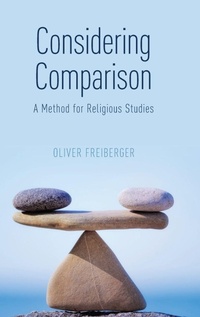
Considering Comparison
A Method for Religious Studies
Published on 21. February 2019
Book
Hardback
256 pages
978-0-19-996500-7 (ISBN)
Description
The comparative method is an integral part of religious studies. All the technical terms that scholars of religion use on a daily basis, such as ritual, hagiography, shrine, authority, fundamentalism, hybridity, and, of course, religion, are comparative terms.
Yet comparison has been subject to criticism, including postcolonialist and postmodernist critiques. Older approaches are said to have used comparison primarily to confirm preconceptions about religion. More recently, comparison has been criticized as an act of abstraction that does injustice to the particular, neglects differences, and establishes a mostly Western power of definition over the rest of the world.
In this book, Oliver Freiberger takes a closer look at how comparison works. Revisiting critical debates and examining reflections in other disciplines, including comparative history, sociology, comparative theology, and anthropology, Freiberger proposes a model of comparison that is based on a thorough epistemological analysis and that takes both the scholar's situatedness and his or her agency seriously. Examining numerous examples of comparative studies, Considering Comparison develops a methodological framework for conducting and evaluating such studies. Freiberger suggests a comparative approach - which he calls discourse comparison - that confronts the omnipresent risks of decontextualization, essentialization, and universalization.
This book makes a case for comparison, arguing that it is indispensable for a deeper analytical understanding of what we call religion. The book is intended to enrich the practice of both aspiring and seasoned comparativists, stimulate much-needed further discussions about comparative methodology, and encourage more scholars to produce responsible comparative studies.
Yet comparison has been subject to criticism, including postcolonialist and postmodernist critiques. Older approaches are said to have used comparison primarily to confirm preconceptions about religion. More recently, comparison has been criticized as an act of abstraction that does injustice to the particular, neglects differences, and establishes a mostly Western power of definition over the rest of the world.
In this book, Oliver Freiberger takes a closer look at how comparison works. Revisiting critical debates and examining reflections in other disciplines, including comparative history, sociology, comparative theology, and anthropology, Freiberger proposes a model of comparison that is based on a thorough epistemological analysis and that takes both the scholar's situatedness and his or her agency seriously. Examining numerous examples of comparative studies, Considering Comparison develops a methodological framework for conducting and evaluating such studies. Freiberger suggests a comparative approach - which he calls discourse comparison - that confronts the omnipresent risks of decontextualization, essentialization, and universalization.
This book makes a case for comparison, arguing that it is indispensable for a deeper analytical understanding of what we call religion. The book is intended to enrich the practice of both aspiring and seasoned comparativists, stimulate much-needed further discussions about comparative methodology, and encourage more scholars to produce responsible comparative studies.
Reviews / Votes
The clarity with which Freiberger articulates his understanding of all the different aspects of the method is truly impressive. This clarity exposes the reasons why past comparative projects have some-times failed, but also the reasons why we should not be put off the compara-tive method as a whole. Students, including undergraduates, will be able to follow the reflections, and for scholars engaged in-or considering engaging in-comparative research it is something of a handbook, and provides tools for explaining and justifying our approach. * Naomi Appleton, Religions of South Asia * Freiberger provides a broad panorama of the debates on comparison and of comparative work in the study of religion\s...his prose is clear and readable. * Michael Strausberg, University of Bergen, Norway, Religion * ...[T]he book is an essential read for anyone looking for an updated and lucid examination of what the stakes of comparison in the study of religion are, and of course for those about to undertake a comparative project themselves. * Philippe Bornet, University of Lausanne, Numen * Freiberger offers a robust and detailed means of conducting inquiry in comparative religion. * Timothy Knepper, Drake University, Journal of the American Academy of Religion *More details
Language
English
Place of publication
New York
United States
Target group
Professional and scholarly
Dimensions
Height: 240 mm
Width: 161 mm
Thickness: 18 mm
Weight
552 gr
ISBN-13
978-0-19-996500-7 (9780199965007)
Copyright in bibliographic data and cover images is held by Nielsen Book Services Limited or by the publishers or by their respective licensors: all rights reserved.
Schweitzer Classification
Other editions
Additional editions
E-Book
01/2019
1st Edition
OUP eBook
€66.49
Available for download
E-Book
01/2019
1st Edition
OUP eBook
€66.49
Available for download
Person
Oliver Freiberger received a PhD from Goettingen University and a DHabil from Bayreuth University. He has taught at The University of Texas at Austin since 2004. His major fields of research, in which he has published widely, are South Asian religious history, early Buddhism, asceticism in the history of religion, and comparative methodology.
Content
Acknowledgements
Introduction
Chapter 1: The Comparative Method in the Study of Religion
Chapter 2: Comparison: Critiques and Challenges
Chapter 3: Comparison in Theory: A Scholar-Centered Approach
Chapter 4: Comparison in Practice: A Methodological Framework
Chapter 5: Discourse Comparison: An Approach and a Case Study
Bibliography
Introduction
Chapter 1: The Comparative Method in the Study of Religion
Chapter 2: Comparison: Critiques and Challenges
Chapter 3: Comparison in Theory: A Scholar-Centered Approach
Chapter 4: Comparison in Practice: A Methodological Framework
Chapter 5: Discourse Comparison: An Approach and a Case Study
Bibliography