

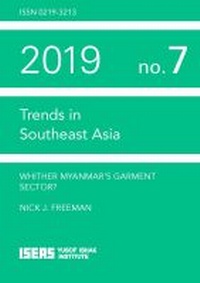
Whither Myanmar's Garment Sector?
Will be published approx. on 30. August 2019
Book
Paperback/Softback
18 pages
978-981-4843-62-1 (ISBN)
Description
The EU has threatened to suspend Generalized Scheme of Preferences (GSP) status for Myanmar, under which the country's exports can enter Europe without any tariffs or quotas. The official reason cited by the EU is a growing concern over human rights violations and issues around labour rights in Myanmar.
If this threat were to be carried out, the business sector that will be most affected is Myanmar's burgeoning garment sector, which employs around 700,000 people, most of whom are women.
The principal worry in Myanmar is that if EU buyers and brands have to start paying tariffs to import Myanmar-made garments, then they will opt to shift their sourcing to other countries. Without GSP, Myanmar's garment exports may no longer be price competitive.
As one of the few manufacturing sectors in Myanmar to employ semi-skilled women, many of whom migrated from poor rural areas, the garment sector has come to play an important socioeconomic role in the country.
Whether or not the EU decides to withdraw GSP status, Myanmar's garment sector faces a number of challenges. How Myanmar's policymakers and garment industry leaders respond to global industry trends will be just as important, in the long run, in determining the sector's commercial sustainability.
If this threat were to be carried out, the business sector that will be most affected is Myanmar's burgeoning garment sector, which employs around 700,000 people, most of whom are women.
The principal worry in Myanmar is that if EU buyers and brands have to start paying tariffs to import Myanmar-made garments, then they will opt to shift their sourcing to other countries. Without GSP, Myanmar's garment exports may no longer be price competitive.
As one of the few manufacturing sectors in Myanmar to employ semi-skilled women, many of whom migrated from poor rural areas, the garment sector has come to play an important socioeconomic role in the country.
Whether or not the EU decides to withdraw GSP status, Myanmar's garment sector faces a number of challenges. How Myanmar's policymakers and garment industry leaders respond to global industry trends will be just as important, in the long run, in determining the sector's commercial sustainability.
More details
Series
Language
English
Place of publication
Pasir Panjang
Singapore
Target group
Professional and scholarly
Dimensions
Height: 229 mm
Width: 152 mm
Weight
63 gr
ISBN-13
978-981-4843-62-1 (9789814843621)
Copyright in bibliographic data and cover images is held by Nielsen Book Services Limited or by the publishers or by their respective licensors: all rights reserved.
Schweitzer Classification
Other editions
Additional editions
Nick J. Freeman
Whither Myanmar's Garment Sector?
E-Book
05/2019
ISEAS Publishing
€9.95
Available for download