

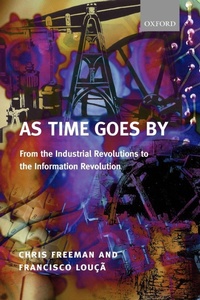
As Time Goes By
From the Industrial Revolutions to the Information Revolution
Published on 7. March 2002
Book
Paperback/Softback
424 pages
978-0-19-925105-6 (ISBN)
Description
How can we best understand the impact of revolutionary technologies on the business cycle, the economy, and society? Why is economics meaningless without history and without an understanding of institutional and technical change? Does the 'new economy' mean the 'end of history'?
These are some of the questions addressed in this authoritative analysis of economic growth from the Industrial Revolution to the 'new economy' of today. Chris Freeman has been one of the foremost researchers on innovation for a long time and his colleague Francisco Louca is an outstanding historian of economic theory and an analyst of econometric models and methods. Together they chart the history of five technological revolutions: water-powered mechanization, steam-powered mechanization, electrification, motorization, and computerization. They demonstrate the necessity to take account of politics, culture, organizational change, and entrepreneurship, as well as science and technology in the analysis of economic growth.
This is a well-informed, highly topical, and persuasive study of interest across all the social sciences.
These are some of the questions addressed in this authoritative analysis of economic growth from the Industrial Revolution to the 'new economy' of today. Chris Freeman has been one of the foremost researchers on innovation for a long time and his colleague Francisco Louca is an outstanding historian of economic theory and an analyst of econometric models and methods. Together they chart the history of five technological revolutions: water-powered mechanization, steam-powered mechanization, electrification, motorization, and computerization. They demonstrate the necessity to take account of politics, culture, organizational change, and entrepreneurship, as well as science and technology in the analysis of economic growth.
This is a well-informed, highly topical, and persuasive study of interest across all the social sciences.
Reviews / Votes
Review from previous edition This major contribution to economic history is the most impressive and convincing attempt I know to apply the concept of the 'long waves', a basic rhythm of historical development in the era of capitalism, to the entire stretch from eighteenth-century Lancashire to twenty-first-century Silicon Valley. It is also a call for economic history to escape from the handcuffs of narrow retrospective econometrics to the freedom of its vocation: understanding and explaining secular historical transformations. * Eric Hobsbawm FBA, American Academy of Arts & Sciences, Emeritus Professor of Social and Economic History, Birkbeck College; Author of The Age of Extremes: The Short Twentieth Century 1914-1991 * . . . a true story has to make sense, to be plausible and persuasive. Cleverness is less useful than sense and sensibility. The inability to see this, to avoid showing off, has been the death of more than one pyrotechnic schema. This book is testimony to knowledge and good sense. Such virtues are rare and that much more valuable. * David Landes, Professor of History and Economics, Harvard University, Emeritus; Author of The Wealth and Poverty of Nations * This book is a thought-provoking work that is valuable for more than its detailed account of the technological revolutions that shape our economy today. By directing our attention to a perspective outside the current wave, it shapes our thinking about events inside the current wave. * Academy of Management Review, 27(2) *More details
Language
English
Place of publication
Oxford
United Kingdom
Target group
Professional and scholarly
Illustrations
34 figures; 60 tables
Dimensions
Height: 234 mm
Width: 156 mm
Thickness: 23 mm
Weight
641 gr
ISBN-13
978-0-19-925105-6 (9780199251056)
Copyright in bibliographic data and cover images is held by Nielsen Book Services Limited or by the publishers or by their respective licensors: all rights reserved.
Schweitzer Classification
Other editions
Additional editions
Chris Freeman | Francisco Louca
As Time Goes By
From the Industrial Revolutions to the Information Revolution
Book
02/2001
Oxford University Press
€282.20
Shipment within 15-20 days
Persons
Chris Freeman is Emeritus Professor at the University of Sussex and was the founder and former Director of SPRU (1966-81). SPRU has become one of the leading world centres for research on technical change. After war-time service in the Manchester Regiment and experience in market research, Chris Freeman became a Research Fellow at the National Institute of Economic and Social Research (1959-66), and later a Visiting Professor at the University of Limburg, Maastricht.
Francisco Louca is a Portuguese Member of Parliament, serving in the Economic and Budgetary Commission. He obtained his Ph.D. in Economics from the University of Lisbon, under the supervision of Chris Freeman. His thesis, entitled Turbulence in Economics has since been published in both English and Portuguese (Edward Elgar/Afrontamento, 1997).
Francisco Louca is a Portuguese Member of Parliament, serving in the Economic and Budgetary Commission. He obtained his Ph.D. in Economics from the University of Lisbon, under the supervision of Chris Freeman. His thesis, entitled Turbulence in Economics has since been published in both English and Portuguese (Edward Elgar/Afrontamento, 1997).
Content
PART I: HISTORY AND ECONOMICS; PART II: SUCCESSIVE INDUSTRIAL REVOLUTIONS