

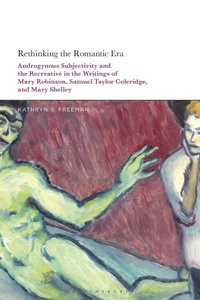
Rethinking the Romantic Era
Androgynous Subjectivity and the Recreative in the Writings of Mary Robinson, Samuel Taylor Coleridge, and Mary Shelley
Published on 25. August 2022
Book
Paperback/Softback
176 pages
978-1-350-19493-9 (ISBN)
Description
Focusing on Samuel Taylor Coleridge, Mary Robinson and Mary Shelley, this book uses key concepts of androgyny, subjectivity and the re-creative as a productive framework to trace the fascinating textual interactions and dialogues among these authors. It crosses the boundary between male and female writers of the Romantic period by linking representations of gender with late Enlightenment upheavals regarding creativity and subjectivity, demonstrating how these interrelated concerns dismantle traditional binaries separating the canonical and the noncanonical; male and female; poetry and prose; good and evil; subject and object.
Through the convergences among the writings of Coleridge, Mary Robinson, and Mary Shelley, the book argues that each dismantles and reconfigures subjectivity as androgynous and amoral, subverting the centrality of the male gaze associated with canonical Romanticism. In doing so, it examines key works from each author's oeuvre, from Coleridge's "canonical" poems such as Rime of the Ancient Mariner, through Robinson's lyrical poetry and novels such as Walsingham, to Mary Shelley's fiction, including Frankenstein, Mathilda, and The Last Man.
Through the convergences among the writings of Coleridge, Mary Robinson, and Mary Shelley, the book argues that each dismantles and reconfigures subjectivity as androgynous and amoral, subverting the centrality of the male gaze associated with canonical Romanticism. In doing so, it examines key works from each author's oeuvre, from Coleridge's "canonical" poems such as Rime of the Ancient Mariner, through Robinson's lyrical poetry and novels such as Walsingham, to Mary Shelley's fiction, including Frankenstein, Mathilda, and The Last Man.
Reviews / Votes
Although recognized as a major component of Romantic literature, story-telling has eluded the critical effort to identify the attributes that render it part of the crucial creative endeavor of the times. Kathryn S. Freeman identifies three traits in her subtitle: subjectivity, androgyny, and the recreative. She demonstrates their relevance by tracing the pervasive strategies of metanarrative, metatextuality, and metasexuality in the narratives of Mary Robinson, Samuel Taylor Coleridge, and Mary Shelley. Freeman is concerned with story-telling, similar to the author-character irony in Lord Byron's Childe Harold or Don Juan, in which the story-teller is a character in the story that he or she is telling, This "he or she" is further relevant to the metasexuality, for authors readily adopt an adapt alternate genders. Freeman reveals as well the tensions between the factual and fictional author, heightened by the metatextual intrusions of prefaces, footnotes, and cross-references. As dissimilar as these three authors might seem, all three implicate allusions and illusions on multiple levels of narrative. Freeman has effectively recontextualized the Romantic obsession with the creative imagination and subjective identity. Her attentive scrutiny of story-telling provides a valuable guide to Romantic narratology at large, applicable to every other story-teller of the period. -- Frederick Burwick, Professor Emeritus, University of California, Los Angeles, USA For those of us who teach and interpret Coleridge's poetry and works by women writers, Rethinking the Romantic Era is an engaging and valuable study. * The Coleridge Bulletin *More details
Language
English
Place of publication
London
United Kingdom
Publishing group
Bloomsbury Publishing PLC
Target group
College/higher education
Dimensions
Height: 234 mm
Width: 156 mm
Thickness: 10 mm
Weight
278 gr
ISBN-13
978-1-350-19493-9 (9781350194939)
Copyright in bibliographic data and cover images is held by Nielsen Book Services Limited or by the publishers or by their respective licensors: all rights reserved.
Schweitzer Classification
Other editions
Additional editions
Kathryn S. Freeman
Rethinking the Romantic Era
Androgynous Subjectivity and the Recreative in the Writings of Mary Robinson, Samuel Taylor Coleridge, and Mary Shelley
E-Book
12/2020
1st Edition
Bloomsbury Academic
€35.49
Available for download
Kathryn S. Freeman
Rethinking the Romantic Era
Androgynous Subjectivity and the Recreative in the Writings of Mary Robinson, Samuel Taylor Coleridge, and Mary Shelley
E-Book
12/2020
1st Edition
Bloomsbury Academic
€35.49
Available for download
Person
Kathryn S. Freeman is Professor of English at the University of Miami, USA.
Content
Introduction
Chapter 1: Expansion and Contraction: Coleridge's Gendered Revolt against Materialism
Chapter 2: Coleridge and Robinson: "Sense unchained"
Chapter 3:Secondary Imagination, Contamination, and Androgyny: Christabel, Magnum Opus, and the Nature of Evil
Chapter 4: Re-thinking Literary Influence: Nondual Relationships of Gender and Generation in Robinson, Coleridge, Mary Wollstonecraft, and Mary Shelley
Bibliography
Index
Chapter 1: Expansion and Contraction: Coleridge's Gendered Revolt against Materialism
Chapter 2: Coleridge and Robinson: "Sense unchained"
Chapter 3:Secondary Imagination, Contamination, and Androgyny: Christabel, Magnum Opus, and the Nature of Evil
Chapter 4: Re-thinking Literary Influence: Nondual Relationships of Gender and Generation in Robinson, Coleridge, Mary Wollstonecraft, and Mary Shelley
Bibliography
Index