

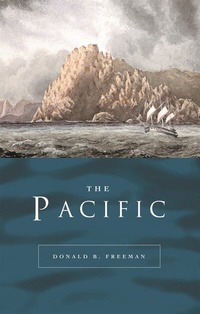
The Pacific
1st Edition
Published on 27. August 2009
Book
Hardback
280 pages
978-0-415-77572-4 (ISBN)
Description
In this fascinating and exciting overview, Donald B. Freeman explores the role of the Pacific Ocean in human history.
Covering over one third of the globe, the Pacific Ocean plays a vital role in the lives and fortunes of more than two billion people who live on its rim-lands and islands. It has played a crucial part in shaping the histories of the different Pacific cultures, towards which it has appeared in a variety of different guises. Exploring the ocean's place in human history, this wide ranging book draws together the long and varied physical, economic, cultural and political history of the Pacific, from Prehistory through to the present day. It takes an interdisciplinary approach to show the changing viewpoints of those who explored, exploited and settled the Pacific, including the inhabitants of its Asian and American rim-lands.
The book draws on new research in a variety of areas, such as early Pacific migrations, impacts of European colonization, the effects of climate change, and current economic and political developments. It provides a uniquely broad overview that will be of vital interest to students and to all those with an interest in World History.
Covering over one third of the globe, the Pacific Ocean plays a vital role in the lives and fortunes of more than two billion people who live on its rim-lands and islands. It has played a crucial part in shaping the histories of the different Pacific cultures, towards which it has appeared in a variety of different guises. Exploring the ocean's place in human history, this wide ranging book draws together the long and varied physical, economic, cultural and political history of the Pacific, from Prehistory through to the present day. It takes an interdisciplinary approach to show the changing viewpoints of those who explored, exploited and settled the Pacific, including the inhabitants of its Asian and American rim-lands.
The book draws on new research in a variety of areas, such as early Pacific migrations, impacts of European colonization, the effects of climate change, and current economic and political developments. It provides a uniquely broad overview that will be of vital interest to students and to all those with an interest in World History.
Reviews / Votes
'In straightforward fashion, Freeman presents a cornucopia of information, much of it well known but not as handily available as he makes it here.' CHOICE (Recommended title)More details
Series
Language
English
Place of publication
London
United Kingdom
Publishing group
Taylor & Francis Ltd
Target group
College/higher education
Product notice
Paper over boards
Illustrations
7 s/w Abbildungen, 16 s/w Photographien bzw. Rasterbilder
16 Halftones, black and white; 7 Illustrations, black and white
Dimensions
Height: 234 mm
Width: 156 mm
Weight
680 gr
ISBN-13
978-0-415-77572-4 (9780415775724)
Copyright in bibliographic data and cover images is held by Nielsen Book Services Limited or by the publishers or by their respective licensors: all rights reserved.
Schweitzer Classification
Other editions
Additional editions
Person
Donald B. Freeman is Emeritus Professor of Geography, York University, Canada. His research interests include the historical geography of trade and development in the Pacific and Southeast Asia. His books include The Straits of Malacca: Gateway or Gauntlet?(2003).
Content
Introduction 1. Comprehending the Pacific: Environmental Influences and Effects 2. Peopling the Pacific: from Prehistory to the First European Incursions 3. Claiming the Pacific: European Exploration and Annexation 4. Encompassing the Pacific: Revolutions in Transport, Navigation and Chart-Making 5. Exploiting Pacific Resources 6. Contesting the Pacific: Military Activity, Colonial Struggle and Imperial Competition 7. Picturing the Pacific: The Ocean Hemisphere in Art, Literature and Film 8. Developing the Pacific: Political Independence, Economic Advancement, and Environmental Protection. Conclusion. Selected Bibliography