

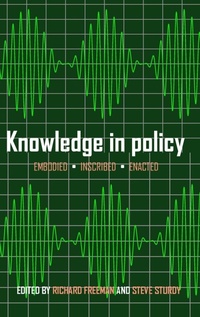
Knowledge in Policy
Embodied, Inscribed, Enacted
1st Edition
Published on 29. April 2014
Book
Hardback
256 pages
978-1-4473-0998-7 (ISBN)
Description
This important collection presents a radical reconception of the place of knowledge in contemporary policymaking in Europe, based not on assumptions about evidence, expertise or experience but on the different forms that knowledge takes.
Knowledge is embodied in people, inscribed in documents and instruments, and enacted in specific circumstances. Empirical case studies of health and education policy in different national and international contexts demonstrate the essential interdependence of different forms and phases of knowledge. They illustrate the ways in which knowledge is mobilised and resisted, and draw attention to key problems in the processing and transformation of knowledge in policy work.
This novel theoretical framework offers real benefits for policymakers, academics in public policy, public administration, management studies, sociology, education, public health and social work, and those with a practical interest in education and health and related fields of public policy.
Knowledge is embodied in people, inscribed in documents and instruments, and enacted in specific circumstances. Empirical case studies of health and education policy in different national and international contexts demonstrate the essential interdependence of different forms and phases of knowledge. They illustrate the ways in which knowledge is mobilised and resisted, and draw attention to key problems in the processing and transformation of knowledge in policy work.
This novel theoretical framework offers real benefits for policymakers, academics in public policy, public administration, management studies, sociology, education, public health and social work, and those with a practical interest in education and health and related fields of public policy.
Reviews / Votes
"A very thought-provoking book for anyone involved in policymaking, and in trying to understand how and why policy is, or is not, made and implemented in different contexts." SRA Research Matters.More details
Edition
First Edition
Language
English
Place of publication
Bristol
United Kingdom
Publishing group
Bristol University Press
Target group
College/higher education
Illustrations
Not illustrated
Dimensions
Height: 240 mm
Width: 161 mm
Thickness: 18 mm
Weight
552 gr
ISBN-13
978-1-4473-0998-7 (9781447309987)
Copyright in bibliographic data and cover images is held by Nielsen Book Services Limited or by the publishers or by their respective licensors: all rights reserved.
Schweitzer Classification
Other editions
Additional editions
Book
10/2015
1st Edition
Policy Press
€42.50
Shipment within 15-20 days
E-Book
10/2015
1st Edition
Policy Press
€48.99
Available for download
E-Book
04/2014
1st Edition
Policy Press
€248.99
Available for download
Persons
Richard Freeman teaches theory and method in the Graduate School of Social and Political Science, University of Edinburgh. Following comparative studies of health and health care, his recent work has been concerned with knowledge and practice in public policy. Steve Sturdy is head of Science, Technology and Innovation Studies at the University of Edinburgh, and has published widely in the history and sociology of medical science and medical practice.
Content
Introduction: knowledge in policy - embodied, inscribed, enacted ~ Richard Freeman and Steve Sturdy;
Part One: Policy knowledge in space and time;
Seeing knowledge in mental health in Scotland ~ Jennifer Smith-Merry;
Knowledge moves: regulation and the evaluation of Portuguese schools ~ Natercio Afonso and Estela Costa;
Knowledge, policy and coordinated action: mental health in Europe ~ Richard Freeman and Steve Sturdy;
Part Two: Embodied, inscribed and enacted knowledges;
'We know who to talk to': embodied knowledge in England's Department of Health ~ Jo Maybin;
Reconstructing school inspectorates in Europe: the role of inscribed knowledge ~ Sotiria Grek;
Enacting knowledge in a European project ~ Maria Jose dos Santos Freitas;
Part Three: Knowledge interests, knowledge conflict and knowledge work;
Knowledge interests: promoting and resisting change in mental health in Hungary ~ Bori Fernezelyi and Gabor Eroess;
Knowledge conflicts: embodiment, inscription and the education of children with learning disabilities in Germany ~ Alma Demszky;
Knowledge work: organising mental health care networks in Belgium ~ Sophie Thunus, Gaetan Cerfontaine and Frederic Schoenaers;
Knowledge and policy in research and practice ~ Richard Freeman and Steve Sturdy.
Part One: Policy knowledge in space and time;
Seeing knowledge in mental health in Scotland ~ Jennifer Smith-Merry;
Knowledge moves: regulation and the evaluation of Portuguese schools ~ Natercio Afonso and Estela Costa;
Knowledge, policy and coordinated action: mental health in Europe ~ Richard Freeman and Steve Sturdy;
Part Two: Embodied, inscribed and enacted knowledges;
'We know who to talk to': embodied knowledge in England's Department of Health ~ Jo Maybin;
Reconstructing school inspectorates in Europe: the role of inscribed knowledge ~ Sotiria Grek;
Enacting knowledge in a European project ~ Maria Jose dos Santos Freitas;
Part Three: Knowledge interests, knowledge conflict and knowledge work;
Knowledge interests: promoting and resisting change in mental health in Hungary ~ Bori Fernezelyi and Gabor Eroess;
Knowledge conflicts: embodiment, inscription and the education of children with learning disabilities in Germany ~ Alma Demszky;
Knowledge work: organising mental health care networks in Belgium ~ Sophie Thunus, Gaetan Cerfontaine and Frederic Schoenaers;
Knowledge and policy in research and practice ~ Richard Freeman and Steve Sturdy.