

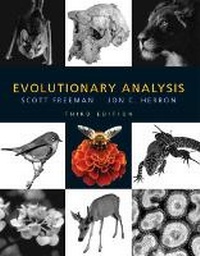
Evolutionary Analysis
3rd Edition
Published on 24. July 2003
Book
Hardback
816 pages
978-0-13-101859-4 (ISBN)
Description
For undergraduates majoring in the biological sciences.
In its Third Edition, Evolutionary Analysis presents evolution as a process, emphasizing the relationship between theory, observation, testing, and interpretation. By introducing principles through recent and classical studies and emphasizing real-world applications, Evolutionary Analysis conveys the excitement and logic of evolutionary science.
In its Third Edition, Evolutionary Analysis presents evolution as a process, emphasizing the relationship between theory, observation, testing, and interpretation. By introducing principles through recent and classical studies and emphasizing real-world applications, Evolutionary Analysis conveys the excitement and logic of evolutionary science.
More details
Edition
3rd edition
Language
English
Place of publication
United States
Publishing group
Pearson Education (US)
Target group
Professional and scholarly
Dimensions
Height: 256 mm
Width: 209 mm
Thickness: 33 mm
Weight
1648 gr
ISBN-13
978-0-13-101859-4 (9780131018594)
Copyright in bibliographic data and cover images is held by Nielsen Book Services Limited or by the publishers or by their respective licensors: all rights reserved.
Schweitzer Classification
Other editions
New editions
Book
02/2007
4th Edition
Pearson
€115.31
Article exhausted; check for reprint
Previous edition
Scott Freeman | Jon C. Herron
Evolutionary Analysis
Book
09/2000
2nd Edition
Pearson
€53.31
Article exhausted; check for reprint
Content
I. INTRODUCTION.
1. A Case for Evolutionary Thinking: Understanding HIV.
2. The Evidence for Evolution.
3. Darwinian Natural Selection.
II. MECHANISMS OF EVOLUTIONARY CHANGE.
4. Mutation and Genetic Variation.
5. Mendelian Genetics in Populations I: Selection and Mutation as Mechanisms of Evolution.
6. Mendelian Genetics in Populations II: Migration, Genetic Drift, and Nonrandom Mating.
7. Evolution at Multiple Loci: Linkage and Sex.
8. Evolution at Multiple Loci: Quantitative Genetics.
III. ADAPTATION.
9. Studying Adaptation: Evolutionary Analysis of Form and Function.
10. Sexual Selection.
11. Kin Selection and Social Behavior.
12. Aging and Other Life History Characters.
13. Darwinian Medicine.
IV. THE HISTORY OF LIFE.
14. Reconstructing Evolutionary Trees.
15. Mechanisms of Speciation.
16. The Origins of Life and Precambrian Evolution.
17. The Cambrian Explosion and Beyond.
18. Development and Evolution.
19. Human Evolution.
1. A Case for Evolutionary Thinking: Understanding HIV.
2. The Evidence for Evolution.
3. Darwinian Natural Selection.
II. MECHANISMS OF EVOLUTIONARY CHANGE.
4. Mutation and Genetic Variation.
5. Mendelian Genetics in Populations I: Selection and Mutation as Mechanisms of Evolution.
6. Mendelian Genetics in Populations II: Migration, Genetic Drift, and Nonrandom Mating.
7. Evolution at Multiple Loci: Linkage and Sex.
8. Evolution at Multiple Loci: Quantitative Genetics.
III. ADAPTATION.
9. Studying Adaptation: Evolutionary Analysis of Form and Function.
10. Sexual Selection.
11. Kin Selection and Social Behavior.
12. Aging and Other Life History Characters.
13. Darwinian Medicine.
IV. THE HISTORY OF LIFE.
14. Reconstructing Evolutionary Trees.
15. Mechanisms of Speciation.
16. The Origins of Life and Precambrian Evolution.
17. The Cambrian Explosion and Beyond.
18. Development and Evolution.
19. Human Evolution.