

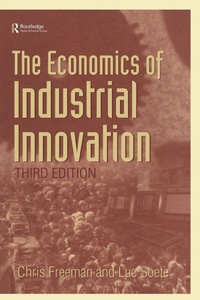
The Economics of Industrial Innovation
1st Edition
Published on 9. January 2012
Book
Paperback/Softback
480 pages
978-0-415-51610-5 (ISBN)
Description
First published in 1997. Massive technological development has changed the face of industry drammatically. This text provides an analysis of the trends and dynamics of innovation in industry. It has been updated with recent statistical information and examples. A new section explores the debate surrounding macroeconomics in an analysis of the impact of globalization on industrial change. This book covers such topics as: the rise of science-related technology; innovations and the firms; macroeconomics of innovation; and innovation and public policies.
More details
Language
English
Place of publication
London
United Kingdom
Publishing group
Taylor & Francis Ltd
Target group
College/higher education
Dimensions
Height: 234 mm
Width: 156 mm
Thickness: 26 mm
Weight
726 gr
ISBN-13
978-0-415-51610-5 (9780415516105)
Copyright in bibliographic data and cover images is held by Nielsen Book Services Limited or by the publishers or by their respective licensors: all rights reserved.
Schweitzer Classification
Other editions
Additional editions

Chris Freeman | Luc Soete
The Economics of Industrial Innovation
E-Book
07/2012
1st Edition
Routledge
€67.49
Available for download

Chris Freeman | Luc Soete
The Economics of Industrial Innovation
E-Book
07/2012
1st Edition
Routledge
€67.49
Available for download
Chris Freeman | Luc Soete
The Economics of Industrial Innovation
Book
07/1997
Routledge
€237.91
Shipment within 3-4 weeks
Persons
Chris Freeman (Professor Emeritus, Science Policy Research Unit, University of Sussex) (Author),Luc Soete (Professor of International Economics, University of Maastricht, Netherlands)
Content
Part 1 Rise of science-related technology: introduction; evolutionary theory in economics and technical change; process innovations; materials innovations; product and system innovation; paradigm change. Part 2 Innovations and the firms: the microeconomics of innovation; success and failure, the role of marketing and user-producer networks; innovation, size of firm, economies of scale and scope; uncertainty, project evaluation and finance of innovation, management strategy and theory of the firm. Part 3 Macroeconomics of innovation - science, technology and economic growth; globalization and multinational corporations; underdevelopment and catching up. Part 4 Innovation and public policies: market failure and aspects of public support for innovation; technical change, employment and skills; environmental issues; technological assessment. Appendix: measurement and definitions.