

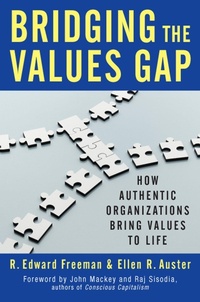
Bridging the Values Gap: How Authentic Organizations Bring Values to Life
Description
The reason, argue top scholars and consultants Edward Freeman and Ellen Auster, is that most companies' values are handed down from on high, with no employee input or discussion. This practically invites disconnects between intention and reality.
To bridge this values gap, Freeman and Auster provide a process, Values through Conversation, that focuses on four key types of values: introspective (reflecting on who we are and how we do things), historical (understanding our past and how it influences us), relational (asking how we can best work together), and aspirational (articulating our hopes and dreams). By developing values through discussions - casual or formal, one-on-one or in groups - VTC ensures that they are dynamic and evolving, not static words on a wall or a website. Freeman and Auster offer advice, real-world examples, and sample questions to help you create values that are authentic and embraced because they are rooted in the lived experience of the organization.
More details
Persons
Ellen R. Auster is professor of strategic management and founding director of the Schulich Centre for Teaching Excellence at the Schulich School of Business, York University, Toronto, Canada. She is widely published and is the recipient of the prestigious Distinguished Educator Award conferred by the Academy of Management.
Content
Preface
Part I: Understanding the Values Gap in Business
Chapter 1: The Values Gap in Business
Chapter 2: Just Be Authentic: Not So Fast, Not So Easy
Chapter 3: Authentic Organizations: Is Yours One?
Chapter 4: Do Values Right or Don’t Do Them at All
Part II: How Businesses Can Bridge the Values Gap
Chapter 5: Introspective Values: Reflecting on Self and the Organization
Chapter 6: Historical Values: Exploring the Impact of Our Past
Chapter 7: Connectedness Values: Creating a Sense of Belonging and Community
Chapter 8: Aspirational Values: Our Hopes and Dreams
Part III: Bringing the Conversation to Life
Chapter 9: Getting Started
Notes
Index
About the Authors