

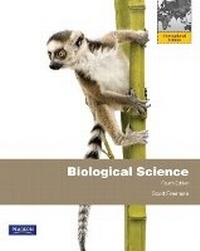
Biological Science Plus Mastering Biology with eText -- Access Card Package
International Edition
4th Edition
Published on 25. March 2010
Book
Mixed media product
1392 pages
978-0-321-69504-8 (ISBN)
Description
ALERT: Before you purchase, check with your instructor or review your course syllabus to ensure that you select the correct ISBN. Several versions of Pearson's MyLab & Mastering products exist for each title, including customized versions for individual schools, and registrations are not transferable. In addition, you may need a CourseID, provided by your instructor, to register for and use Pearson's MyLab & Mastering products.
Packages
Access codes for Pearson's MyLab & Mastering products may not be included when purchasing or renting from companies other than Pearson; check with the seller before completing your purchase.
Used or rental books
If you rent or purchase a used book with an access code, the access code may have been redeemed previously and you may have to purchase a new access code.
Access codes
Access codes that are purchased from sellers other than Pearson carry a higher risk of being either the wrong ISBN or a previously redeemed code. Check with the seller prior to purchase.
--Supports and motivates you as you learn to think like a biologist.
Building upon Scott Freeman's unique narrative style that incorporates the Socratic approach and draws you into thinking like a biologist, the Fourth Edition has been carefully refined to motivate and support a broader range of learners as they are introduced to new concepts and encouraged to develop and practice new skills. Each page of the book is designed in the spirit of active learning and instructional reinforcement, equipping novice learners with tools that help them advance in the course-from recognizing essential information in highlighted sections to demonstrating and applying their understanding of concepts in practice exercises that gradually build in difficulty.
New to Freeman's MasteringBiology (R) online tutorial and assessment system are ten classic experiment tutorials and automatically-graded assignment options that are adapted directly from content and exercises in the book.
Package Components:
Biological Science, Fourth Edition
MasteringBiology (R) with Pearson eText Student Access Kit
Packages
Access codes for Pearson's MyLab & Mastering products may not be included when purchasing or renting from companies other than Pearson; check with the seller before completing your purchase.
Used or rental books
If you rent or purchase a used book with an access code, the access code may have been redeemed previously and you may have to purchase a new access code.
Access codes
Access codes that are purchased from sellers other than Pearson carry a higher risk of being either the wrong ISBN or a previously redeemed code. Check with the seller prior to purchase.
--Supports and motivates you as you learn to think like a biologist.
Building upon Scott Freeman's unique narrative style that incorporates the Socratic approach and draws you into thinking like a biologist, the Fourth Edition has been carefully refined to motivate and support a broader range of learners as they are introduced to new concepts and encouraged to develop and practice new skills. Each page of the book is designed in the spirit of active learning and instructional reinforcement, equipping novice learners with tools that help them advance in the course-from recognizing essential information in highlighted sections to demonstrating and applying their understanding of concepts in practice exercises that gradually build in difficulty.
New to Freeman's MasteringBiology (R) online tutorial and assessment system are ten classic experiment tutorials and automatically-graded assignment options that are adapted directly from content and exercises in the book.
Package Components:
Biological Science, Fourth Edition
MasteringBiology (R) with Pearson eText Student Access Kit
More details
Edition
4th edition
Language
English
Place of publication
United States
Publishing group
Pearson Education (US)
Target group
College/higher education
Dimensions
Height: 276 mm
Width: 226 mm
Thickness: 38 mm
Weight
2520 gr
ISBN-13
978-0-321-69504-8 (9780321695048)
Copyright in bibliographic data is held by Nielsen Book Services Limited or its licensors: all rights reserved.
Schweitzer Classification
Other editions
New editions
Scott Freeman | Kim Quillin | Lizabeth Allison
Biological Science Plus Mastering Biology with eText -- Access Card Package
International Edition
Book
02/2013
5th Edition
Pearson
€184.47
Article exhausted; check for reprint
Previous edition
Book
01/2008
3rd Edition
Pearson
€64.53
Article exhausted; check for reprint
Person
Scott Freeman
Scott Freeman received his Ph.D. in Zoology from the University of Washington and was subsequently awarded an Alfred P. Sloan Postdoctoral Fellowship in Molecular Evolution at Princeton University. His current research focuses on the scholarship of teaching and learning and he recently published two papers on his work: (1) how active learning and peer teaching techniques increase student learning and improve performance in introductory biology (Freeman, S., E. O'Connor, J.W. Parks, M. Cunningham, D. Hurley, D. Haak, C. Dirks, and M.P. Wenderoth. 2007. Prescribed active learning increases performance in introductory biology. CBE-Life Sciences Education 6: 132-139.); and (2) how the levels of exam questions vary among introductory biology courses, standardized post-graduate entrance exams, and professional school courses (Zheng, A.Y., J.K. Lawhorn, T. Lumley, and S. Freeman. 2007. Applications of Bloom's Taxonomy Debunks the "MCAT Myth." Science 25 January 2008: 414-415).
Kim Quillin
Illustrator, Kim Quillin, combines expertise in biology and information design to create lucid visual representations of biological principles. She received her B.A. in Biology at Oberlin College and her Ph.D. in Integrative Biology from the University of California, Berkeley (as a National Science Foundation Graduate Fellow), and has taught undergraduate biology at both schools. Students and instructors alike have praised Kim's illustration programs for Biological Science, as well as Biology: A Guide to the Natural World, by David Krogh, and Biology: Science for Life, by Colleen Belk and Virginia Borden, for their success at the visual communication of biology. Kim is a lecturer in the Department of Biological Sciences at Salisbury University.
Scott Freeman received his Ph.D. in Zoology from the University of Washington and was subsequently awarded an Alfred P. Sloan Postdoctoral Fellowship in Molecular Evolution at Princeton University. His current research focuses on the scholarship of teaching and learning and he recently published two papers on his work: (1) how active learning and peer teaching techniques increase student learning and improve performance in introductory biology (Freeman, S., E. O'Connor, J.W. Parks, M. Cunningham, D. Hurley, D. Haak, C. Dirks, and M.P. Wenderoth. 2007. Prescribed active learning increases performance in introductory biology. CBE-Life Sciences Education 6: 132-139.); and (2) how the levels of exam questions vary among introductory biology courses, standardized post-graduate entrance exams, and professional school courses (Zheng, A.Y., J.K. Lawhorn, T. Lumley, and S. Freeman. 2007. Applications of Bloom's Taxonomy Debunks the "MCAT Myth." Science 25 January 2008: 414-415).
Kim Quillin
Illustrator, Kim Quillin, combines expertise in biology and information design to create lucid visual representations of biological principles. She received her B.A. in Biology at Oberlin College and her Ph.D. in Integrative Biology from the University of California, Berkeley (as a National Science Foundation Graduate Fellow), and has taught undergraduate biology at both schools. Students and instructors alike have praised Kim's illustration programs for Biological Science, as well as Biology: A Guide to the Natural World, by David Krogh, and Biology: Science for Life, by Colleen Belk and Virginia Borden, for their success at the visual communication of biology. Kim is a lecturer in the Department of Biological Sciences at Salisbury University.
Content
1. Biology and the Tree of Life
I. THE MOLECULES OF LIFE
2. Water and Carbon: The Chemical Basis of Life
3. Protein Structure and Function
4. Nucleic Acids and the RNA World
5. An Introduction to Carbohydrates
6. Lipids, Membranes, and the First Cells
II. CELL STRUCTURE AND FUNCTION
7. Inside the Cell
8. Cell-Cell Interactions
9. Cellular Respiration and Fermentation
10. Photosynthesis
11. The Cell Cycle
III. GENE STRUCTURE AND EXPRESSION
12. Meiosis
13. Mendel and the Gene
14. DNA and the Gene: Synthesis and Repair
15. How Genes Work
16. Transcription, RNA Processing, and Translation
17. Control of Gene Expression in Bacteria
18. Control of Gene Expression in Eukaryotes
19. Analyzing and Engineering Genes
20. Genomics
IV. DEVELOPMENTAL BIOLOGY
21. Principles of Development
22. An Introduction to Animal Development
23. An Introduction to Plant Development
V. EVOLUTIONARY PROCESSES AND PATTERNS
24. Evolution by Natural Selection
25. Evolutionary Processes
26. Speciation
27. Phylogenies and the History of Life
VI. THE DIVERSIFICATION OF LIFE
28. Bacteria and Archaea
29. Protists
30. Green Algae and Land Plants
31. Fungi
32. An Introduction to Animals
33. Protostome Animals
34. Deuterostome Animals
35. Viruses
VII. HOW PLANTS WORK
36. Plant Form and Function
37. Water and Sugar Transport in Plants
38. Plant Nutrition
39. Plant Sensory Systems, Signals, and Responses
40. Plant Reproduction
VIII. HOW ANIMALS WORK
41. Animal Form and Function
42. Water and Electrolyte Balance in Animals
43. Animal Nutrition
44. Gas Exchange and Circulation
45. Electrical Signals in Animals
46. Animal Sensory Systems and Movement
47. Chemical Signals in Animals
48. Animal Reproduction
49. The Immune System in Animals
IX. ECOLOGY
50. An Introduction to Ecology
51. Behavioral Ecology
52. Population Ecology
53. Community Ecology
54. Ecosystems
55. Biodiversity and Conservation
I. THE MOLECULES OF LIFE
2. Water and Carbon: The Chemical Basis of Life
3. Protein Structure and Function
4. Nucleic Acids and the RNA World
5. An Introduction to Carbohydrates
6. Lipids, Membranes, and the First Cells
II. CELL STRUCTURE AND FUNCTION
7. Inside the Cell
8. Cell-Cell Interactions
9. Cellular Respiration and Fermentation
10. Photosynthesis
11. The Cell Cycle
III. GENE STRUCTURE AND EXPRESSION
12. Meiosis
13. Mendel and the Gene
14. DNA and the Gene: Synthesis and Repair
15. How Genes Work
16. Transcription, RNA Processing, and Translation
17. Control of Gene Expression in Bacteria
18. Control of Gene Expression in Eukaryotes
19. Analyzing and Engineering Genes
20. Genomics
IV. DEVELOPMENTAL BIOLOGY
21. Principles of Development
22. An Introduction to Animal Development
23. An Introduction to Plant Development
V. EVOLUTIONARY PROCESSES AND PATTERNS
24. Evolution by Natural Selection
25. Evolutionary Processes
26. Speciation
27. Phylogenies and the History of Life
VI. THE DIVERSIFICATION OF LIFE
28. Bacteria and Archaea
29. Protists
30. Green Algae and Land Plants
31. Fungi
32. An Introduction to Animals
33. Protostome Animals
34. Deuterostome Animals
35. Viruses
VII. HOW PLANTS WORK
36. Plant Form and Function
37. Water and Sugar Transport in Plants
38. Plant Nutrition
39. Plant Sensory Systems, Signals, and Responses
40. Plant Reproduction
VIII. HOW ANIMALS WORK
41. Animal Form and Function
42. Water and Electrolyte Balance in Animals
43. Animal Nutrition
44. Gas Exchange and Circulation
45. Electrical Signals in Animals
46. Animal Sensory Systems and Movement
47. Chemical Signals in Animals
48. Animal Reproduction
49. The Immune System in Animals
IX. ECOLOGY
50. An Introduction to Ecology
51. Behavioral Ecology
52. Population Ecology
53. Community Ecology
54. Ecosystems
55. Biodiversity and Conservation