

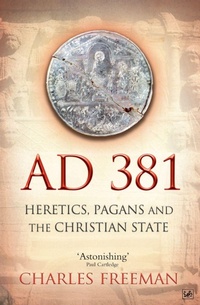
AD 381
Heretics, Pagans and the Christian State
Published on 5. February 2009
Book
Paperback/Softback
272 pages
978-1-84595-007-1 (ISBN)
Description
In AD 381, Theodosius, emperor of the eastern Roman empire, issued a decree in which all his subjects were required to subscribe to a belief in the Trinity of the Father, Son and Holy Spirit. This edict defined Christian orthodoxy and brought to an end a lively and wide-ranging debate about the nature of the Godhead; all other interpretations were now declared heretical.
Moreover, for the first time in a thousand years of Greco-Roman civilization free thought was unambiguously suppressed. Yet surprisingly this political revolution, intended to bring inner cohesion to an empire under threat from the outside, has been airbrushed from the historical record. Instead, it has been claimed that the Christian Church had reached a consensus on the Trinity which was promulgated at the Council of Constantinople in AD 381.
In this groundbreaking new book, Freeman argues that Theodosius's edict and the subsequent suppression of paganism not only brought an end to the diversity of religious and philosophical beliefs throughout the empire but created numerous theological problems for the Church, which have remained unsolved. The year AD 381, Freeman concludes, marked 'a turning point which time forgot'.
Moreover, for the first time in a thousand years of Greco-Roman civilization free thought was unambiguously suppressed. Yet surprisingly this political revolution, intended to bring inner cohesion to an empire under threat from the outside, has been airbrushed from the historical record. Instead, it has been claimed that the Christian Church had reached a consensus on the Trinity which was promulgated at the Council of Constantinople in AD 381.
In this groundbreaking new book, Freeman argues that Theodosius's edict and the subsequent suppression of paganism not only brought an end to the diversity of religious and philosophical beliefs throughout the empire but created numerous theological problems for the Church, which have remained unsolved. The year AD 381, Freeman concludes, marked 'a turning point which time forgot'.
Reviews / Votes
Even if theology and ancient history are subjects you avoid, you should not miss this book. It's lucidity and critical challenge are a feast for the mind -- John Carey * Sunday Times * Astonishing... Breathtaking... The sad history of heresy-hunting starts here -- Paul Cartledge Freeman has a talent for narrative history and for encapsulating the more arcane disputes of ancient historians and theologians -- Mary Beard * Independent *More details
Language
English
Place of publication
London
United Kingdom
Publishing group
Vintage Publishing
Target group
Professional and scholarly
College/higher education
Dimensions
Height: 234 mm
Width: 153 mm
Thickness: 16 mm
Weight
462 gr
ISBN-13
978-1-84595-007-1 (9781845950071)
Copyright in bibliographic data and cover images is held by Nielsen Book Services Limited or by the publishers or by their respective licensors: all rights reserved.
Schweitzer Classification
Other editions
Additional editions
E-Book
02/2011
1st Edition
Vintage Digital
€12.99
Available for download
Person
Charles Freeman is a freelance academic and the author of more than five books, including The Closing of the Western Mind (2003), also published by Pimlico, and The Horses of St Mark's (2004). He lives in Suffolk.