

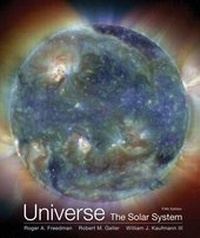
Universe: The Solar System
5th Edition
Published on 29. December 2013
Book
Paperback/Softback
416 pages
978-1-4641-3528-6 (ISBN)
Description
This is an abbreviated volume of Universe by Freedman et al., focusing on the solar system. Known for their state-of-the-science coverage, the various Universe books place the basics of astronomy and the process of science within the grasp of introductory students. The fifth edition has been updated with new material and new discoveries.
More details
Edition
5th ed. 2014
Language
English
Place of publication
New York
United Kingdom
Publishing group
Macmillan Learning
Target group
Professional and scholarly
Edition type
Revised edition
Illustrations
416 p.
Dimensions
Height: 27.5 cm
Width: 23 cm
ISBN-13
978-1-4641-3528-6 (9781464135286)
Schweitzer Classification
Other editions
New editions

Roger Freedman | Robert Geller | William Kaufmann
Universe: The Solar System
Book
01/2019
6th Edition
Macmillan Higher Education
€199.50
Shipment within 15-20 days
Previous edition
Book
01/2010
4th Edition
W.H.Freeman & Co Ltd
€78.17
Article exhausted; check for reprint
Persons
Roger A. Freedman is a Lecturer in Physics at the University of California, Santa Barbara, USA. At UCSB, Dr. Freedman has taught in both the Department of Physics and the College of Creative Studies, a branch of the university intended for highly gifted and motivated undergraduates. He has published research in nuclear physics, elementary particle physics, and laser physics. In recent years, he has helped to develop computer-based tools for learning introductory physics and astronomy and helped pioneer the use of classroom response systems and the "flipped" classroom model at UCSB. He is co-author of three introductory textbooks: University Physics (Pearson), Universe (Freeman), and Investigating Astronomy (Freeman).
Robert M. Geller teaches and conducts research in astrophysics at the University of California, Santa Barbara, USA. Using data from the Hubble Space Telescope, he is currently involved in a search for bursts of lights that are predicted to occur when a supermassive black hole consumes a star. Dr. Gellar als has a strong emphasis on education, and he received the Distinguished Teaching Award at UCSB in 2003.
William J. Kaufman III (deceased) was the author of the first four editions of Universe. During his career he held positions at the Griffith Observatory in Los Angeles, San Diego State University, UCLA, Caltech, and the University of Illinois, USA. A prolific author, his many books include Black Holes and Warped Spacetime, Relativity and Cosmology, The Cosmic Frontiers of General Relativity, Exploration of the Solar System, Planets and Moons, Stars and Nebulas, Galaxies and Quasars, and Supercomputing and the Transformation of Science. Dr. Kaufmann died in 1994.
Robert M. Geller teaches and conducts research in astrophysics at the University of California, Santa Barbara, USA. Using data from the Hubble Space Telescope, he is currently involved in a search for bursts of lights that are predicted to occur when a supermassive black hole consumes a star. Dr. Gellar als has a strong emphasis on education, and he received the Distinguished Teaching Award at UCSB in 2003.
William J. Kaufman III (deceased) was the author of the first four editions of Universe. During his career he held positions at the Griffith Observatory in Los Angeles, San Diego State University, UCLA, Caltech, and the University of Illinois, USA. A prolific author, his many books include Black Holes and Warped Spacetime, Relativity and Cosmology, The Cosmic Frontiers of General Relativity, Exploration of the Solar System, Planets and Moons, Stars and Nebulas, Galaxies and Quasars, and Supercomputing and the Transformation of Science. Dr. Kaufmann died in 1994.
Content
PART I: INTRODUCING ASTRONOMY.- 1. Astronomy and the Universe.- Guest Essay: Why Astronomy? by Sandra M. Faber.- 2. Knowing the Heavens.- Guest Essay: Why Astrology Is Not Science by James Randi.- 3. Eclipses and the Motion of the Moon.- Guest Essay: Archaeoastronomy and Ethnoastronomy by Mark Hollabaugh.- 4. Gravitation and the Waltz of the Planets.- 5. The Nature of Light.- 6. Optics and Telescopes.- PART II: PLANETS AND MOONS.- 7. Comparative Planetology I: Our Solar System.- 8. Comparative Planetology II: The Origin of Our Solar System.- Guest Essay: Alien Planets by Geoff Marsh.- 9. The Living Earth.- 10. Our Barren Moon.- 11. Mercury, Venus, and Mars: Earthlike yet Unique.- Guest Essay: Robotic Geologists and the Search for Habitale Environments on Mars by John Grotzinger.- 12. Jupiter and Saturn: Lords of the Planets.- 13. Jupiter and Saturn's Satellites of Fire and Ice.- 14. Uranus, Neptune, Pluto, and the Kuiper Belt: Remote Worlds.- 15. Vagabonds of the Solar System.- Guest Essay: Pluto and the Kuiper Belt by Scott Sheppard.- 16. Our Star, the Sun.- 28. The Search for Extraterrestrial Life.- Guest Essay: A Biologist's View of Astrobiology by Kevin W. Plaxaco.