

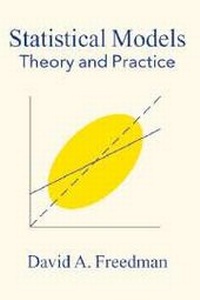
Statistical Models
Theory and Practice
Published on 8. August 2005
Book
Paperback/Softback
424 pages
978-0-521-67105-7 (ISBN)
Description
This lively and engaging textbook provides the knowledge required to read empirical papers in the social and health sciences, as well as the techniques needed to build statistical models. The author explains the basic ideas of association and regression, and describes the current models that link these ideas to causality. He focuses on applications of linear models, including generalized least squares and two-stage least squares. The bootstrap is developed as a technique for estimating bias and computing standard errors. Careful attention is paid to the principles of statistical inference. There is background material on study design, bivariate regression, and matrix algebra. To develop technique, there are computer labs, with sample computer programs. The book's discussion is organized around published studies, as are the numerous exercises - many of which have answers included. Relevant papers reprinted at the back of the book are thoroughly appraised by the author.
Reviews / Votes
'... a modern introduction to the subject, discusses graphical models and simultaneous equations among other topics. There are plenty of instructive exercises and computer labs. Especially valuable is the critical assessment of the main 'philosophers' stones' in applied statistics. This is an inspiring book and a very good read, for teachers as well as students.' Professor Gesine Reinert, Oxford University 'Regression techniques are often applied to observational data with the intent of drawing causal conclusions. In what circumstances is this justified? What are the assumptions underlying the analysis? Statistical Models answers these questions. The book is essential reading for anybody who uses regression to do more than summarize data. The treatment is original, and extremely well written. Critical discussions of research papers from the social sciences are most insightful. I highly recommend this book to anybody who engages in statistical modeling, or teaches regression, and most certainly to all of my students.' Aad van der Vaart, Professor of Statistics, Vrije Universiteit Amsterdam 'A pleasure to read, Statistical Models shows the field's most elegant writer at the height of his powers. While most textbooks hurry past core assumptions in order to explicate technique, this book places the spotlight on the core assumptions, challenging readers to think critically about how they are invoked in practice.' Donald Green, Director of the Institution for Social and Policy Studies, Yale UniversityMore details
Language
English
Place of publication
Cambridge
United Kingdom
Target group
College/higher education
Professional and scholarly
Product notice
Paperback (trade)
Illustrations
Worked examples or Exercises; 22 Tables, unspecified
Dimensions
Height: 240 mm
Width: 160 mm
Thickness: 26 mm
Weight
675 gr
ISBN-13
978-0-521-67105-7 (9780521671057)
Copyright in bibliographic data and cover images is held by Nielsen Book Services Limited or by the publishers or by their respective licensors: all rights reserved.
Schweitzer Classification
Other editions
New editions
Book
04/2009
2nd Edition
Cambridge University Press
€73.90
Shipment within 15-20 days
Person
David A. Freedman is Professor of Statistics at the University of California, Berkeley. He has also taught in Athens, Caracas, Jerusalem, Kuwait, London, Mexico City, and Stanford. He has written several previous books, including a widely used elementary text. He is one of the leading researchers in probability and statistics, with 150 papers in the professional literature. He is a member of the American Academy of Arts and Sciences. In 2003, he received the John J. Carty Award for the Advancement of Science from the National Academy of Sciences, recognizing his "profound contributions to the theory and practice of statistics." Freedman has consulted for the Carnegie Commission, the City of San Francisco, and the Federal Reserve, as well as several departments of the U.S. government. He has testified as an expert witness on statistics in law cases that involve employment discrimination, fair loan practices, duplicate signatures on petitions, railroad taxation, ecological inference, flight patterns of golf balls, price scanner errors, sampling techniques, and census adjustment.
Content
1. Observational studies and experiments; 2. The regression line; 3. Matrix algebra; 4. Multiple regression; 5. Path models; 6. Maximum likelihood; 7. The bootstrap; 8. Simultaneous equations; References; Answers to exercises; The computer labs; Appendix: sample MATLAB code; Reprints; Index.