

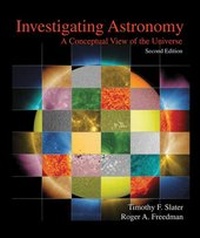
Investigating Astronomy
2nd Edition
Published on 21. March 2014
Book
Paperback/Softback
480 pages
978-1-4641-4085-3 (ISBN)
Description
With a vision of capturing the latest developments in astronomy education research, this textbook focuses on conceptual understanding, visual literacy, and inquiry-based learning. Tim Slater and Roger Freedman's concise, yet highly detailed (15 chapter) text explores core topics showing how astronomers study and decipher the universe's underlying processes. This helps students approach the subject from a professional scientist's perspective and provides a deeper insight into investigating astronomy.
Investigating Astronomy is available with LaunchPad. LaunchPad combines an interactive ebook with high-quality multimedia content and ready-made assessment options, including LearningCurve adaptive quizzing. See 'Instructor Resources' and 'Student Resources' for further information.
Investigating Astronomy is available with LaunchPad. LaunchPad combines an interactive ebook with high-quality multimedia content and ready-made assessment options, including LearningCurve adaptive quizzing. See 'Instructor Resources' and 'Student Resources' for further information.
More details
Edition
2nd ed. 2014
Language
English
Place of publication
New York
United Kingdom
Publishing group
Macmillan Learning
Target group
Professional and scholarly
Edition type
Revised edition
Illustrations
480 p.
Dimensions
Height: 27.9 cm
Width: 22.9 cm
ISBN-13
978-1-4641-4085-3 (9781464140853)
Schweitzer Classification
Other editions
Previous edition
Book
12/2011
W.H.Freeman & Co Ltd
€74.55
Available (delivery time upon request)
Persons
Timothy F. Slater holds the University of Wyoming Excellence in Higher Education Endowed Chair for Science Education where he holds faculty appointments in the College of Education, the College of Science, and the School of Energy Resources. Internationally known for his work in the teaching and learning of astronomy, he serves as the Director of the Cognition in Astronomy & Physics Education Research CAPER Team where his research focuses on uncovering learners' conceptual models when engaging in science.
Dr. Roger A. Freedman is a Lecturer in Physics at the University of California, Santa Barbara. At UCSB, Dr. Freedman has taught in both the Department of Physics and the College of Creative Studies, a branch of the university intended for highly gifted and motivated undergraduates. In recent years, he has helped to develop computer-based tools for learning introductory physics and astronomy and has been a pioneer in the use of classroom response systems and the "flipped" classroom model at UCSB.
Dr. Roger A. Freedman is a Lecturer in Physics at the University of California, Santa Barbara. At UCSB, Dr. Freedman has taught in both the Department of Physics and the College of Creative Studies, a branch of the university intended for highly gifted and motivated undergraduates. In recent years, he has helped to develop computer-based tools for learning introductory physics and astronomy and has been a pioneer in the use of classroom response systems and the "flipped" classroom model at UCSB.
Content
1. Predicting the Motions of the Stars, Sun, and Moon.- 2. Decoding the Hidden Messages in Starlight.- 3. Analyzing Scales and Motions of the Universe.- 4. Exploring Our Evolving Solar System.- 5. Uncovering Earth's Systems.- 6. Exploring Terrestrial Surface Processes and Atmospheres.- 7. Observing the Dynamic Giant Planets.- 8. Looking for Life beyond Earth.- 9. Probing the Dynamic Sun.- 10. Observing Properties of Distant Stars.- 11. Inferring Patterns in Star Life Cycles.- 12 . Predicting the Violent End of the Largest Stars.- 13. Exploring Our Galaxy.- 14. Investigating Other Galaxies.- 15. Observing the Evolution of the Universe.