

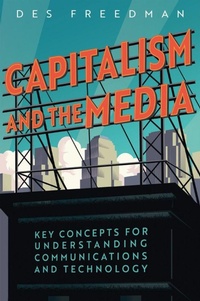
Capitalism and the Media
Key Concepts for Understanding Communications and Technology
1st Edition
Published on 29. May 2026
Book
Hardback
300 pages
978-1-5095-6530-6 (ISBN)
Description
Capitalism is the most powerful, creative and destructive social system the world has ever seen. Vigorously celebrated and fiercely contested, it provides the backdrop for the pipelines and platforms that supply audiences with entertainment, information and connection.
This book provides an accessible introduction to the key characteristics of capitalism and illustrates how they shape and distort our media and communications landscapes. Exploring concepts including accumulation, exploitation, ideology, oppression, commodification and colonization, the book discusses the impact of these processes on everything from our experiences online and the dynamics of algorithms to the power of oligarchs and the media's role in the escalating environmental crisis.
At a time when technology is often heralded as either the cause or the solution to issues of polarization, disinformation and atomization, an understanding of the simultaneous resilience and fragility of capitalism is essential. Capitalism and the Media is important reading for students of media, communications, cultural studies and politics and provides a valuable resource for scholars and activists.
This book provides an accessible introduction to the key characteristics of capitalism and illustrates how they shape and distort our media and communications landscapes. Exploring concepts including accumulation, exploitation, ideology, oppression, commodification and colonization, the book discusses the impact of these processes on everything from our experiences online and the dynamics of algorithms to the power of oligarchs and the media's role in the escalating environmental crisis.
At a time when technology is often heralded as either the cause or the solution to issues of polarization, disinformation and atomization, an understanding of the simultaneous resilience and fragility of capitalism is essential. Capitalism and the Media is important reading for students of media, communications, cultural studies and politics and provides a valuable resource for scholars and activists.
Reviews / Votes
"A vital corrective to technological determinism, Freedman masterfully reasserts capitalism's centrality in the digital age. Essential reading for anyone seeking to understand who truly controls what we watch, read and think."Nick Srnicek, King's College, London, and author of Silicon Empires
"With clarity and precision, Freedman dismantles the deep entanglements between capitalism and media that structure our social, cultural and economic realities. Incisive and urgent - this book is important reading for anyone seeking to understand how systemic power operates."
Jennifer Holt, UC Santa Barbara, and author of Cloud Policy
More details
Language
English
Place of publication
Oxford
United Kingdom
Target group
College/higher education
Product notice
sewn/stitched
Cloth over boards
Dimensions
Height: 231 mm
Width: 155 mm
Thickness: 31 mm
Weight
567 gr
ISBN-13
978-1-5095-6530-6 (9781509565306)
Copyright in bibliographic data and cover images is held by Nielsen Book Services Limited or by the publishers or by their respective licensors: all rights reserved.
Schweitzer Classification
Other editions
Additional editions
Book
05/2026
1st Edition
Polity Press
€22.50
Shipment within 15-20 days
Person
Des Freedman is Professor of Media and Communication Studies at Goldsmiths, University of London.
Content
Acknowledgments
1. Capitalism shouldn't need an introduction
2. Technology and revolution
3. Private property and enclosure
4. Labour, exploitation and class
5. Commodification and marketization
6. Competition and monopoly
7. Accumulation and profit
8. Ideology and hegemony
9. Freedom and democracy
10. Capitalism and the state
11. Imperialism, colonialism and globalization
12. Oppression
13. Nature and environment
14. Contradiction and crisis
15. Conclusion
Bibliography
Notes
Index
1. Capitalism shouldn't need an introduction
2. Technology and revolution
3. Private property and enclosure
4. Labour, exploitation and class
5. Commodification and marketization
6. Competition and monopoly
7. Accumulation and profit
8. Ideology and hegemony
9. Freedom and democracy
10. Capitalism and the state
11. Imperialism, colonialism and globalization
12. Oppression
13. Nature and environment
14. Contradiction and crisis
15. Conclusion
Bibliography
Notes
Index