

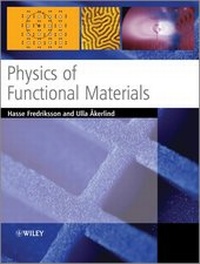
Physics of Functional Materials
Will be published approx. on 13. June 2008
Book
Paperback/Softback
490 pages
978-0-470-51758-1 (ISBN)
Description
Written by academics with more than 30 years experience teaching physics and material science, this book will act as a one-stop reference on functional materials. Offering a complete coverage of functional materials, this unique book deals with all three states of the material, providing an insightful overview of this subject not before seen in other texts.
* Includes solved examples, a number of exercises and answers to the exercises.
* Aims to promote understanding of the subject as a basis for higher studies.
* The use of mathematically complicated quantum mechanical equations will be minimized to aid understanding.
More details
Edition
1. Auflage
Language
English
Place of publication
New York
United States
Target group
Professional and scholarly
Product notice
Paperback (trade)
Unsewn / adhesive bound
Dimensions
Height: 280 mm
Width: 210 mm
Thickness: 26 mm
Weight
1187 gr
ISBN-13
978-0-470-51758-1 (9780470517581)
Schweitzer Classification
Other editions
Additional editions
Hasse Fredriksson | Ulla Akerlind
Physics of Functional Materials
E-Book
09/2008
Wiley
€81.99
Available for download
Hasse Fredriksson | Ulla Akerlind
Physics of Functional Materials
Book
05/2008
Wiley
€243.50
Shipment within 10-20 days
Persons
Hasse Fredriksson is professor in the casting of metals in the Department of Materials Science at KTH, Royal Institute of Technology, in Stockholm, (Sweden). He was educated at KTH gaining a Master of Science in 1966 and he received his doctorate of science in 1971 in physical metallurgy. Since 1975, he has been responsible for research and education in the field of casting and solidification of metals at KTH. The aim of the research in the group is to experimentally, theoretically and/or numerically describe solidification processes. The group has published over 200 international scientific papers.
Dr Ulla Akerlind is Docent in Physics at the University of Stockholm. She has extensive experience of teaching at university level and writing textbooks at university and college level. Dr Akerlind has been a guest lecturer on summer courses in physics in the US and an exchange teacher in physics at the University of Surrey in 1984.
Dr Ulla Akerlind is Docent in Physics at the University of Stockholm. She has extensive experience of teaching at university level and writing textbooks at university and college level. Dr Akerlind has been a guest lecturer on summer courses in physics in the US and an exchange teacher in physics at the University of Surrey in 1984.
Content
Preface
1 Structures of Melts and Solids
1.1 Introduction
1.2 X-ray Analysis
1.3 The Hard Sphere Model of Atoms
1.4 Crystal Structure
1.5 Crystal Structures of Solid Metals
1.6 Crystal Defects in Pure Metals
1.7 Structures of Alloy Melts and Solids
Summary
Exercises
2 Theory of Atoms and Molecules
2.1 Introduction
2.2 The Bohr Model of Atomic Structure
2.3 The Quantum Mechanical Model of Atomic Structure
2.4 Solution of the Schrödinger Equation for Atoms
2.5 Quantum Mechanics and Probability. Selection Rules
2.6 The Quantum Mechanical Model of Molecular Structure
2.7 Diatomic Molecules
2.8 Polyatomic Molecules
Summary
Exercises
3 Theory of Solids
3.1 Introduction
3.2 Bonds in Molecules and Solids. Some Definitions
3.3 Bonds in Molecules and Non-Metallic Solids
3.4 Metallic Bonds
3.5 Band Theory of Solids
3.6 Elastic Vibrations in Solids
3.7 Influence of Lattice Defects on Electronic Structures in Crystals
Summary
Exercises
4 Properties of Gases
4.1 Introduction
4.2 Kinetic Theory of Gases
4.3 Energy Distribution in Particle Systems. Maxwell-Boltzmann´s Distribution Law
4.4 Gas Laws
4.5 Heat Capacity
4.6 Mean Free Path
4.7 Viscosity
4.8 Thermal Conduction
4.9 Diffusion
4.10 Molecular Sizes
4.11 Properties of Gas Mixtures
4.12 Plasma - The Fourth State of Matter
Summary
Exercises
5 Transformation Kinetics. Diffusion in Solids
5.1 Introduction
5.2 Thermodynamics
5.3 Transformation Kinetics
5.4 Reaction Rates
5.5 Kinetics of Homogeneous Reactions in Gases
5.6 Diffusion in Solids
Summary
Exercises
6 Mechanical, Thermal and Magnetic Properties of Solids
6.1 Introduction
6.2 Total Energy of Metallic Crystals
6.3 Elasticity and Compressibility
6.4 Expansion
6.5 Heat Capacity
6.6 Magnetism
Summary
Exercises
7 Transport Properties of Solids. Optical Properties of Solids
7.1 Introduction
7.2 Thermal Conduction
7.3 Electrical Conduction
7.4 Metallic Conductors
7.5 Insulators
7.6 Semiconductors
7.7 Optical Properties
Summary
Exercises
8 Properties of Liquids and Melts
8.1 Introduction
8.2 X-ray Spectra of Liquids and Melts
8.3 Models of Pure Liquids and Melts
8.4 Melting Points of Solid Metals
8.5 Density and Volume
8.6 Thermal Expansion
8.7 Heat Capacity
8.8 Transport Properties of Liquids
8.9 Diffusion
8.10 Viscosity
8.11 Thermal Conduction
8.12 Electrical Conduction
Summary
Exercises
Answers to Exercises
Further Reading
Index